
|
THE ORDER OF THE TILE | |||
| |||
|
ISSUE NO. 27 · SEPTEMBER 2026 | |||
|
"The inner circle has opinions." |
My Fellow Table Guests,
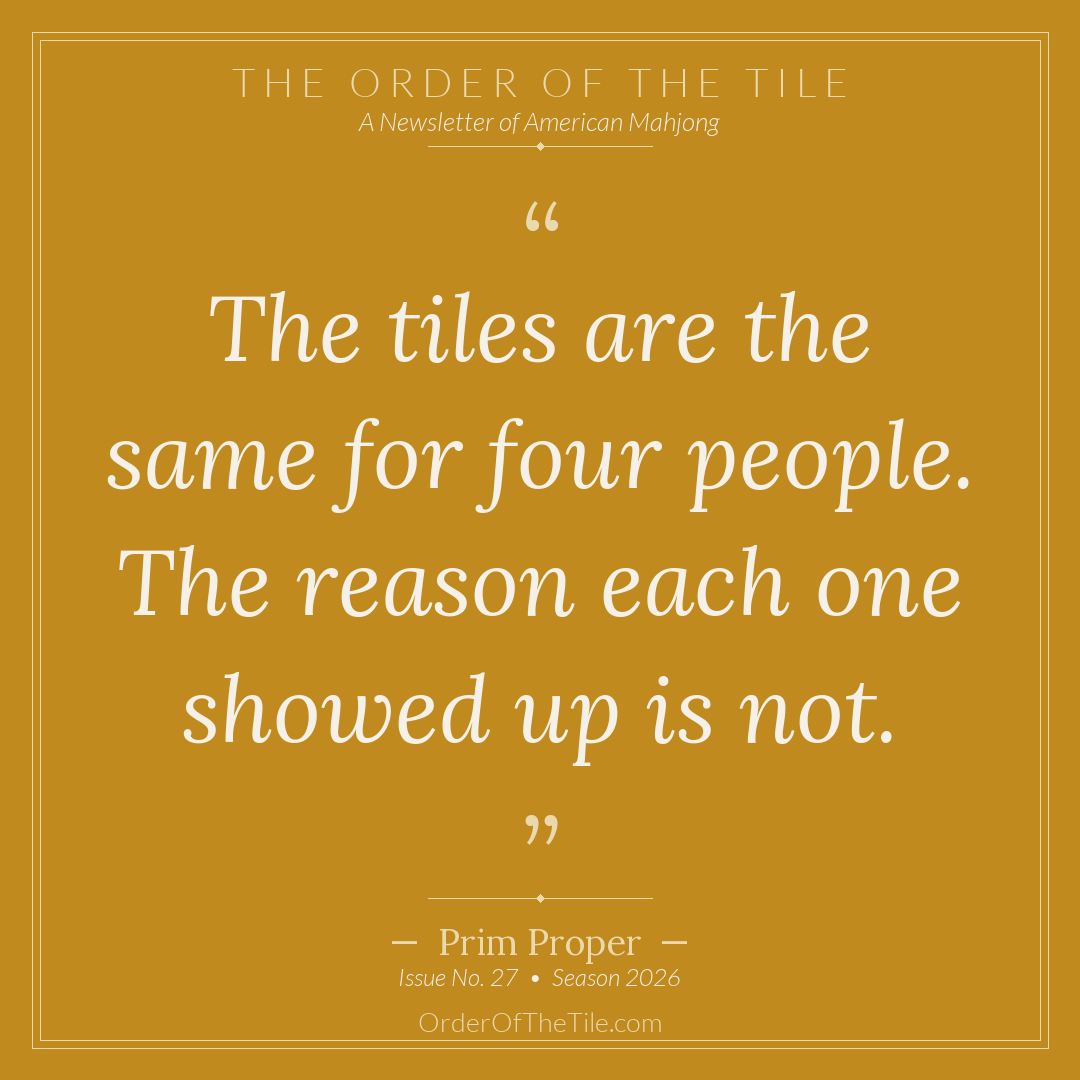
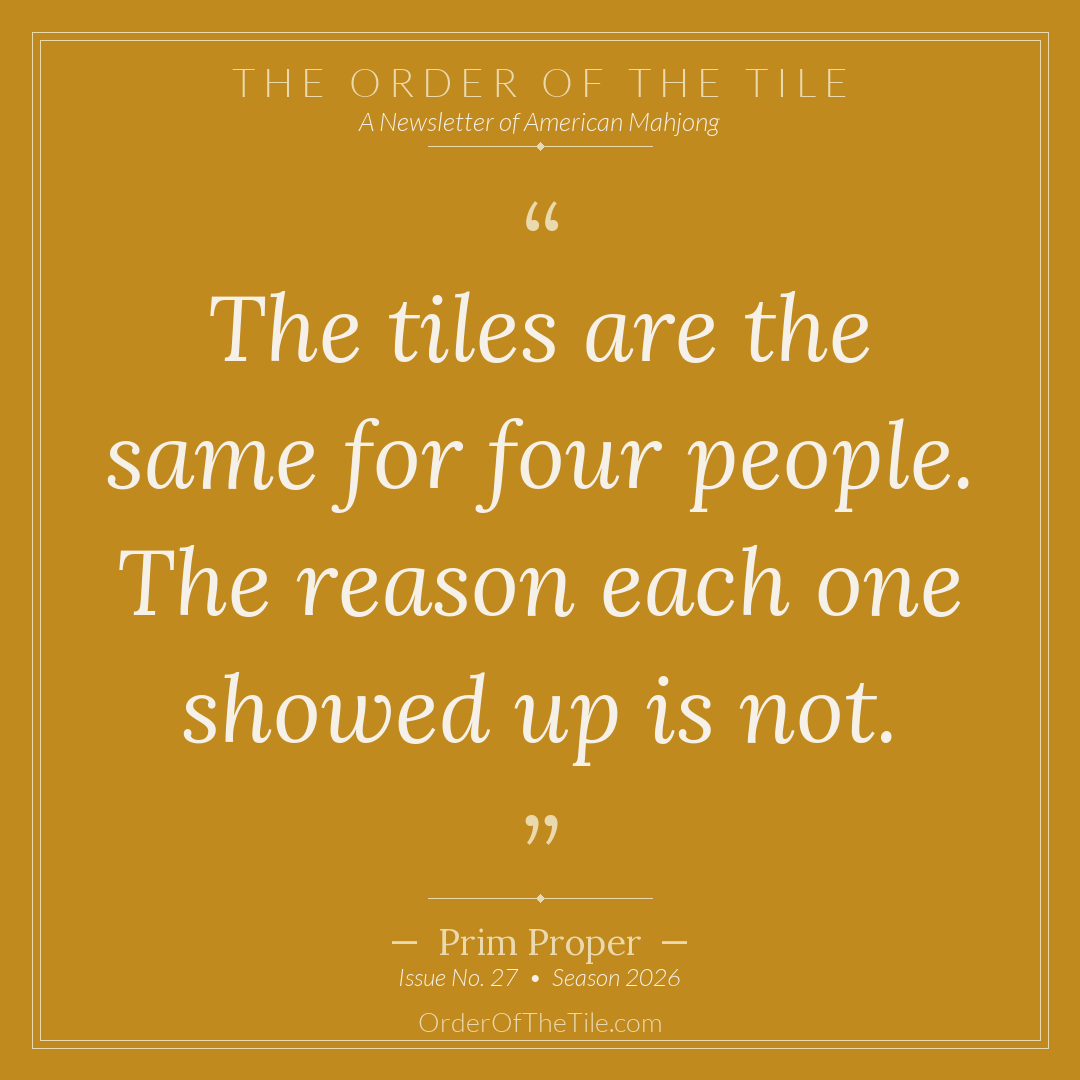
Four women sit down at one table. The tiles are identical, the card is identical, the four seats are identical, and not one of the four is playing the same game. One came to win, and means it. One came to talk, and the tiles are merely something for her hands to do while she does. One came because the alternative was a quiet house on a Tuesday, and this is the warmest room she will be in all week. One came because a friend asked, and she could not think of a kind reason to say no. The tiles know none of this. And almost every sore feeling this game has ever produced, Prim has come to believe, begins right there, in four people quietly wanting four different things and each assuming the other three want the same one she does.
Prim would like to spend this whole letter on that assumption, because it is the most expensive one at any table, and because the cure for it is so small and so gracious that she is a little embarrassed it took her this many years to name it. You will see the same move in every section. Find out what the other three came for. Say what you came for. And stop, forever, mistaking a game that is different from yours for a game that is wrong.
And one of those reasons to sit down is the largest there is, and Prim will come to it before this letter is through. Families like my friend Mimi's know how important St. Jude is, to the survival of the ones they love, and to the whole family, carried through it together. Hold that close. Prim will bring you back to it.
|
~Prim |
|
Your seat at the table is open There is a chair with your name on it The practice table is always laid, and nobody there is waiting on you. Play a hand at your own pace, with no audience watching you think and no one drumming her fingers while you decide. Your newsletter email is already your key, so there is no password to invent and nothing whatsoever to remember. Ask for a sign-in link, take your seat, and begin with the free Daily Tile.
|
THE DRAW |
The tables are re-forming, and not everyone remembers them the same way |
Something happens to a table when it comes back together in the fall, and it is not always the reunion everyone pictured over the summer. The league restarts. The weekly game gets its fourth back. The group chat that spent August failing to find a date suddenly has a standing Tuesday again. And then, a hand or two in, a small friction turns up that nobody quite expected, because four people walked back into the same room carrying four different memories of what that room was for.
You can watch it happen in the community every September, in the same threads that resurface like clockwork. Someone posts, a little wounded, that her table has gotten too competitive, that the chatting she loved has been replaced by three women staring at their racks. Someone else posts the mirror image, that she cannot get a hand finished because the table treats every turn as an excuse for a story, and she came to actually play. The comments fill with people taking sides, as though one of these women is right and the other is the problem. Prim has read a great many of these, and she will tell you plainly what she sees. Neither of them is the problem. The problem is that all four sat down assuming the table remembered itself the way each of them did.
 |
Here is what Prim is pushing against, gently, because it is a habit and not a person. It is the belief that a table has one true nature and that anyone who wants something else has broken it. A table has no nature. It has four people, and it becomes whatever the four of them are honest with each other about wanting. The fall is the moment to do that honesty, before the season sets like concrete around whatever went unsaid in the first three weeks. Ask your table what it is this year. You may be surprised, and Prim suspects you will be, at how gladly everyone answers a question no one had thought to ask out loud.
|
Prefer to listen? Prim reads each letter aloud on Spotify.
|
CRAK THE CARD |
Reading what she wants, not only what she needs |
Every player at your table is telling you what she needs. Her discards say it, hand after hand, if you are reading them, and reading the wall for what your opponents need is the strategy everyone eventually learns. Prim would like to teach the deeper read, the one almost nobody names, because it is the read this whole letter is about. Learn to see, underneath what a player needs, what a player wants. They are not the same thing, and the difference is written all over the table if you know where to look.
The player who is chasing a win plays like a closed door.
She discards fast and she discards clean. She is not narrating her decisions, because narrating them costs tempo and gives you information, and she wants neither. Her tiles come off the rack with a certain finality, and when the table's talk swells up around a hand she goes a little quiet, not rudely, just gone, the way anyone goes quiet when the thing in front of them has their whole attention. You will notice she picks up the pace when she is close, and that she plays defense when she cannot win, holding the tile she suspects you want rather than freeing it. She is not being cold. She is playing the game she came to play, and she is playing it well, and the sooner you read that in her the sooner you stop mistaking her focus for a slight.
The player who came to pass an evening plays like an open window.
She thinks out loud. She will tell you, against every principle of the closed door above, that she is one tile away, because the fun of it for her is the telling, not the winning. Her discards drift according to the conversation as much as the hand. She will keep a tile a beat too long because she is mid story, and she will pass up a defensive hold because guarding a tile against a friend is not why she is here. Prim adores this player and will not have a word said against her. But read her correctly. She is not bad at the game. She is playing a different game on the same tiles, and the tell is that her hand and her attention are never quite in the same place, on purpose.
The read that matters is which one is sitting across from you right now.
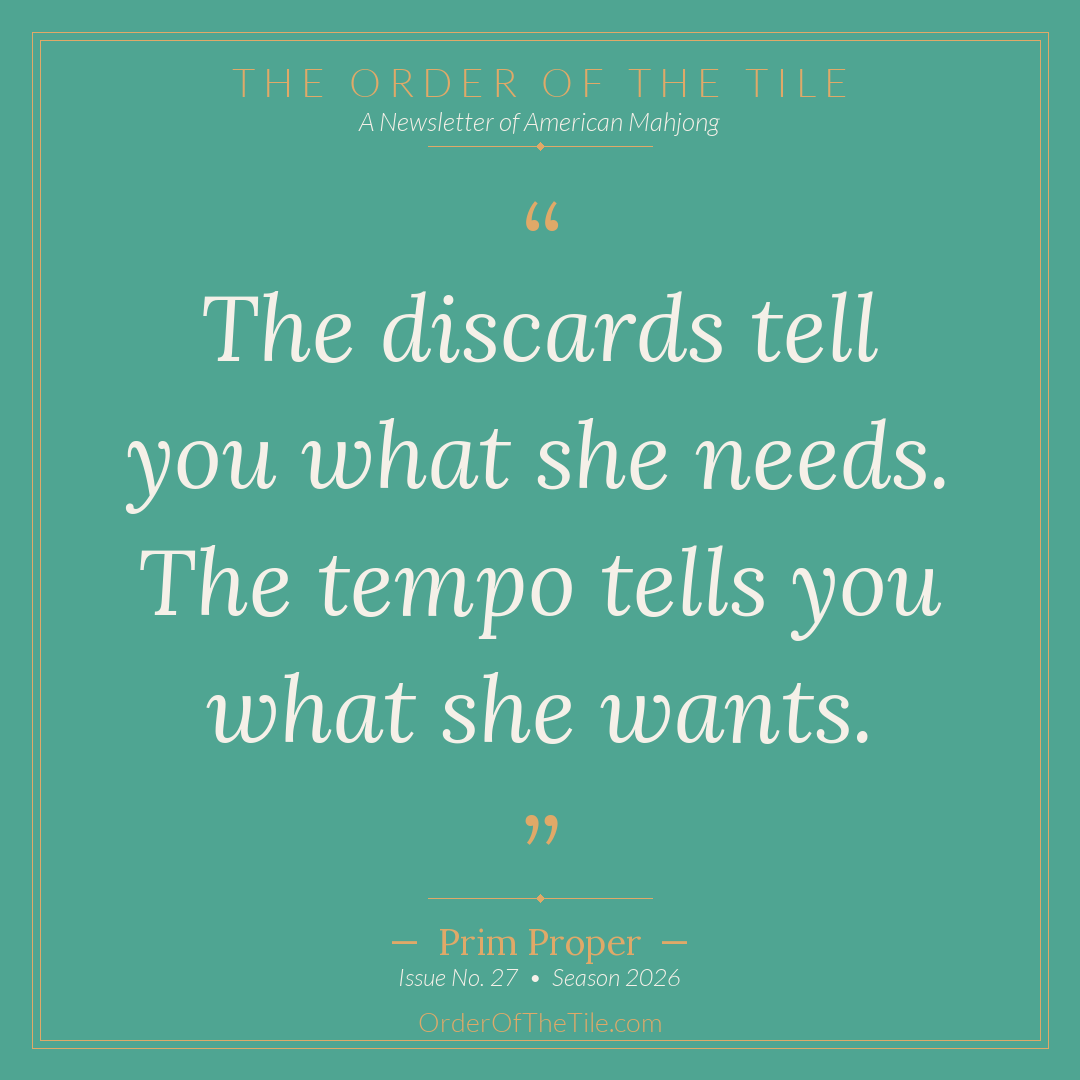
Because here is the whole of it. If you play the closed door against the open window and expect her to guard her discards, you will be baffled and a little annoyed all afternoon. If you play the open window against the closed door and expect her to chat while she is trying to bank a hand on a clock in her own head, you will feel snubbed by a woman who is simply concentrating. The discards tell you what everyone needs. The tempo, the talk, the little tell of where a player's attention actually lives, that tells you what she wants. Read that, and you will finally be playing the same afternoon as the three people you are sitting with, which is a rarer thing than it sounds.
 |
|
Between the Letters Today's Latest News A letter a week is never quite enough for a game moving this fast. The Dispatch is Prim's daily page, where the latest updates and announcements land between letters... the releases, the tournaments, and the stories the table is talking about, gathered and told the moment they happen.
|
THE TABLE IS ASKING |
Is it rude to play fast when the rest of the table wants to talk? |
The question arrived the way the honest ones do, from a woman who was plainly a little defensive about it, which Prim recognizes as passion. She is a fast player. She reads her hand, she picks her discard, she is ready when it is her turn, and she has started to feel like a villain for it, because her table wants to visit and she wants to play, and somewhere in there she has picked up the idea that her tempo is bad manners. So she asked Prim directly. Is it rude to play fast when everyone else came to talk.
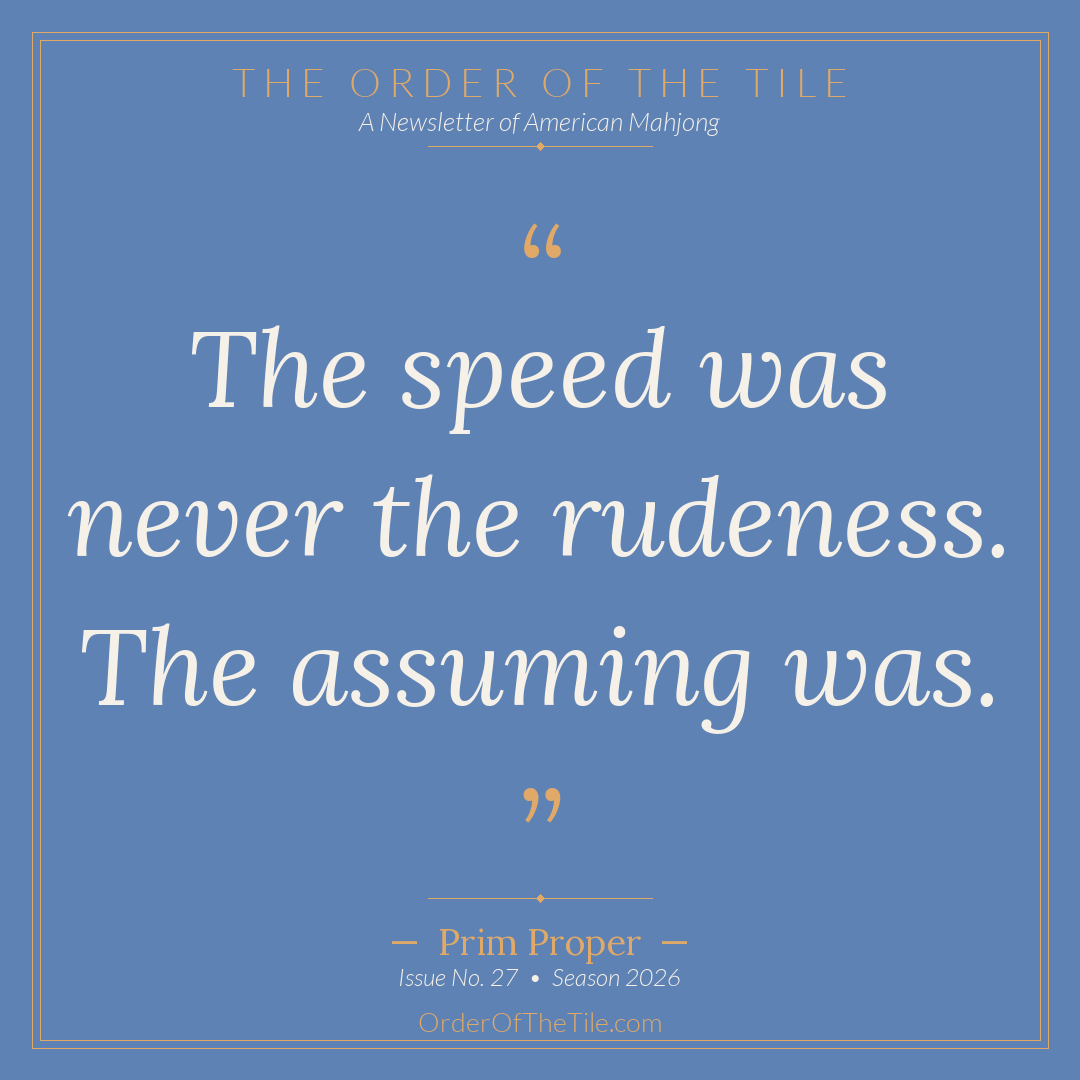
Prim will give you the answer plainly, because you asked plainly. No. Playing fast is not rude. Playing slow is not rude either. The speed was never the rudeness. The assuming was.
 |
Here is the thing almost no one says out loud. The fast player and the slow talker are making the identical mistake, and it is not about tempo at all. Each has decided, privately and without checking, that the table shares her reason for being there, and each is quietly grading the other three against it. The fast player sighs, or taps, or lets a small impatience leak into the room, because obviously we are here to play. The talker lets a hand stretch to fifteen minutes because obviously we are here to be together. Neither is a monster. Both have simply forgotten to ask. And the honest fix, the one the whole community keeps circling in every etiquette thread it writes, is not that the fast player must slow down or the talker must speed up. It is that a table should say, out loud and early, what kind of afternoon it wants to be, and then everyone gets to actually choose.
So here is Prim's actual position, which is less diplomatic than the above. If you are the fast player, you owe the table two things, and neither of them is slowing down against your nature. You owe it the small courtesy of your patience while others take their turn, no tapping, no sighing, no theatrical little exhale, because those are the only genuinely rude things in this whole scenario. And you owe it one honest sentence at the start. I love to play at a good clip, is that alright, or are we here to visit today. Say that, and match the answer, and you are not a villain. You are the most considerate person at the table, and a fast game among four people who all wanted a fast game is one of the great pleasures this hobby has to offer. Go find your people who want it too, and fly.
Bring the question to your own table this week. Not the question of who is right. The question of what everyone actually came for. Prim would bet the afternoon runs smoother the moment it is asked, no matter how differently the four of you answer.
|
WHO'S TALKING |
The two neighbors who decided a whole town could use a fourth |
This week a small local paper in Virginia ran a story that Prim read twice, because it is the theme of this letter with the serial numbers still on. The Zebra, which covers Alexandria, wrote up the Old Town Mahjong Club, and the line that stopped her came from one of its two founders, Heather Johanson, who said the goal is to build community and make Old Town feel like Cheers, where everyone knows your name. Not to win. Not to run a league. To make a town feel like a bar where the regulars turn round when the door opens.
The club is the work of Johanson and Katherine May Schwartz, both Old Town residents, and it did not begin as a club at all. It began as a Mahjong 101 class at Boxwood, a shop in the neighborhood, and then as a WhatsApp chat among the friends who had taken it, the kind of chat that exists to find a Tuesday. When they posted about it on Facebook and Instagram the thing took off, and it is now free open play at la Madeleine, at King and St. Asaph, with shared sets on the tables so nobody has to own one to sit down. Experienced players, beginners and, in the club's own words, curious neighbors are all welcome, whether you arrive with your own foursome or entirely alone. The one ask is that a newcomer takes the 101 class first, so that the open tables stay tables and do not turn into lessons, and there are beginner and intermediate classes and guided play coming for the people still finding their confidence.
Prim would like you to notice what that is, because it is exactly the thing this letter has been circling. A room where the woman who came to win, the woman who came to talk, and the woman who came because the house was quiet can all sit down at the same free table and nobody has to pretend to be there for the same reason. The 101 class is the closed door. The open play is the open window. Both are honored, and neither is asked to become the other.
Prim does not rank clubs, and she will not tell you this one is the best in the country, because she has never sat at its tables and would not say so if she had. She will tell you it is new, it is free, it plays the League card, and it was built by two neighbors who noticed that what their town was missing was not a game but a fourth chair. You will find it at oldtownmahjong.com and on Instagram at @oldtownmahjongclub, and if you are anywhere near Alexandria, Prim suspects you already know which of the four women you are, and that they have a seat for her.
|
Out in the World There is very likely a shop nearer to you than you think. Prim keeps a directory of them, along with the teachers and the tables, sorted by state and by the ones that ship anywhere. Every listing is backed by a source you can check yourself.
|
TILE ENVY |
The set that fits in a coat pocket and deals anywhere |
The holidays are coming. Prim can feel it in the calendar the way you feel a change in the weather, and she is, frankly, thrilled about it, because the travel season is the one time of year this game goes where the people are instead of the other way round. Thanksgiving at a sister's. The long week at the in-laws. The rented house at the beach with too many cousins in it. What a time to share this beautiful, exasperating, wonderful game with the people you love, and what a shame to leave the set at home because it weighs as much as a small dog.
So this week Tile Envy covets something of our own, and Prim asks your indulgence for it, because she has watched it get built all year and she is proud. Order of the Tile has made a series of printable card decks, and a deck is a whole American Mahjong set that fits in your coat pocket. One hundred and fifty six cards, every tile in the set drawn for the season, printed on cardstock and cut to deal. There is a Halloween deck and a Thanksgiving deck, Christmas and Hanukkah and New Year's, a Birthday deck, a Summer deck, a Lucky deck, an Americana deck, a Gridiron deck for the football table, and the Cocktails deck, where a martini sits on the One Dot and the Jokers are eight named drinks. On the Cocktails deck every Crak wears a lime wedge. Prim did not know she needed that until she saw it.
What comes with each one is the part she wants you to hear, because it is not a picture of a set. It is the whole table. Every deck ships as an instant download with the Cricut Print Then Cut sheets, so a cutting machine does the tedious part, and the plain sheets and directions for those of you who own scissors and patience instead. There is a table guide, a How to Play, and a How to Print that walks you through cardstock and settings. And there is a Card. Not the League card, which belongs to the League, but twelve hands of our own written for that deck and that season, with a Solutions page that draws every one of the twelve out in the actual tiles, so the person learning at your holiday table can see the hand rather than decode it.
And then there is the Black Dragon, which deserves its own paragraph, because it is the best conversation this game has had in years. If you have been anywhere near a mahjong group since late August you have heard it. Gladys Grad, the mind behind Siamese Mah Jongg, has been making the case for a fourth dragon tile, a Black Dragon to stand for the Dots, so that every suit has a dragon of its own and the Soap can stop working two jobs and settle into being the zero and the letter O that every modern card keeps asking of it. Missy Mahjong wrote the whole argument up on her blog at the end of August and came back to it on 10 September, and Prim recommends the piece to you, not least for the history in it, since the flowers and the jokers were both once the new thing everyone swore they would never play with. The reception has been passionate on every side, which is how you know it matters. Gladys offered stickers for blank tiles and was buried in requests within days. Tens of thousands of players have already drawn one on a blank with a Sharpie and dealt it. Prim has read the arguments against, and she understands them, and she has decided all the same. We are in. Every one of our decks now carries four Black Dragons, which is how a deck went from one hundred and fifty two cards to one hundred and fifty six, hands eleven and twelve on every Card are written around the tile, and the guide card carries a couple of house rules of our own for the tile. It is still a proposal, mind you, not yet a tile you will find in a box from a tile maker, and whether it lasts is really up to the people who make the cards, the tiles and the games. We make two of those three. Our games do not deal it yet. We probably will, late this year or early next depending on how much you ask for it, and it will be a choice you make before you play, with it or without it. Prim will write about it properly another week. For now, know that when you print a deck this season, the tile everyone is talking about is already in the box.
Every deck lives at orderofthetile.com/shop, and every one of them is ours, so this is the one week Prim will not pretend to be neutral. Print one before you pack. Deal it on the kitchen island at your mother's. Teach a nephew. The set can be one woman's pride, and this one is Prim's.
|
Prim's Own Shelf Written at the table, not at a desk Every deck in this letter lives on a shelf Prim keeps for herself, and not one thing on it needs room in a suitcase. Every guide and printable in her shop is her own original work, written by somebody who actually plays, and it arrives the moment you buy it with nothing to wait on. The Game Pass sits there too, and it opens every game she has built, including the ones still to come.
|
SET YOUR RACK |
The afternoon where the reason you came is the largest one there is |
This whole letter has been about the many reasons a person sits down at a table. Here is an afternoon built around the best one there is.
On Saturday, September 26, Mahj Life runs its MAHJ-A-THON for St. Jude, a twenty four hour livestream that begins at noon Eastern and plays straight through, all of it in support of St. Jude Children's Research Hospital. It is free to watch, from wherever you are, on whatever screen is nearest you. Nobody has to travel. Nobody has to register for a tournament or pack a bag or find a fourth. You can drop in for ten minutes between errands or leave it running all afternoon, and the good you do by being there is measured in donations to a hospital that never sends a family a bill. It is the gentlest possible way to spend a Saturday at the game, and it happens to be pointed at the largest reason any of us ever plays, which is each other.
And one line on the season's summit, and only one, because the excitement issue is still weeks away. The eleventh Mah Jongg World Championship gathers October 16 to 18 at Paris Las Vegas, it is sold out to a waitlist, and Prim will have a great deal more to say about it when the eve is closer.
The board this week:
|
The full calendar, kept current and free, lives at orderofthetile.com/events.
CRAK INTELLIGENCE |
What a game has to remember before you come back to it |
Here is a thing worth knowing the next time someone at your table sniffs that online mahjong is not the real thing. The platform most players mean when they say they play online did not begin as a game at all. It began, in 2014, as a scheduling headache. A Mah Jongg group in Texas had grown past the point where four women could sort out a Tuesday over text, and the invitations, the yeses and the noes, the waiting list and the question of whose set was coming had turned hosting into a second job. One of the members mentioned it to her husband, who happened to write software for a living, and I Love Mahj was born as a tool for getting real people to a real kitchen table on time. That was its whole first life, six years of it. The online game itself did not arrive until December 2020, at the exact moment the kitchens closed, and the couple behind it, Philippe and Julie, have kept it running in a browser ever since, on the current card, with bots at three levels, a video call built into the table, and a fee of six dollars a month after a two week trial. Prim tells you this not to sell it but because the order of events is the lesson. The organizing came first. The game came second. Even the people who built the online table most of you have sat at understood that what players actually needed was a way to keep showing up.
And that, Prim has come to believe, is the rarest thing in games of any kind. A good game is easy to find. A game you come back to, week after week, without anyone having to remind you, is the rare one, and it is hard to build, and she knows this because we have spent this year building one and it has cost us every spare hour we own. So she is going to spill the beans, this once, about what has gone in behind the games at Order of the Tile, because a section called Crak Intelligence ought occasionally to crack open its own house.
 |
Start with the laurels, which is our name for the thing Prim is proudest of, and which is not a trophy case, though there are medals in it. It is a tracking system built on the year's card. Every game you play with us is written down for you without your lifting a finger, the games you play against friends and the games you play against yourself, every hand you complete and the line you completed it on, every day you turned up. And the same notebook has a page for the games you play away from us. Your Tuesday table, your tournament, the afternoon at your sister's, logged with the date, the place, the hands you played and every hand you won, section and line, with a picture if you have one. It is the record this game has never kept for anyone, online and in person in one place, and all of it points at one goal, which is completing the entire card in the year it is current. There is a bar that fills as you work your way across it, section by section, every hand on it, so that for the first time completing a card is something you can watch happen rather than something you vaguely believe you may have done in 2019. Finish in the top three of a daily game and a medal lands beside it, gold, silver or bronze, with a public page you can send to the friend who does not believe you. But the medals are the ribbon. The notebook is the gift.
Which brings her back to the four women and their four different games. Whatever you came for, the win, the talk, the afternoon out of the house, a game worth returning to is one that remembers you came. The strangers online taught this community that the tiles were never the whole of it. Prim has taken the lesson to heart and built the rest.
A CLOSING NOTE |
It is the twenty seventh letter, and it has spent every section on a single small idea, which is that the four people at any table are almost never playing the same game, and that this is not a problem to be solved but a truth to be asked about.
The tiles are the same for everyone. The reasons are not. One of you is chasing the win and one of you is chasing the conversation and one of you is chasing an afternoon out of the house and one of you cannot quite say why she came, only that she is glad she did. The discards will tell you what each of you needs. Only asking will tell you what each of you wants. And the whole of Prim's counsel, from the strategy to the etiquette to the club built for the player who came to belong to the afternoon that costs a child's hospital nothing and gives it everything, is the same single sentence. Say what you came for. Ask what they came for. And never once mistake a different game for a wrong one.
Prim may write for the women at the table, but she firmly believes everyone is welcome. Everyone deserves a seat at this table.
|
| |||
|
Don't tap it, rack it, double stack it. | |||
|
Until next week, may your rack be blessed | |||
|
Prim, as always | |||
| |||
|
Forward this to your favorite fourth. |