
|
THE ORDER OF THE TILE | |||
| |||
|
ISSUE NO. 28 · SEPTEMBER 2026 | |||
|
"Fortune favors the prepared rack." |
My Fellow Table Guests,
Prim has been watching the lucky charms come out, the way they always do as the season narrows toward its serious end. A particular coin that has to be in a particular pocket. A tile turned a particular way on the rack before the Charleston, for no reason anyone can name and every reason anyone can feel. The friend who will not sit in the north seat, ever, and has a whole private theology about why. Prim is fond of all of it, and she is not here to take a single charm away from anybody.
But she would like to say the quiet thing out loud, because it is the whole of this letter. A charm is what a person reaches for when a thing feels random and she wants to feel a little less at the whim of it. And there is nothing on earth more likely to feel random than a game of chance played, suddenly, for something that matters, which is exactly what a tournament is. The rack goes cold. The wall will not give you the tile. The mind, being a mind, starts quietly bargaining with the universe. Hence the coin. Hence the seat. Hence the tile that has to sit just so.
Here is Prim's gentle heresy. Most of what feels random is not. The card in your hand is neither a mystery nor a neutral party, and the cure for feeling at the mercy of the tiles was never a luckier charm. Superstition, Prim has come to believe, is simply a system with the serial numbers filed off. So keep your coin. Prim is keeping hers. But this week, let us also read the card like the honest scoreboard it has always been.
 |
|
~Prim |
|
Your seat at the table is open There is a chair with your name on it The practice table is always laid, and nobody there is waiting on you. Play a hand at your own pace, with no audience watching you think and no one drumming her fingers while you decide. Your newsletter email is already your key, so there is no password to invent and nothing whatsoever to remember. Ask for a sign-in link, take your seat, and begin with the free Daily Tile.
|
THE DRAW |
What the table blames when the tiles turn cold |
Every year as the calendar tips toward the championship, a particular kind of thread blooms in the groups, and Prim has learned to expect it the way she expects the leaves to turn. Someone posts that her tiles have gone cold, that she has not won in six weeks, that the wall simply will not give her what she needs, and she would dearly like to know what she did to deserve it. The comments arrive in two flavors. Half are remedies, the lucky bracelet and the cleansing and the new set that finally broke the streak. The other half are commiseration, a warm chorus of women who have all been cursed by the same indifferent tiles.
Prim reads a great many of these, and she will tell you kindly what she sees, because it is a habit and not a person. It is the instinct, when a game of chance stops going your way, to reach for a cause somewhere outside the card. The set is unlucky. The universe has it in for you this particular September. Underneath all of it sits one true and very human thing, that the game feels random and the randomness feels personal, and neither of those feelings is a strategy.
Here is what Prim would gently offer into that thread instead. The wall is not withholding anything from you on purpose, because the wall cannot hold a grudge, and the card has never been shy about what it wants you to do. A cold streak is very often not a curse at all. It is a run of hands chosen by feel rather than by the numbers the card is printing right there beside every single line. The remedy is duller than a bracelet and it works a great deal better. Before you decide the tiles have turned against you, check whether you have been reading what the card actually rewards, or only what you were hoping it would say.
|
Prefer to listen? Prim reads each letter aloud on Spotify.
|
|
CRAK THE CARD |
The hands that pay, and the one you keep reaching for anyway |
Every serious player has one. The hand she loves. The one her eye goes to first when the card comes out in the spring, the one she once won a whole glorious afternoon on and has quietly believed in ever since, the one that simply feels like hers. Prim has one too and is not going to pretend otherwise. There is nothing wrong with loving a hand. There is only something worth noticing about why, because a beloved hand and a lucky hand are usually the very same hand, and a lucky hand is a charm you keep on your rack instead of in your pocket.
 |
A lucky hand is a story you tell about a coincidence.
You made it once, beautifully, on a day that felt like fate. So you reach for it again, and again, and you read every card since through the hope of making it a second time. That is precisely how a charm works. It took the credit for a good outcome it did not cause, and now it collects your loyalty in perpetuity. The tiles do not know you love this hand. The card could not care less. And the afternoons you spent steering toward it, past three other lines that were sitting right there and closer, are afternoons the beloved hand quietly cost you while passing itself off as the hand that helps.
The card already tells you what it rewards. It is not being coy.
Look at any line and there is a number printed beside it, and that number is neither decoration nor a ranking of prettiness. It is the card stating, plainly, what it will pay you for finishing that hand. The League published fifty five lines this year, and it did not price them at random. It laid a wide floor of ordinary value, set a few taller steps above it, and placed exactly one line at the very top of the whole card. That shape is an argument, and the argument is that the game rewards the hand you can actually complete far more dependably than the hand you can merely dream about. What a line is worth to you is never only the number printed beside it. It is that number weighed against how often you truly finish the thing, and the hand you love has almost certainly been quietly failing that second test for years.
This is why the prepared rack beats the lucky one, and Prim will hold this under fire.
Nowhere does it matter more than in the room this whole season is pointed toward. A tournament does not settle at the end of each hand and move on. It keeps a running score across every round, which means the modest hand you take cleanly, again and again, stacks into a number that wins weekends, and the magnificent hand you fell in love with back in March is worth precisely nothing on every round you did not finish it. The player who has trained her eye to read what the card rewards, and to pivot toward the open line instead of the beloved one, is not less romantic than you are. She has simply noticed that the card was never random, and she has stopped asking her favorite hand to do the work of a strategy. Keep the hand you love. Just stop mistaking it for the hand that pays.
|
Between the Letters Today's Latest News A letter a week is never quite enough for a game moving this fast. The Dispatch is Prim's daily page, where the latest updates and announcements land between letters... the releases, the tournaments, and the stories the table is talking about, gathered and told the moment they happen.
|
THE TABLE IS ASKING |
You called it, the table went quiet, and you were wrong. Now what. |
The question arrived, as the good ones do, wrapped in a small confession. She had called it. She had said the word out loud, with the whole table listening, laid her hand down faceup, and then watched a friend tilt her head and go very still, and understood in the pit of her stomach that she had it wrong. And what she wanted to know, weeks later and still a little pink about it, was simple. What actually happens when you call mahjong and you are wrong, and who gets to decide that you are.
Prim will answer plainly, because the not knowing is the whole of the trouble. A wrong mahjong, a false declaration, is a real thing with a real consequence, and the first part of it is quiet and immediate. Your hand is dead. You have shown everyone your tiles and your intentions and ended your own round in the same breath, and nothing you brought to the table can undo it. The rest of the consequence, who pays what, depends entirely on where you are sitting. At most home tables it is settled gently, and the exact coin is whatever your group long ago agreed on. In a tournament it is stricter, a false call can cost you the hand and points besides, and the rulebooks are refreshingly candid that the precise penalty is a matter of table and tournament rules rather than one universal number, which is exactly why the card you are playing and the rules your table agreed on before the first Charleston are what settle it when anyone truly disagrees.
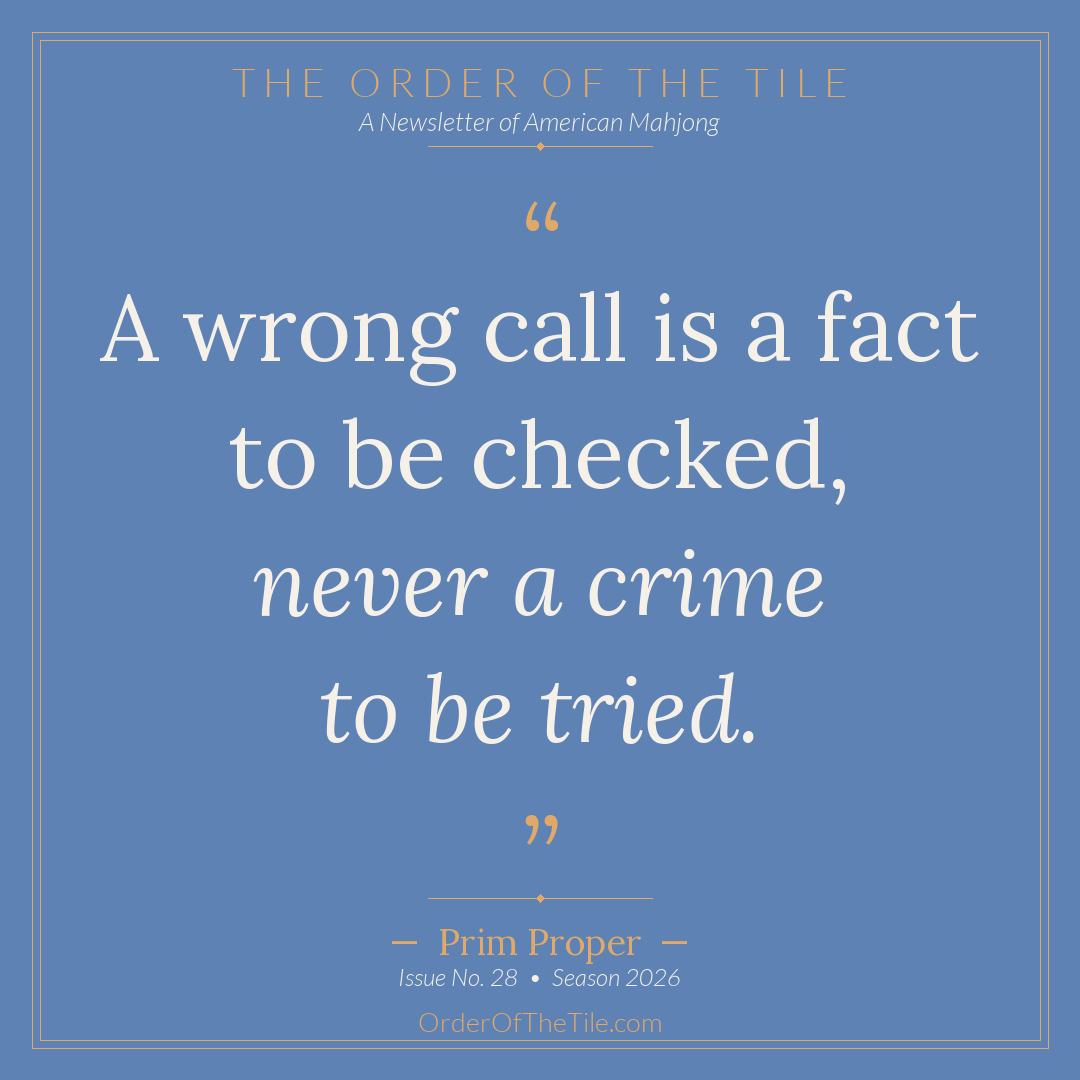
But the part Prim most wants to answer is the second part, the who decides, because that is where the fear actually lives. You do not decide. That is the mercy of it. You cannot rule on your own hand, not to save it and not to condemn it, and this is no loophole, it is a kindness built into the game. At your kitchen table the others check your tiles against the card, together, and the card gets the last word, not the loudest woman in the room. At a tournament there is a director whose entire job is to walk over, look, and say what is so, calmly, so that nobody at your table has to be the one who challenges a friend. Prim will say it that plainly. The director is not a prosecutor and the rule is not an indictment. Both exist precisely so that a wrong call is a fact to be checked rather than a crime to be tried, and so that no woman at your table is ever made to choose between her friend and the truth.
 |
Which brings Prim to the superstition sitting underneath the whole question, because there is one. Calling mahjong when you are not certain is a gamble dressed up as confidence. It is hoping, out loud, that the universe will round up in your favor. The cure is not a luckier feeling. It is knowing the rule by heart, so that you call when you have it and you wait when you do not, and you are never again reduced to declaring on a prayer. Bring this one to your own table this week, before anybody needs it in anger. Agree, in daylight and good humor, how your table handles a wrong call, and who checks it, and against what. Prim suspects the simple act of saying it out loud will make every one of you a little braver, and a good deal less superstitious, the next time the word is sitting on the tip of your tongue.
|
WHO'S TALKING |
The man who answered the luck question honestly, and kept answering |
Prim wanted someone this week who has thought harder than almost anyone about the question sitting underneath every charm in every pocket, which is how much of this game is luck at all. There is one obvious name, and somehow, in twenty seven letters, she has never given him this section. His name is Tom Sloper.
If you have ever typed a rules question into a search bar late at night, you have very likely landed on his pages without knowing whose they were. Tom came to mahjong sideways, through a career making video games. At Activision he produced the Shanghai series, the tile matching games, for the better part of a decade, and somewhere in all of that he fell for the real game underneath. He went on to play in tournaments in Japan, Europe, China and here at home, lectured on the game at the Smithsonian, and wrote The Red Dragon & The West Wind, a guide to both the official Chinese and the American game. But his great gift to this community is the least glamorous one. He wrote the questions and the answers down. His mahjong FAQs, and the long running column and question board at sloperama.com, have been patiently answering strangers for more than a quarter century, and his papers are now kept in the archives of The Strong National Museum of Play.
Here is why he belongs in this letter in particular. His strategy page, first posted in June 1999, takes on the very question every superstition is trying to answer, and he answers it with an honesty Prim finds rare. The more skilled player wins more often, he writes, and then admits in the same breath that even the best are "subject to the vagaries of chance." He goes further and says, plainly, that he has no idea how to measure how much is luck and how much is skill. No charm. No promise. Just the order of the wall, the roll of the dice and the other players' hands named for exactly what they are, and the steady work of playing well inside them.
That is the habit Prim admires most in him. He never pretended the randomness away, and he never surrendered to it either. He simply kept writing down what the game actually does, one answer at a time, so that the next player would sit down a little steadier. Prim does not rank the people in this community, and this is not a verdict on anyone. It is thanks to a man who has been answering the table's questions since before many of us owned a set. You can find his FAQs and his column at sloperama.com.
|
Out in the World There is very likely a shop nearer to you than you think. Prim keeps a directory of them, along with the teachers and the tables, sorted by state and by the ones that ship anywhere. Every listing is backed by a source you can check yourself.
|
TILE ENVY |
The coin in the pocket, and the tile that grew up to be one |
Look under the hands at any serious table and you will find the tokens. A tiny jade something on a keychain that has seen a thousand games. A scarf that only ever comes out for tournaments. A pencil that has kept score on every good afternoon for years and is never, under any circumstances, lent out. Prim finds these objects genuinely moving. A charm is not a strategy, but it was never trying to be. It is a way of carrying a little courage in a form you can hold, and there is real tenderness in that.
So it delights Prim, in a letter about precisely this, that one of the loveliest tile ideas going takes the superstition and builds it right into the set. Bespoke Mahjong makes a collection called, of all the perfect things, Lucky Charms, and its wit lives in the jokers. The joker is already the luckiest tile in the game, the wild one, the tile that gets to be anything you need it to be. This collection dresses that idea up and lets it play, reimagining the jokers as a whole small menagerie of talismans, a horseshoe, a four leaf clover, a turtle, a pair of dice, a rainbow, a little evil eye to ward off exactly the cold streak Prim was describing a page ago. It comes in soft, happy colorways with names to match and a puffy heart on the zipper of the bag, and the whole thing is unapologetically joyful about the very instinct this letter keeps gently poking.
That is why Prim covets it this week, and she covets it without ranking it against a single other thing, because taste is yours and nobody else's. She covets it because it is honest. It does not pretend players are somehow above a little luck. It takes every jade keychain and tournament scarf in the room, and it says, warmly, we see you, and then it paints the whole sweet superstition right onto the one tile that has always been about fortune anyway. A set that knows why you carry a charm is a set with a sense of humor about all of us, and Prim will take a sense of humor over solemnity at the table every single time.
|
Prim's Own Shelf Written at the table, not at a desk Since we are discussing the things you keep, Prim keeps a shelf of her own. Every guide and printable in her shop is her own original work, written by somebody who actually plays, and it arrives the moment you buy it with nothing to wait on. The Game Pass sits there too, and it opens every game she has built, including the ones still to come.
|
SET YOUR RACK |
A week away, in the hills, where the only luck required is a spot off the waiting list |
Last week this section sent you somewhere free and online, a screen you could drop in on from your own couch. This week it points the other direction entirely, at a room you have to drive to, because both kinds of afternoon are worth having and the season is generous enough to hold them both.
From Friday, October 2 through Sunday, October 4, Becky Hassloch hosts a Mahjong retreat at the French Lick Springs Hotel, in the wooded hills of southern Indiana, and Prim will be honest about the shape of it straight away. It is full. There is a waiting list, though, and plans do change, so if a weekend away sounds like exactly what your season needs, write to Becky at beckyhassloch@gmail.com and ask to be added. The weekend is built for intermediate and advanced players, with lodging and meals, plenty of play, prizes and giveaways in the evening sessions, and a themed night on the Saturday. The setting deserves a word of its own. French Lick is a genuine old American resort, two historic hotels including the great domed West Baden Springs that was once called the eighth wonder of the world, set in the Hoosier National Forest, with the spas and the long porches and the unhurried quality that a good retreat is really for. A weekend like this is not about anyone's ranking. It is about a table of people, a beautiful room, and three days where the only thing on the schedule is the game and each other.
And one line on the summit, because it is close now and the excitement issue is still ahead. The eleventh Mah Jongg World Championship gathers October 16 to 18 at Paris Las Vegas, it is sold out to a waitlist, and Prim will have a great deal more to say about it when the eve of it arrives.
The board this week:
|
The full calendar, kept current and free, lives at orderofthetile.com/events.
CRAK INTELLIGENCE |
Why a flower on your rack feels like good news |
Here is a thing worth knowing the next time a flower turns up on your rack and something in you quietly relaxes, as if the afternoon just tilted your way. That feeling is very old, and it did not begin at your table.
The flowers were never ordinary tiles. In the older Chinese sets they stand for the Four Gentlemen, the plum that blooms in the dead of winter and so means resilience, the orchid for spring, the chrysanthemum that keeps its color into the cold and so means perseverance, the bamboo that bends in the storm rather than breaking. Other sets loaded them with frank good fortune, the characters for long life and prosperity and happiness, or small painted scenes of immortals and legends. And crucially, in the games those sets were made for, the flowers did something the ordinary tiles did not. You set them aside when they came, faceup, for bonus points, a little windfall that arrived by pure chance and belonged to whomever the wall happened to favor. A tile you could not earn and could not plan, that only paid you and only ever felt like luck. Of course we came to love them. They were designed, across centuries, to feel exactly like fortune landing in your lap.
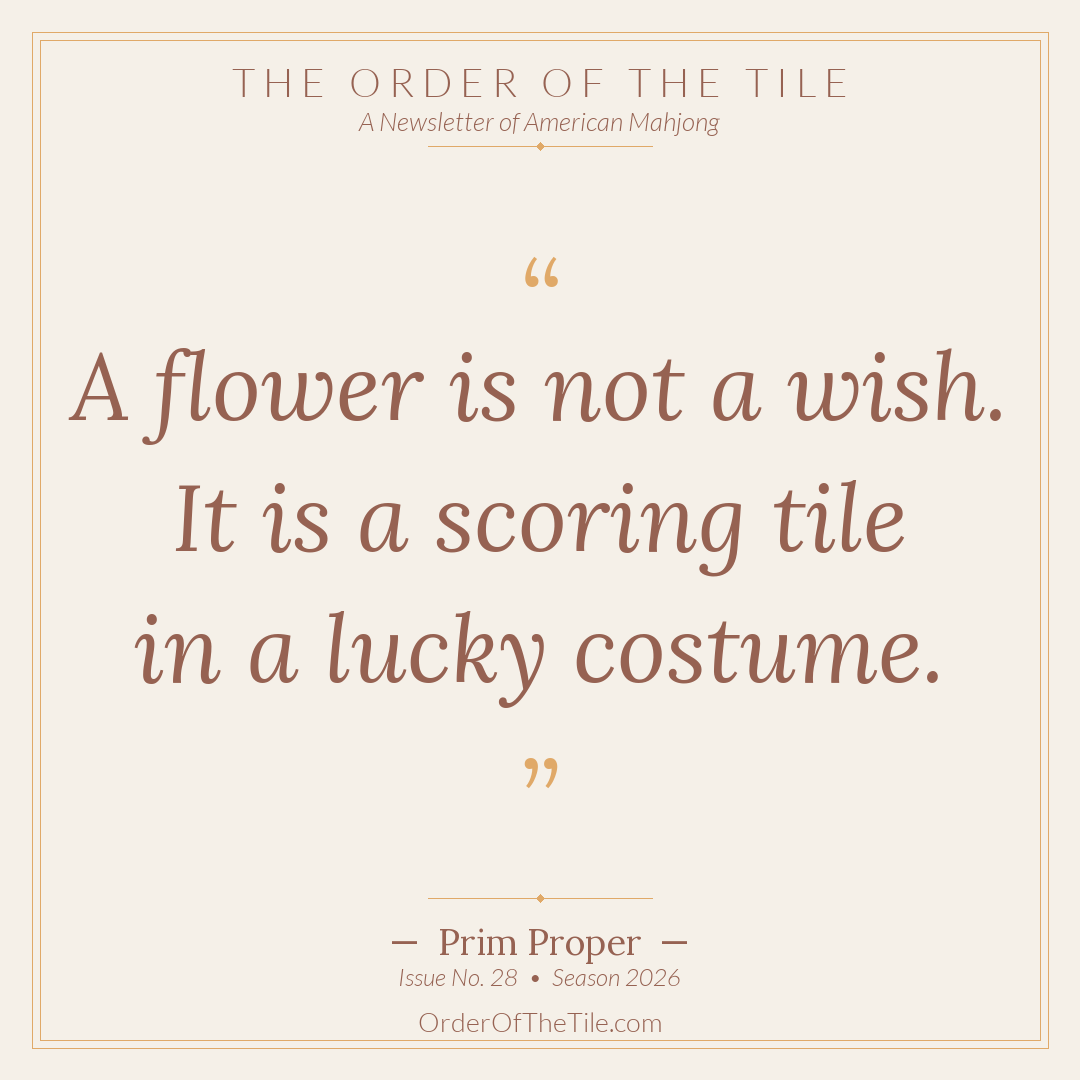
That inheritance still runs quietly under the American game, and Prim finds it changes how people play in ways they rarely notice. A player who has decided, somewhere below thinking, that flowers are lucky will overvalue them, hold one a beat too long because letting a lucky tile go feels like tempting fate, read an early flower as a sign the hand is blessed and lean into a line she should have left alone. The belief is charming and it is also, softly, a leak. Because here is the thing the costume hides. On your card, a flower is not a wish. It is a component, a working tile that particular hands are built to use, valuable exactly where the card says it is valuable and no more magical than a Four Bam. The luck you feel when it lands is a very old feeling doing its very old job. Enjoy it, by all means. Prim does. Just do not let a scoring tile in a lucky costume talk you into a hand the card was never going to reward.
 |
THE WEEKLY CHALLENGE |
Seven racks. Your call. Then Prim's. |
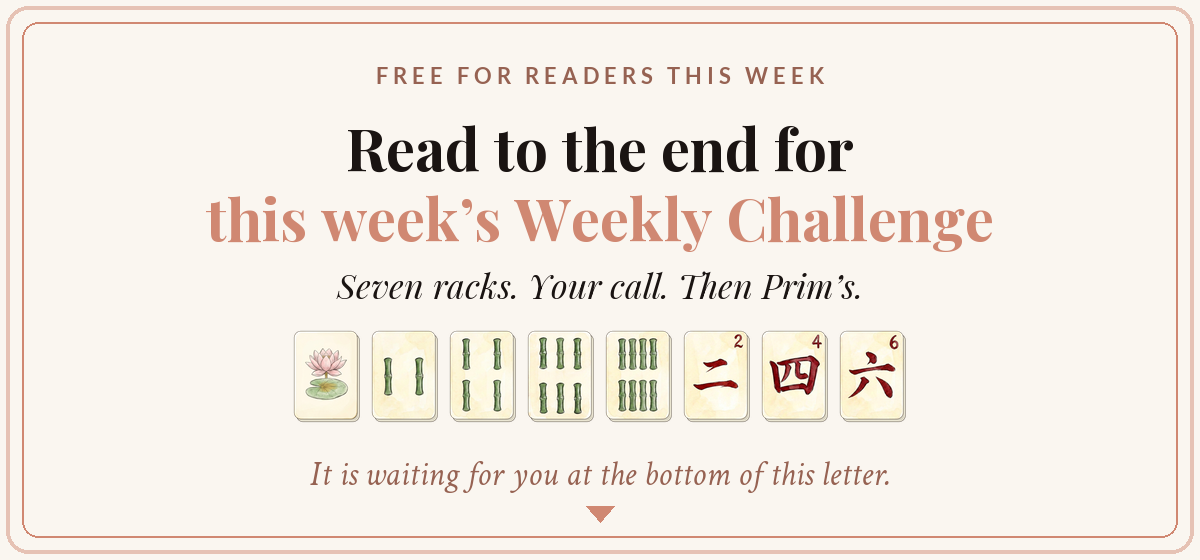
Seven new problems from the table, every Thursday, for readers of this letter. You make your call, you tell Prim why, and only then does she tell you how she would play it. Here is the first of this week's seven. The other six are waiting for you on the site all week, until the next set opens.
|
Drill one · Charleston · At the Table Your rack         The table agreed to a second Charleston. First pass, to the left. Every tile on your rack is even, and your hand is plain to see. Which three can go? Think about your own hand, and then about the player who picks them up. A. The Two, Four and Six Crak B. The Two Crak, the Four Crak and the Eight Bam, and the Six Crak waits for the pass across C. Two Flowers and the Eight Bam No answer here on purpose. Make your call on the site, write a line about why, and Prim answers you there. Your letter email is your key; no password, ever.
|
Answer all seven before next Thursday and your name goes in the month's pot, once for every set you finish. One reader is drawn each month for a Practice Workbook of her choice, and Prim announces the first name here in October.
|
A CLOSING NOTE |
It is the twenty eighth letter, and Prim has spent all of it turning one stubborn idea over in her hands.
Fortune, at this table, has always favored the prepared rack. Preparation is not the opposite of magic. It is the better magic, the kind that works on an ordinary Tuesday, holds up in a tournament hall, and stays with you on the afternoons the wall gives you nothing at all.
So bring whatever you carry to the table. Then go be the most quietly confident woman in the room, the one who knows exactly what she is playing for.
Prim may write for the women at the table, but she firmly believes everyone is welcome. Everyone deserves a seat at this table.
|
| |||
|
Don't tap it, rack it, double stack it. | |||
|
Until next week, may your rack be blessed | |||
|
Prim, as always | |||
| |||
|
Forward this to your favorite fourth. |