
|
THE ORDER OF THE TILE | |||
| |||
|
ISSUE NO. 24 · AUGUST 2026 | |||
|
"Luck owns the wall. Nothing else." |
My Fellow Table Guests,
Twenty four.
Prim has it on excellent authority that twenty four is a lucky number. The authority is her son, whose name is Kaige, and who has held this position for years with the perfect calm of a man who has never once been asked to defend it. He does not suspect that twenty four is lucky. He knows it. And Prim, looking at the number printed at the top of this very letter, has decided that the mathematically responsible course of action is to agree with the boy.
And then there is little Lisa.
Prim would like to be precise about little Lisa, because she is a phenomenon and phenomena deserve accuracy. Lisa is the sweetest person in any room she walks into. She is everybody's friend, and Prim does not mean that as a compliment about her manner, she means it as a headcount. She is always there. And she wins. Prim does not mean often. She means there is rarely a day that goes by that little Lisa does not win something, from somebody, somewhere, and she does it so graciously that the rest of the table finds itself genuinely pleased for her, which anyone who has ever lost to the same woman twice will tell you is an extraordinary thing to be able to arrange.
Prim has heard her called the little energizer bunny that could, which is two entirely separate sayings welded into a single one, and which is somehow more accurate than either of them ever managed on its own. One of them is about never stopping. The other is about deciding you can before anybody has handed you a reason. Lisa does both, daily, and has never once brought it up.
Now read that list again, because Prim has been staring at it for a week. Sweetest person in the room. Everybody's friend. Always there. Always wins.
Prim would like to suggest that those are not four separate facts.
So let us call this the lucky issue and be done with the pleasantries, because Prim has a question for you, and she would like an honest answer. Not the answer you would give at the table. The one you would give in your own kitchen, with the light off, where nobody is keeping score.
When you lose, is it the wall?
And when you win, is it you?
Those two answers cannot both be true. Most of us are carrying both of them around anyway, all season, in the same handbag, and we have never once made them sit down and look at each other. Prim proposes that we do that this week.
|
~Prim |
|
Your seat at the table is open There is a chair with your name on it The practice table is always laid, and nobody there is waiting on you. Play a hand at your own pace, with no audience watching you think and no one drumming her fingers while you decide. Your newsletter email is already your key, so there is no password to invent and nothing whatsoever to remember. Ask for a sign-in link, take your seat, and begin with the free Daily Tile.
|
THE DRAW |
The one excuse the whole table agrees to accept |
There is one sentence that no mahjong table in America has ever challenged, and Prim would like to put it under the light.
"I am just unlucky tonight."
Say it and watch what happens. Nobody argues. Nobody asks a follow up question. Three women make a small sympathetic noise and the game continues, because the sentence is doing something useful for everyone at the table at once. It excuses the woman who said it. It reassures the woman who is winning that she has done nothing to be sorry for. And it quietly promises all four of them that tonight was weather rather than a decision. Prim understands entirely why it survives. It is the most socially efficient sentence in the game.
 |
It is also the only claim we let stand with no evidence whatsoever. We will argue for forty minutes about whether a discard was safe. We will not spend forty seconds on whether the wall has a personal grievance.
And when the community does take the question seriously, look what happens to it. The question gets asked constantly, and the honest answer that comes back is that the game is both luck and skill, with the ratio put at seventy to thirty by some and fifty to fifty by others. Prim has read that answer many times and she will say the ungracious thing about it: everyone agrees, so nothing is being argued. The percentages are a parlour game. Luck and skill are not two teams competing for the same field. They do not overlap at all. Luck owns the wall. You own every single thing that happens after a tile arrives in your hand.
Which is not to say the rituals must go. Prim would not dream of it. Sit in your seat, hold your bracelet, tap the wall twice, tell the tiles what you think of them. She has her own habits and she is not putting them in writing. The ritual is not the problem. The problem is the moment the ritual gets promoted to an explanation.
|
Prefer to listen? Prim reads each letter aloud on Spotify.
|
CRAK THE CARD |
Two doors, and the moment you pick one |
Here is the whole of it, and Prim will be brief because the truth is short.
Luck has a budget, and the budget is about four seconds long. It is spent the moment a tile leaves the wall and lands in front of you. That is luck's entire jurisdiction and it never once extends past it. What happens next is not luck arriving. It is you, deciding, whether or not you notice yourself doing it.
So the useful question is never whether you got a good tile. It is whether you were standing somewhere that tile could reach you.
And this is the part almost nobody talks about, because it is invisible from the other three seats. The strong player does not sit down and pick a hand. She sits down and picks a neighborhood. She holds one hand and a second hand behind it, chosen because the two of them want many of the same tiles, so keeping the door open costs her almost nothing. She is not being indecisive. She is being cheap. Every tile she draws is working for two futures at once, and she pays no premium at all for the privilege. That is the craft, and it is entirely learnable, and it looks like absolutely nothing while it is happening.
 |
Then the wall tells her which door to walk through. And here is the moment the whole section is built around, and it is the moment Prim would tattoo on a rack if racks allowed it. When it is time, lock in. Do not hesitate.
Because hesitation is the only genuinely unlucky thing at a mahjong table, and it is entirely self inflicted. Hesitation is the tile you should have called and let go by while you were still admiring your options. It is the third pass of the Charleston spent protecting a hand you had already privately given up on. It is the exposure you were owed and did not take because you wanted one more turn of certainty, and certainty is not on the card. The wall does not punish a wrong decision nearly as hard as it punishes a slow one. A wrong decision leaves you somewhere. A slow one leaves you nowhere, holding tiles for two hands and committed to neither, which is the only way to lose to both.
And this is the sentence Prim would have you carry to the table. Not every hand deserves your loyalty. Loyalty is a virtue among people. Among tiles it is a habit, and it is an expensive one. The hand you chose in the first four minutes was chosen with a quarter of the information you have now, by a woman who knew less than you do. You are permitted to overrule her. You are not betraying anybody. She was you, and she would agree with you if she could see what you can see.
Does any of this win every time? It does not, and Prim is not going to stand here and suggest otherwise. Does Prim win every time? Certainly not. But you are most welcome to pretend she does.
That is the correct amount of confidence to bring to a Tuesday.
|
Between the Letters Today's Latest News A letter a week is never quite enough for a game moving this fast. The Dispatch is Prim's daily page, where the latest updates and announcements land between letters... the releases, the tournaments, and the stories the table is talking about, gathered and told the moment they happen.
|
THE TABLE IS ASKING |
A question built wrong, answered anyway |
The question arrives every season, in every group, usually from somebody who has just had a terrible night and is being much braver about it than the rest of us would be.
Is this a game of luck or a game of skill?
Prim is going to be unkind to the question rather than to the person asking it, which is the only direction she permits herself. The question is built wrong. It asks you to split one hundred percent between two things that are not sharing a room. Luck deals. You decide. Those are different jobs, performed at different times, by different parties, and no percentage can be run between them any more than you can ask what fraction of a letter is paper and what fraction is opinion.
 |
So here is the answer, and Prim will say it that plainly. The tiles are luck. The table is skill. And almost everything you have ever called luck happened on your side of the rack. The hand you did not pivot out of. The tile you held two turns too long because it was pretty and it was yours. The call you did not make because you wanted to be sure first. None of that was the wall. All of it was a decision, made quickly, by you, in a moment you have genuinely forgotten having.
Which is not a scolding, and Prim wants to be careful here, because there is a version of this argument that turns into a woman being told her rotten evening was her own fault. Sometimes you draw nothing. Sometimes you draw nothing four times running while the woman across from you draws the only two tiles in the wall that she needed, and she is gracious about it, which is somehow worse. That is real. That happens. That's little Lisa! Prim has sat in that chair with a fixed expression on her face. Over one evening, luck is enormous and there is nothing to be done about it but hold your posture.
The trick is that nobody keeps score by the evening. You keep score by the season. And across a season, luck does something wonderfully boring: it flattens. It arrives for everyone in roughly the same quantity, and it leaves the same way, and what is left standing at the end of a card year is the sum of what each of you decided. That is not a consoling philosophy. That is arithmetic, and it is on your side.
So bring it to your own table this week, and be honest about the answer. When you lost the last hand you lost, could you name the decision? If you can, you are not unlucky. You are learning, and it is expensive, and it works.
|
WHO'S TALKING |
In the city built on chance, someone teaches the other thing |
Prim has been looking at Las Vegas for a week and she has an admission to make. She had assumed there was not much there for the American Mahjong World. A city of ninety second attention spans and free drinks does not sound like a place that sits still for thirteen tiles and a Charleston. Prim was wrong, comprehensively, and she is delighted about it.
Start with Shauna, who runs Las Vegas Mahjong, and who teaches American Mah Jongg on the National Mah Jongg League card to a city that is world famous for the opposite activity. She is a certified Oh My Mahjong instructor. She runs a beginners course she calls MAHJ101 and a second one, MAHJ102, for the players who are past the basics and into the part where it gets interesting. Group lessons run sixty dollars a head for four to eight people. She will come to you in Henderson or Summerlin, and she says so on the page rather than making you ask.
And her home base, which Prim promises she did not arrange for the purposes of this letter, is a studio inside a business called Lucky Hare on West Sahara Avenue. In an issue called Hey, Lucky Lady. Prim has decided to accept this as a gift and move on.
What Prim admires here is the choice underneath the business, because it was not the obvious one. In that city, in that location, the easy money is in a novelty hour. Tiles as decor, an hour of vaguely Asiatic ambience, a photograph, a bachelorette party, done. Instead the page describes a hundred level and a hundred and two level, which is not the language of a novelty hour. That is the language of somebody who expects you to come back and be better the second time. Her own line for the whole enterprise is that she is bringing people together, one tile at a time. Prim believes her.
There is more of it than that, too. Angel Kuo runs an outfit called Mission: Mahjong! whose stated purpose is to create "welcoming, thoughtfully designed opportunities to learn, play, and connect," and who has put mahjong into free Sunday sessions at Las Vegas public libraries, a Monday night open play, and a Friday social at a board game cafe for three to five dollars. Prim will be precise, because precision is a courtesy: their house style is Vegas style, built on the Hong Kong game with adapted Taiwanese scoring, and the American game is one of several they teach rather than the whole enterprise. So this is not a plug for a fellow NMJL shop. It is credit for something harder. Somebody looked at a city with no mahjong habit and decided to build the room and turn the lights on, in a library, for free, on a Sunday, which is the least glamorous possible way to grow a game.
Prim recognizes her educators. And she notes, with the particular satisfaction of a woman whose entire thesis this is, that in the one city on earth built end to end on chance, the people doing the real work are teaching the part that is not chance at all.
You will find Shauna at lasvegasmahj.com and Angel Kuo at missionmahjong.com. If you are in the valley, or you are passing through with three hours and a set of morals, Prim suggests you go and be somebody's fourth.
|
Out in the World There is very likely a shop nearer to you than you think. Prim keeps a directory of them, along with the teachers and the tables, sorted by state and by the ones that ship anywhere. Every listing is backed by a source you can check yourself.
|
TILE ENVY |
The set that gets you to the table |
Prim has been looking at the desert, aesthetically speaking, and the desert is having a moment.
The Charleston Club works out of Scottsdale and describes itself as an American Mah Jongg company making beautifully designed essentials for the game you love, which is a modest sentence for what is actually a full opinion about how the game should feel. Tiles in two sizes, thirty and thirty six millimetre, because those two numbers are a genuine argument among people who care. Racks. Bags. A neoprene mat at thirty two inches square. And, tellingly, a guide to the best set under a hundred dollars sitting on the same site as the pretty things, which tells you they would rather you played than admired.
What Prim covets there is the restraint. There is a version of desert design that goes straight to cactus, and this is not it. This is the other desert, the one that is all long light and dust pink and a green so pale it has to be described as a memory of green. It photographs like a room you would like to be sitting in at six in the evening, and Prim would like to be sitting in it, with three other people, at six in the evening.
And now the part Prim did not expect to enjoy writing.
There is a real body of research on this game and what it does to a person, and it is more serious than the wellness language around it suggests. A review published last year in the Journal of Prevention of Alzheimer's Disease gathered fifty three studies on whether playing mahjong benefits older people. More playing experience tracked with better cognitive, psychological and functional ability. Used deliberately, as something you do rather than something you have, the game improved general thinking and short term memory and eased depressive symptoms.
Prim will now do the thing the wellness industry never does and tell you the limits, because you are grown and you can hold two ideas. Most of those studies watched people rather than testing them, so nobody can yet tell you the mechanism, and the researchers themselves say so and ask for proper trials. And nearly all of that work studies the Chinese game rather than ours. Prim is not going to hand you a prescription and pretend it was written for an NMJL card.
But look at what survives all that caution, because something does, and it is the whole point of this letter. Whatever the game is doing for you, it is not doing it through the tiles. It is doing it through the deciding. Fourteen tiles, incomplete information, three opponents, and a small hard choice every ninety seconds for two hours. That is the active ingredient. Which means the set that earns its price is not the most beautiful one. It is the one you are willing to carry to somebody's kitchen on a Tuesday when you are tired.
Buy the pretty tiles. Prim insists on it, she is not made of stone. Just buy the pretty tiles you will actually use, and then go and use them, because the benefit is entirely in the using, and none of it is luck either.
|
Prim's Own Shelf Written at the table, not at a desk Since we are discussing the things you keep, Prim keeps a shelf of her own. Every guide and printable in her shop is her own original work, written by somebody who actually plays, and it arrives the moment you buy it with nothing to wait on. The Game Pass sits there too, and it opens every game she has built, including the ones still to come.
|
SET YOUR RACK |
Doors that are actually open |
Prim is going to arrange this section a little differently this week.
The sold out ones are still down there on the board, at the bottom, where you can see them. Prim is not going to pretend they are not happening, and there is real use in knowing what filled up, because next year you will know to move earlier. What she is not going to do is spend the good half of this section describing a room you cannot get into. A waitlist is a wish. It is not a plan. So the spotlight goes to a door that is open, and the closed ones get a line each, and everybody is better served.
Which brings her to the desert in December.
Destination Mah Jongg is in Scottsdale from the eleventh to the thirteenth of December, at the Embassy Suites, and as of this morning they say there is space still available. Our own records have it as a Golden Ticket qualifier, which is the part worth your attention, because a Golden Ticket is what turns a good weekend into a discounted seat at next year's championship. Pricing is not posted yet. Prim will tell you the moment it is rather than guessing at it now.
And here is the number that matters about it, and it is not the prize money. It is twelve.
Twelve rounds, spread across three days. Prim wants you to sit with how deliberately unromantic that structure is, because it is a compliment to you. Twelve rounds is not a coin toss. Twelve rounds is a measurement. It is long enough that the woman who draws beautifully on Friday and badly on Saturday finishes precisely where her decisions put her, and short enough that she has to keep making them while tired. Nobody wins twelve rounds on a lucky wall. That is the entire reason the format exists, and it is the reason a tournament weekend will teach you more about your own game than a year of Tuesdays at home.
Three days in Scottsdale in December, incidentally, is also seventy degrees and dry while the rest of us are scraping something off a windscreen. Prim mentions it only in passing.
This week's board, open doors first, and then the ones that got away so you know to move earlier next year. Reconfirm before you reach for a card, because these move.
|
CRAK INTELLIGENCE |
Where the most practiced players in America live |
On the first day of 1960, a builder named Del Webb opened five model homes in a stretch of Arizona desert outside Phoenix and waited to see whether anybody would want them. He was selling something that did not exist yet: a town for people who were finished working. He hoped ten thousand people might come and look over the three day weekend.
More than a hundred thousand came. They queued in the desert to see a house. Two hundred and thirty seven of them bought one before the weekend was out, and Sun City became the first active retirement community in America, and every place like it since is a copy of a copy of that weekend.
Prim tells you this because of what happened next, quietly, in those rooms, for sixty five years and counting. Those hundred thousand people were not buying a house. They were buying a schedule. And into that schedule, in Arizona and then everywhere, went the standing Tuesday, the Monday afternoon at the community center, the group that meets at the library, the four women who have played together so long that they no longer discuss the arrangements. Your own Mahjong Near You directory carries a Sun City Mah Jongg Club to this day, along with a Monday group at a Scottsdale community center and open play on Wednesday afternoons at a clubhouse in Tucson, and Prim finds that continuity genuinely moving.
 |
Now here is the part that lands this whole letter.
Somewhere in a room like that is a woman who has played this game every week for forty years. Prim would like to be exact about what that means, because it is the answer to the question this issue opened with. It means she has sat down to the game something like two thousand times. It means that whatever luck was ever going to do to her, for her, or about her, it has now done, in every possible combination, and it has all cancelled out. Every rotten wall has been paid back by a charmed one. Every miracle joker has been balanced by a night when nothing came. Her luck, across those two thousand evenings, sums to almost exactly zero.
And she is still better than you.
That is not mysticism and it is not a story about a gifted woman. It is arithmetic, and it is the most encouraging arithmetic in this game, because it means the thing that separates her from the rest of us is the only thing that was ever available to any of us. She did not get luckier. She got more repetitions. She has simply made the small hard choice so many thousands of times that she now makes it correctly without appearing to think, which from the fourth chair looks exactly, precisely, indistinguishably like being lucky.
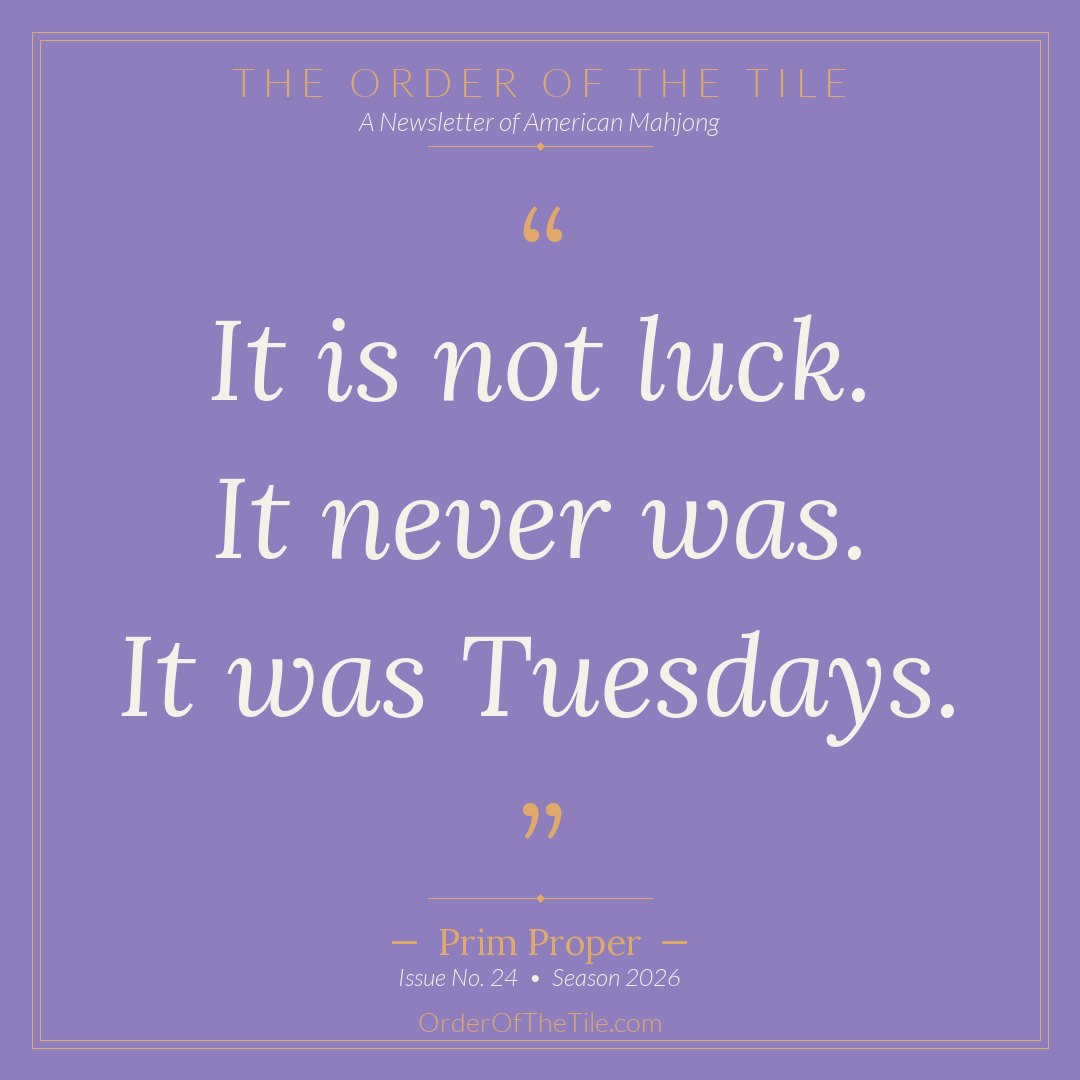
It is not luck. It never was. It was Tuesdays.
A CLOSING NOTE |
Prim had this letter finished and ready to go, and then the news came in, and she is going to set it down for a moment.
Dolly Parton died on Tuesday, in Nashville, at eighty.
In 1976 she recorded a song called Hey, Lucky Lady. That is the name at the top of this letter, and Prim chose it on purpose, because of every word in the language available for describing Dolly Parton, lucky is the one that fits worst.
Look at where that song sits in her life. Hey, Lucky Lady is on an album called All I Can Do, and All I Can Do is the last record Porter Wagoner had a hand in, after seven years in which he was her partner, her producer, and the man whose name came first. The next album she made opens with a song she called her deliverance. She had been loyal to that hand for years. She looked at what she was holding, she looked at what the wall had told her, and she left, and she rebuilt, and she did not hesitate. Everything the world thinks of when it thinks of Dolly Parton happened afterwards.
She wrote a song about walking away from him, and it was I Will Always Love You, written in 1973, and it is the least bitter goodbye anybody has ever written about anything. Then Elvis Presley wanted to record it, and the deal required her to hand over half of the writing, and she said no. She has said she cried all night. She has also said that when Whitney Houston's version came out, she made enough money to buy Graceland.
Prim would like that anecdote read back slowly, because it is this entire letter with a rhinestone on it. A woman turned down Elvis Presley, wept about it until morning, and was right. Not lucky. Right. And she had to be right at the moment of the decision, with no way whatsoever of knowing, which is precisely the position you are in every time you decide whether to keep a hand.
The rest is what she built with the years that decision bought her. She kept her own songs and answered to nobody. She put a theme park in the mountains she grew up poor in. She started handing free books to children in 1995, and by 2018 the hundred millionth one went to the Library of Congress. She was underestimated for sixty years by people who mistook the sparkle for the whole story, and she let them do it, because she was never for one moment confused about what she was building. She was also meant to be on a Las Vegas stage next month, six nights at the Colosseum, and she called it off in the spring.
Hey, lucky lady. Prim thinks not. She was not lucky. She was Dolly.
And one final thing this week that we are not going to call luck either, because it was hard work.
Prim has released the phone friendly versions of her games. All of them. Every game on the site now plays properly in your hand, wherever you happen to be sitting. She mentions it down here rather than at the top because it belongs to this argument and nowhere else: if luck is mostly just hands you have not played enough of yet, then the cure has always been repetitions, and the repetitions now fit in a handbag. Two thousand Tuesdays is one way to get there. A phone in a waiting room is another, and it is considerably faster.
And while you are there, ask Prim something. She is at her most useful when she is being asked, and she will tell you plainly that her sharpness is not luck and never has been. It is the questions. Every single one anybody brings her makes her better at answering the next one, which is a slightly humbling way for a woman of her bearing to live, and she has made peace with it.
One last thing, and it is a genuine request rather than a courtesy. Prim wants to hear what is wrong. Anything at all. A dream request, a simple fix, or something small and stupid sitting in the way of your game. There is a button on the screen for exactly this and Prim would be delighted if you wore it out.
Prim may write for the women at the table, but she firmly believes everyone is welcome. Everyone deserves a seat at this table.
Twenty four, then. Kaige says it is lucky, and Prim has decided he is right, though possibly not for his reasons.
And one last thing, for the lady this letter is named after.
Of all the songs she wrote, there was one she kept back for the very end of the night. She would hold it all evening, through everything else, and then sing it straight out at the room and mean every word, decade after decade, to a hall full of strangers, as a way of saying goodbye. It was the song she had written about the hardest decision she ever made. And it opens like this.
"If I should stay, I would only be in your way."
Prim has read that line a dozen times today and she is not over it yet. Eleven words. That is this entire letter, written in 1973 by a woman walking away from a hand she had been loyal to for seven years, who was gentle about it, and who was right, and who could not possibly have known she was right at the time. Nobody ever can. That is the job.
So, from this table, and from every one of us sitting at it, to Miss Dolly Parton of Locust Ridge, Tennessee, in her own words and with our whole hearts:
"And I will always love you."
|
| |||
|
Don't tap it, rack it, double stack it. | |||
|
Until next week, may your rack be blessed | |||
|
Prim, as always | |||
| |||
|
Forward this to your favorite fourth. |