
|
T H E O R D E R O F T H E T I L E | |||
| |||
|
Issue No. 9 | May 2026 | |||
|
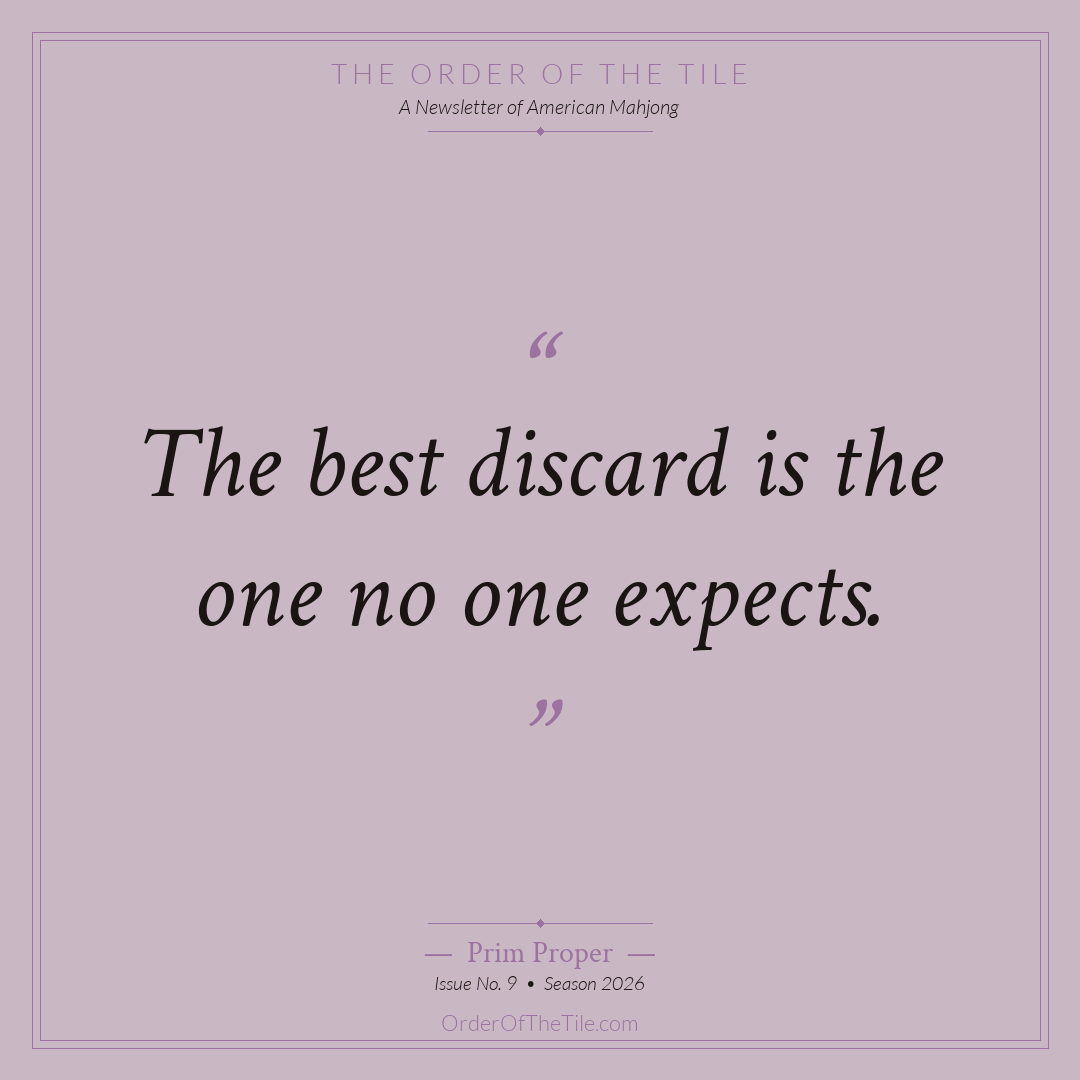
"The best discard is the one no one expects." |
My Dearest Table Guests,
Prim is writing this on the Thursday after Mother's Day, and the pages of this newsletter are full to the margin with the things you sent in over the weekend. Photos of mothers and daughters sitting down to play for the first time. Photos of sets that were gifts from one generation to another. A four-table setup in a backyard in Tulsa where three grown daughters had surprised their mother with the mahjong brunch she did not ask for but apparently wanted. A single photo from a woman in Portland that was just two racks, two cups of tea, and the caption "first game with mom, and she kept the extra tile." Prim read them all and cried a little, professionally, and then got to work on this issue.
The thing Prim keeps thinking about, as she sorts through your weekend, is how much of Mother's Day at a mahjong table is about the unexpected. The mother who had never picked up a tile who turned out to be a natural. The grown daughter who had avoided the game for years and finally said yes. The sister who was only there to watch who ended up playing four hands. The game has a way of producing surprise, and the community this week has been full of it. Prim would like that to be the spine of this issue, because the tagline she has been carrying all week is exactly about this. The best discard is the one no one expects. The surprise is the point. The game that can surprise you can be learned by anyone, at any age, at any table, and can surprise the players who think they have seen it all.
We will talk about the backup hand, which is the single most important unglamorous concept on the 2026 card. We will talk about teaching new players without killing the thing that made them curious in the first place. We will meet one of the most patient and skilled teachers of adult beginners in the country. We will look at the arc of tile design itself, from bone and bamboo to the acrylic in your case right now. And we will spend a quiet moment with the designers who are making the sets that will define this era of American Mahjong. Pull up your chair. The wall is built. Let us begin.
~Prim |
|
Did this letter arrive by way of a friend? Prim would love to add you to the list. 
|
THE DRAW |
Mother's Day landed, the cruise is sailing, and the community is warming |
|
The weekend was exactly what the Facebook groups had been quietly hoping for, which is to say, full of new players and full of patient veterans and largely free of the usual mahjong group arguing. Not to mention a little mahjong movie time. Prim hopes you all enjoyed that small bonus of game delight. Prim watched Sunday unfold on her phone and on the TV, because a professional mahjong writer has professional obligations, and what she saw was a community doing its best work. Mothers who had never played were being taught by daughters who had learned last year. Daughters who had avoided the game for years were being invited in by mothers who had been hoping for exactly this Sunday. And the photos kept coming, and the captions were unusually gentle, and Prim would like to hold onto the mood of Sunday for as long as it will last.
One pattern Prim noticed and wants to name. A surprising number of Mother's Day posts this year came from families where the mother was the one teaching an adult daughter, but the daughter was the one who had suggested the lesson. The dynamic was not "my mother taught me the game" as it has been told for decades in this community. It was "I asked my mother to finally teach me." That is a subtle generational shift, and Prim finds it significant. The new players coming into this game are not waiting to be invited. They are knocking on the door. The veterans in their lives, if they are paying attention, are opening it faster than they used to. This is how a community grows. It grows because the incoming generation asks, and the outgoing generation answers, and the answer is finally, reliably, warmly yes.
The other major event of the week is a boat. Destination Mah Jongg's Mediterranean Cruise aboard the Celebrity Ascent departs tomorrow, and Prim has been watching her social feeds fill with pre-travel photos of packed tile cases, luggage tags, and the inevitable last-minute "does anyone know if they have a good pusher for the ship tables" posts. This is the first major destination mahjong event of the summer calendar, and for the hundred-plus players who have committed, Prim would like to say bon voyage. The photos from the Mediterranean mahjong sessions will flood your feed for the next ten days. Enjoy them. Be gracious. Try not to get too jealous. Save the screenshots. The cruise circuit is one of the most distinctive features of this community in 2026, and watching it from shore is part of the experience for the rest of us.
One quiet piece of news from the teaching side of the community. Several of the instructors Prim follows have reported a clear bump in class registrations this week, and the pattern is consistent. The new students are adult women who attended a Mother's Day game on Sunday, loved it, and then went looking for a proper lesson on Monday. This is exactly the handoff the community hopes for between a casual introduction and a real relationship with the game. If you are a teacher reading these pages, check your inbox. Your spring class may be about to fill. If you are a new player who is considering a class, the demand is high and the good teachers are booking out. Move this week.
CRAK THE CARD |
The backup hand, and why the 2026 card rewards players who keep two options alive |
Prim has been sitting with a concept all week that she has been trying to get into these pages for three issues now, and she is finally going to do it. The backup hand. If you have never heard this phrase, it is because most mahjong teaching is organized around the single hand you are building, the one you commit to, the one you expose on, the one you close with. The backup hand is the one you are quietly watching in the background, the alternative route your rack could take if the tiles you are hoping for never come, and on the 2026 card, the players who hold a backup hand alive through the middle of the game are the players who win the most often. Prim would like to walk you through this.
What a backup hand actually is.
A backup hand is not a second plan you switch to in a panic. It is a second pattern you are quietly reading into your own rack as the game develops, alongside your primary hand, and it is almost always in the same family. A backup hand is the cousin of the hand you are building. If you are committed to a particular hand in the 2468 section, your backup is probably another hand in the same section with one or two different tile requirements. If you are building toward a specific Consecutive Runs hand, your backup is the adjacent Consecutive Runs hand that shares most of the tiles you have already collected. The backup is not a pivot. It is a reserve. Knowing the reserve exists is what lets you throw unexpected tiles without fear, because you are not throwing a tile you need for any plausible hand. You are throwing a tile you do not need for either of the two hands you are quietly holding open.
This is the direct connection to the tagline Prim has been carrying. The best discard is the one no one expects, and the way you become the player who discards unexpected tiles is by having a rack that does not commit prematurely. A player who has a primary hand and a backup hand can discard tiles that look random to the rest of the table. A player with only a primary hand discards predictably, because her discards are the tiles that do not fit the single pattern she has locked onto. The table reads her. She loses the information game before the game is half over. The backup hand is how you stay unreadable.

|
The 2026 card rewards this posture specifically.
Here is why the backup hand is not a universal mahjong concept but a 2026-specific skill. The 2026 card has an unusually high number of hand pairs that share structural DNA. Many of the Consecutive Runs hands share a spine. Several of the 2468 hands share pairs. The Singles and Pairs section, unusually, has hands that are adjacent enough that a careful player can hold two of them open simultaneously through the first third of the game. This is not true on every card. On some years, the hand families are more distinct, and a backup hand means fundamentally changing direction. On the 2026 card, a backup hand means holding two closely related hands in the same pocket, both of which are reachable with slight variations in what the wall provides.
The practical implication is that the player who reads the card carefully in advance, and who identifies the pairs of hands that share structure, will play this year's card with a flexibility that players who memorized only one hand at a time will not have. This is less a game skill than a homework skill. Before your next game, take the card out, sit with it for twenty minutes, and map the pairs. Which Consecutive Runs hand shares most of its tiles with which other Consecutive Runs hand? Which 2468 hand is one tile swap away from a different 2468 hand? Build a small mental library of adjacent hand families. When the game begins, your rack will start to sort itself into these families on its own, and you will find that you are naturally holding two options longer than you used to. That is the backup hand technique in action.
When to commit, and how to commit.
The backup hand only works if you eventually let one of them go. The player who tries to hold three options through round eight is not playing flexible mahjong, she is playing indecisive mahjong, and the difference is real. The rule of thumb Prim uses, and which she would recommend to you, is that by the end of round five, you should have narrowed from two hands to one. Round five is usually when the wall is tight enough that exposures are starting to land and discard patterns are starting to signal what the rest of the table is doing. By round five, the information has arrived. Read it. Pick a hand. Commit.
The commitment is not a ceremony. It is quiet. It is internal. The tiles in your rack that belonged only to the backup hand become immediately eligible for discard. The tiles that belonged only to the primary hand become tiles you will defend. Your rack tightens in one invisible motion, and from round six forward, you play with the certainty that marks a real player. The player across from you will not know the moment the commitment happened. That is part of the beauty of it. She will only notice, in retrospect, that your discards suddenly stopped making sense to her, because they stopped fitting the pattern she thought you were in. The best discard is the one no one expects. The backup hand is how you earn the right to make them.
The cost of the discipline.
Prim will be honest with you. The backup hand approach costs you something. It costs you the early feeling of certainty. It costs you the satisfying moment in round three when you look at your rack and say, I know exactly what I am doing now. It replaces that moment with a longer, more ambiguous middle game where you are carrying more in your head. Some players love this. Some players hate it. If you are a player who enjoys the ceremony of clean commitment, the backup hand will feel like clutter for the first few games you try it. Stay with it anyway. After five or six games of running a backup, the discipline becomes background. Your rack will feel lighter, not heavier, because you will no longer be afraid of what you cannot control. You will know that whatever the wall gives you, you have a path through it. The game rewards players who can hold complexity without anxiety. The backup hand is the training ground for exactly that.
THE TABLE IS ASKING |
Teaching the new player without killing the thing that made her curious |
The question arrived from teachers this week, not students, and it came in a dozen forms that all pointed at the same anxiety.
|
"I finally got a new player to the table. She is interested. She is nervous. She is trying. And I cannot figure out how much to teach at once without overwhelming her, and I cannot figure out when to correct her, and I cannot figure out whether to let her lose or to steer her toward a win. What is the actual method?" |
Prim has a method, and she is going to give it to you, because she has now taught enough adult beginners to be confident in what works and what does not. This is not the method you learned from your own teacher, necessarily. It is the method Prim has refined from teaching Nan, and from watching the best teachers in this community work with their own students, and from her own mistakes. There are four principles. Follow them in order.
Principle one: teach only what the current hand requires.
The single most common mistake experienced players make when teaching a new player is trying to teach the whole game in the first session. The Charleston. The card. The hands. The jokers. The scoring. The etiquette. Six systems, none of which anyone absorbs on first exposure, all delivered while the new player is trying not to drop her tiles. Stop. The new player does not need to fully understand the card on game one. She does not need to understand all joker nuances on game one. She doesn't need to do the Charleston yet. She needs to understand the tiles, the letters and numbers on the card and how the two tie together, and finally, how to follow the rhythm of a turn. Teach her those three things. Play an open face hand. Everything else will be introduced, one concept at a time, over sessions. The patience here is not virtue. It is technique.
Principle two: expose your own thinking, not hers.
When you are teaching, narrate what you are doing with your own rack. Say out loud what you are considering, what you are choosing, and why. Do not hover over her rack and offer suggestions about her tiles. Do not ask her what she is going to do. Do not quiz her on what she should do. Chances are she couldn't tell you, at first anyway. The new player learns by watching a confident player play, not by being coached through her own moves. Your narration is a window into strategic thinking. Her private struggle with her own rack is where she develops her own judgment. Respect the privacy of her rack as you would respect the privacy of a veteran's rack. She will figure out more, faster, if you let her figure it out.
Principle three: let her lose, early and often.
This is the principle most teachers resist, and it is the one that matters most. The new player must be allowed to lose games. She must be allowed to make wrong calls. She must be allowed to walk into the obvious trap, to expose too early, to fail to spot the Charleston strategy that any veteran would have seen. The losses are the teaching. Every loss produces a question, and the question is the thing she will bring to you later, in her own words, at a moment when she is ready to hear the answer. If you steer her toward a win on game three, you have stolen the loss she needed to have. You have also, subtly, signaled that winning is the measure, and the new player will spend the next year playing fragile mahjong because she is afraid of losing. Let her lose. Tell her you also lost, many times, and that losing was how you got good. Then play the next hand.
Principle four: answer the question she actually asks.
When a new player asks a question, answer only that question. Do not take the question as an invitation to explain six adjacent concepts. Do not use the question to teach a mini-lesson. The new player's attention span during a game is short and precious, and the question she asked is the thing she is ready to understand. If she asks why you threw a tile, explain that single discard. Do not explain defensive discarding as a concept. Do not explain the history of the game. Do not explain the 2026 card. She asked about one tile. Give her one answer. The next question will come when she is ready.
Prim will close this section with the hardest thing to say to teachers, which is that the goal of teaching is to produce a player who eventually does not need you. The teachers Prim most admires are the ones whose students are playing confident, independent mahjong within a few months. The teachers whose students are still deferential to them five years later have, however warmly, failed. Let your new player become her own player. The best gift you can give her is the confidence to walk into a table of strangers and hold her own. That gift takes patience. The patience is the method. The rest is details.

|
WHO'S TALKING |
Toby Salk is quietly running one of the most generous teaching practices in the country |
|
Her voice is the voice of the patient table.
Her name is Toby Salk. She is a longtime American Mahjong teacher with a substantial online following, and her teaching voice is as close to the ideal Prim has described in The Table Is Asking above as any voice in the contemporary community. Toby has built her practice around the adult beginner, which is the demographic this game is attracting in the largest numbers right now, and the pacing of her instruction, the patience of her explanations, and the warmth of her presence make her exactly the right feature for an issue about teaching without overwhelm.
She teaches at the speed the student actually learns.
What sets Toby apart, for Prim, is that her teaching respects the actual absorption rate of a new learner, which is slower than most teachers want to admit. Most beginner instruction is calibrated to how fast the teacher wishes her students would pick it up. Toby's instruction is calibrated to how fast they actually do. This means more games where the goal is not to close a hand but to practice the pacing of play. This kind of teaching looks, on the surface, less impressive than a high-speed curriculum that claims to produce tournament-ready players in a month. It is, in practice, significantly more effective, because the students who learn at their own speed stay with the game. The students who are rushed tend to quit within the first year, and the community rarely notices they were there.
The online footprint is doing quiet work.
Toby's Facebook presence and her broader online teaching footprint have become, over the last several years, a resource for adult beginners who are not near a local instructor and who need somewhere to go with their questions. Prim would describe what she has built as an accessible classroom, available in the kitchen of any woman who has a phone and a beginner's curiosity. This is the kind of infrastructure the game needs more of, not less, and Prim would encourage any reader who is either teaching or learning to spend some time with Toby's content. You will find, even if you have been playing for years, that her framing of a concept you thought you understood will produce a fresh way of explaining it to the next new player at your table.
Find her. Follow her. Send her your beginners.
If you have a new player in your life who is not ready to sign up for a formal class but who wants a lower-stakes way to start, Toby's material is a gentle on-ramp. Her approach is the opposite of the January-learner problem. She does not deliver confident bad advice. She delivers patient, correct, sequenced instruction, and she does it in a voice that feels like the voice of a friend who happens to know the game. The community is better because she is in it. If you have benefited from her work, Prim would encourage you to say so, publicly, where she can see it. Teachers who do this work rarely hear back from the students they helped. A few words from you this week would not be wasted.
TILE ENVY |
The designers making the face of the next decade of American Mahjong |
|
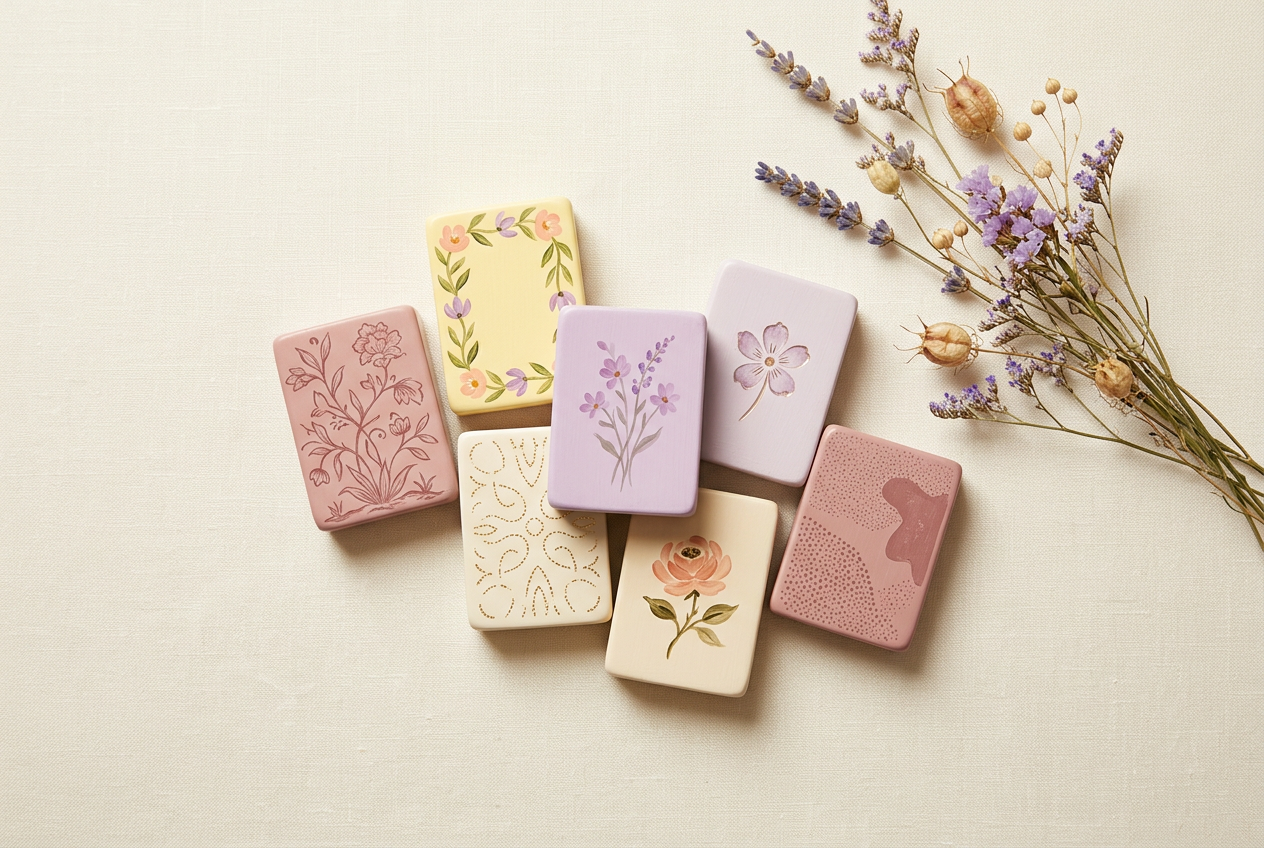
Prim would like to spend this section with the people who are designing the tile faces that you will be playing with for the next ten years, because the face of the American Mahjong set is in the middle of a quiet reinvention and the community has not quite named what is happening. For most of the last fifty years, the American Mahjong set looked more or less like the American Mahjong set had always looked. Traditional carvings. Standard colors. Recognizable but unremarkable. The last five years have changed this. A generation of designers has started treating the tile face as a canvas, and the results are some of the most aesthetically rich game objects on the market in any category.
Southern Sparrow's Chinoiserie work, under Jessica Roe's creative direction, is probably the most visible example of this shift. The tile faces carry hand-illustrated floral and botanical elements that feel at once traditional and completely contemporary. Prim would argue that Jessica has done more than any other single designer to demonstrate that a tile face can be a small work of art without losing readability at speed. The tiles are fast to read. The face is beautiful. Both things are true at once, which is harder than it looks, and the rest of the industry is studying her work whether they will admit it or not.
The Mahjong Line has taken a different approach, one rooted in color palette rather than illustrated detail. Their spring collection this year, and the Ranch Dusty Rose line in particular, has shown that the emotional register of a tile set can be shifted dramatically by chromatic choice alone. A set in the right tones does not feel like a traditional set in a new wrapper. It feels like a different kind of object. Prim has played on a Mahjong Line set recently and can report that the effect on the table is real. The game feels softer, warmer, slightly less competitive, entirely without losing the rigor of the tiles themselves. What the brand has done with color is design thinking, and Prim recognizes it.
Oh My Mahjong has been doing something subtler, which is reimagining the geometry of the tile face itself. The proportions, the typography of the numbers, the negative space around each symbol. These are choices most players never notice consciously but that register in the reading speed and the tactile satisfaction of the set. A well-designed tile face is the difference between a set you enjoy playing on and a set you barely register. Oh My Mahjong has been pushing the baseline of what a modern American tile face can look like, and their spring and summer drops this year have continued that work.
A fourth name Prim wants in your head. Bespoke Garden has been doing custom commission work on tile faces for clients who want something genuinely specific to their family, their home, or their taste. The commissioned sets run in the high four figures, which is not a price for everyone, but the craftsmanship is serious and the client base is growing. If you have ever thought about commissioning a set as an heirloom object, Bespoke Garden is the conversation to open.
The common thread across all four of these designers is that the tile face is no longer being treated as a neutral functional surface. It is being treated as the primary design object of the set, and the secondary design, the case and rack and accessory design, is being built to support the tile face rather than the other way around. Prim finds this development extraordinarily encouraging. The game is finding its contemporary visual voice, and the players who are buying these sets are voting with their dollars that they want the game to look like them, not like their grandmothers' mahjong closet. Both are valid. The range is healthy. Pick the set that looks like the table you want to play at, and do not apologize for the choice.
|
Prim keeps a small shop of her own. Printables, score cards, and a few things she is quietly proud of. 
|
SET YOUR RACK |
The cruise sails, Fever recaps, and the summer calendar opens further |
Mediterranean boarding is tomorrow.
Destination Mah Jongg's Mediterranean Cruise aboard the Celebrity Ascent boards tomorrow, and by the time you read the next issue, the first tournament sessions will be underway. For the players going, Prim wishes you smooth seas and steady tiles. For the rest of us, watch the hashtag. The photos will be unreasonably beautiful. The wall-in-the-Mediterranean shot is already a genre, and this year's crop will set the new standard for what a mahjong cruise looks like on social.
Mah Jongg Fever Las Vegas, three weeks later.
The Mah Jongg Fever tenth-anniversary event in Las Vegas finished three weeks ago, and the community pulse on it has settled enough for Prim to say something substantive. The consensus is that the event honored its decade well. The fields were large. The format ran cleanly. The anniversary programming, including the recognition of long-tenured Fever participants, struck exactly the right note. The community seems to be particularly appreciative of the way Fever has maintained a warmer, less intensely competitive culture than some of the other major tournaments. Several players Prim heard from described it as "the one where you actually make friends," and that is a reputation worth having in this community. If you missed Vegas, the Fever calendar has additional events throughout the year, including a late-summer resort event that is currently open for registration.
The next Fever on the calendar.
The next major Mah Jongg Fever event on the public calendar is a destination weekend in early fall, and Prim will say now what she said about the Mediterranean Cruise last week. The good destination events fill faster than you expect. If Fever's warmer culture sounds like your speed, and if you have been circling a destination event this year, the fall Fever is one to prioritize in your registration queue. Full details on the Fever website.
The summer local circuit is now visible.
Prim wrote about local JCC tournaments in Issues 7 and 8, and this week the spring and summer schedules are posting in larger numbers across major metro areas. Specifically, the Philadelphia Main Line circuit has opened four spring and summer dates, the Atlanta area JCCs have announced a joint tournament weekend in late June, the Bay Area Jewish Community Centers are running coordinated sessions through July, and South Florida is publishing its annual summer charity tournament calendar. The pattern Prim flagged in earlier issues is holding. The local circuit is robust. The destinations are the spires. Both matter.
One quiet note on the tournament economy.
Prim has been watching the price points of tournaments this year, and she wants to note a gentle trend. Entry fees at major destination events are edging upward, while entry fees at local JCC events have held remarkably steady. This is not a crisis, and the destinations are still worth their prices if the destination is the draw. But the widening gap between the two tiers is worth being aware of, particularly for players on a fixed budget who might otherwise default to a destination event without realizing how much more accessible the local circuit has become in relative terms. Prim will keep an eye on this and report as it develops.
| Boarding Tomorrow | Destination Mah Jongg Mediterranean Cruise Celebrity Ascent • May 15–25 |
| Open | Destination Mah Jongg San Diego Double Tournament San Diego, CA • June 5–7 |
| Open | Shriners Mah Jongg Tournament Austin, TX • June 20 |
| Open | Destination Mah Jongg Atlantic City Atlantic City, NJ • August 16–18 |
| Open | Mah Jongg Fever fall destination event Check the Fever site for dates |
| Open | Mah Jongg World Championship Paris Las Vegas • October 16–18 |
| Check Your Local JCC | Spring and summer local tournament circuit Philadelphia, Atlanta, Bay Area, South Florida |

|
CRAK INTELLIGENCE |
From bone and bamboo to acrylic, or the long history of the thing in your hand |
Here is a fact that Prim has been saving for the right issue, and this one is it. The tile you are holding in your hand right now, whatever it is made of, is the most recent chapter in a material history that goes back nearly four hundred years. Mahjong's predecessor games, and later mahjong itself, have been played with tiles carved from bone, bamboo, ivory, horn, shell, glass, Bakelite, Catalin, celluloid, polystyrene, urea, ABS plastic, and finally, in most modern American sets, acrylic. Each of those materials changed the game in ways the players who adopted them did not fully understand at the time. Prim would like to walk you through the arc, because the material is not incidental. The material is part of the play.
The earliest mahjong tiles, in the game's late-nineteenth-century Chinese form, were carved from bone, often in two layers, with a bamboo backing glued to the bone face. The craftsmanship was painstaking. A single set could take a skilled artisan weeks to produce. The tiles were heavy, beautifully tactile, and extraordinarily expensive by the standards of the time, which meant that the game was initially a pursuit of families who could afford artisan-made goods. The bone-and-bamboo aesthetic is what the Western imagination still associates with "authentic" mahjong, and there is something to that association. Many of the most beautiful vintage sets in collectors' hands today are bone and bamboo, and the feel of those tiles on a table is distinctive. They click differently. They warm to the hand differently. They are, in a word, alive.
The transition to American Mahjong in the 1920s coincided with a broader material revolution. Bakelite, one of the first synthetic plastics, had been invented in 1907, and by the 1920s it was being used in everything from telephones to jewelry to, yes, mahjong tiles. The American market in particular embraced Bakelite tiles because they could be produced faster, colored more boldly, and sold at a price point that let the game move from a curiosity to a mass-market phenomenon. The Abercrombie and Fitch sets from the 1920s boom, which Prim covered in Letter-03, were often Bakelite. The look and feel of those tiles defined what a modern American set was supposed to be.
Crisloid, based in Providence, Rhode Island, became one of the most important American producers of mahjong tiles in the mid-century period and remains a notable manufacturer today. Their tiles, made from a modern resin that descends aesthetically from the Bakelite era, have the density and clarity of color that longtime players associate with a serious American set. If you have a set that feels slightly heavier than a standard acrylic set, and if the colors have a certain saturation that is hard to replicate, there is a good chance you are holding something in the Crisloid family, or something inspired by it. Prim would like more players to know Crisloid by name. The company has been shaping the American tile aesthetic for longer than most contemporary brands have existed.
The shift to acrylic, which dominates the current market, happened gradually over the last forty years. Acrylic is lighter than the older resin-based tiles. It is easier to manufacture in high volumes. It takes paint and engraved detail well. It is, importantly, cheaper, which has allowed the modern custom-design renaissance Prim discussed in Tile Envy above. The designers working today can afford to iterate, prototype, and release limited runs precisely because the underlying material is accessible. The trade-off is that acrylic is slightly less weighted in the hand than the older sets, and some players prefer the feel of the older tile. Both preferences are valid. The point is that the tile in your hand is the product of a hundred years of material choices, and each choice has changed the play of the game in ways that are worth noticing.
The thing Prim wants you to take away from this section, beyond the history, is a small ritual. The next time you sit down to play, pick up a tile and hold it for three seconds before you set it in your rack. Feel the weight. Feel the surface. Feel the temperature, which will always be slightly cooler than your hand. You are holding a small piece of the long history of human craft, miniaturized into a two-inch rectangle, and passed through your life as part of a game that was being played before your grandmother was born. The tile has a history. The history is part of the game. The best discard is the one no one expects, and the tile you are about to throw is older than any of us, and will outlast most of what we do with it. Play with that awareness. It will change how you hold your rack.
|
Prim writes for the women at the table. The others who join us are also most certainly welcome. Everyone deserves a seat at this table.
| |||
|
Don't tap it, rack it, double stack it. | |||
|
Until next week, may your rack be blessed | |||
|
Prim, as always | |||
| |||
|
Forward this to your favorite fourth. |