
|
THE ORDER OF THE TILE | |||
| |||
|
Issue No. 19 | July 2026 | |||
|
"We have been watching." |
There is a particular hour in late July when the light goes long and gold and the day finally stops asking anything of you, and it is Prim's favorite hour to sit very still and simply notice. She has been doing a great deal of noticing lately. It is, if she is honest, the thing she does best. She watches who arrives and who lingers, who reaches for the last cold tile in the case and who reaches, first, to refill a neighbor's glass. She watches the whole quiet choreography of a good table, and she has come to believe it is the most underrated art in this game.
Because here is what Prim has decided, somewhere between the heat and the long light. To be watched, at the right table, is not to be surveilled. It is to be cared for. The hostess who notices your rack is a little too far from the light and slides the lamp your way. The three women who notice a fourth has gone quiet and gentle their teasing without a word about it. The old set that someone's grandmother watched over for seventy years so that you could hold it now. Attention, paid well, is simply love with better manners.
So pull your rack close, and let Prim tell you what she has seen this week. The woman who makes the whole evening possible before anyone sits down. The Providence workshop that has been making tiles by hand since before your mother held a card. The butterscotch sets keeping their long amber record of every hand they were ever played in. We have been watching. This week, we tell you what we found.
|
~Prim |
|
Prefer to listen? Prim reads each letter aloud on Spotify.
|
|
Between the Letters Today's Latest News A letter a week is never quite enough for a game moving this fast. The Dispatch is Prim's daily page, where the latest updates and announcements land between letters... the releases, the tournaments, and the stories the table is talking about, gathered and told the moment they happen.
|
|
Your seat is saved Come play between the letters Reading is lovely, but this game is meant to be played. Your newsletter email is already your key: tap below, ask for a one-time sign-in link, and you are in. No new password, no fuss. Start with the free Daily Tile, then see how far the rest of the table carries you.
|
THE DRAW |
The Order's own table opens its doors |
 |
Prim has news this week, and for once it is not gossip carried in from someone else's table. It is happening at ours. This week the Order played its very first group game live, all together, on our own table, and Prim is not too proud to admit she got a little misty watching the tiles go round. Everything the Order has been quietly building toward for months came down to a few women, a shared evening, and the click of a hand being built on a screen. Reader, it worked. It really, truly worked.
Let Prim tell you what she loves most about it, because it is the whole idea. This is not a stranger-lobby where you are flung at three faces you will never meet again. The Order's table is built for pockets, small gatherings of the people you actually like to play with. You make your circle, you post a game for a time you can all manage, and the table does the quiet work of gathering everyone. When the hour draws near, the little bell in your navigation menu lights up, about ten minutes ahead, with the time and the way in. You tap it, and the moment your table hostess opens the table, you are through the door, rack in front of you, friends across the felt. It is the Thursday game, made to travel any distance at all.
One more delight while Prim is boasting. The table no longer sets a single card. We have added the Big Card, the Mahjong Press card, and the American Mahjong Society card to the games, so you can wander into a little variety whenever the mood takes you, and for the sentimental among us, last year's card is still laid out too, because some of us are simply not ready to part with a favorite hand.
And because Prim promised you long ago that she would always tell you precisely how things stand, here is the honest part. It is new, and new things wobble. We built it for the phone first, because that is where your life actually happens, and we are still listening hard for what needs mending there, still hungry for your feedback on how the game feels in your hand. We find the odd small bug and fix it about as fast as we find it. Prim will confess one from this very first game, because it is too good not to. A small hiccup kept one player from calling her mahjong during a turn she had rightfully earned. She was gracious about it. In fact, she was silent about it because she knew speaking loudly would have consequences. And then, the very next turn, she called it clean and won the whole thing outright, which Prim chooses to read as the tiles apologizing in the only language they speak. We are mending as we go, and the thing is, at last, starting to find our feet.
So this is Prim's invitation, plainly given. The table is real now, it is ours, and it was built for exactly the people you love to play with. Gather your pocket. Post a game. Watch for the bell. Come and play with us.
CRAK THE CARD |
Why the tiles keep steering you to three, six, and nine |
Prim is going to tell you something about the 369 section, and she is going to tell you because the woman who holds this pen confessed a suspicion Prim intends to examine honestly. She said she leans toward 369 more than any other section, that it always seems to be sitting in her hand, and then, being an honest sort, she wondered aloud whether that was simply luck. Here is the fair answer. The part where the tiles happen to land in your rack, that is luck, and Prim will not pretend otherwise. But the six that keeps arriving with them is another matter entirely, because the six is the single most useful number the card has, and a rack that keeps finding it is being handed a quiet advantage it would be a shame to waste.
Here is the arithmetic behind the instinct. The six turns up in more hands than any other number, across nearly every number-bearing section. It can be pressed into thirty-nine of the card's fifty-five lines... more than two in every three. And once you count every way a six can be worked into those hands, the flexible "any number" and "any like numbers" lines very much included, the people who tally these things for a living reach four hundred and forty in all... sixty-one more than any other single tile can claim. So a rack that quietly gathered a few sixes in the opening hands did not get lucky in the way that word usually means. It landed on the most well-trodden tile the card has, and it is being pulled, correctly, toward the section built to make the most of it. When 369 keeps turning up in your hand, the card is not teasing you. It is pointing.
Now the hard truth, because Prim does not flatter. The 369 section is the most rigid on the card. Six lines, and the numbers never move, three and six and nine and only those, with none of the polite substitutions the other sections allow. Even Jessica of Southern Sparrow admits the section does not "jump" for her the way the others do, and she is right that it asks for commitment rather than rewarding a wanderer. This is a section you decide on, not one you drift into. If your rack arrived with the sixes, you commit and you hunt with purpose. If it did not, no section on the card punishes a half-hearted entry more coldly.
But here is the move Prim loves best, the one the pen-holder found on her own and wins with again and again. When you are holding your threes and sixes and nines and the lines simply will not come together, do not mourn them. Quints may be your next best address, depending on what else you are holding. And if you are in the mood for a genuine challenge, look one section over, to Singles and Pairs, at the concealed 369 mirror... a pair of each number, each pair in its own suit, every tile natural, not a joker anywhere, and fifty points for your patience. It shares its very skeleton with the concealed line back in the 369 section. The two are, quite literally, the same rack's two resting places. You are not abandoning your hand. You are changing its address.
Now, Prim will not sell you a fairy tale, and here she must correct a tempting half-truth, because the real answer is the better one. A concealed hand cannot call. Not one tile off the table until the tile that wins, which means every three, six, and nine of it must arrive by your own draw or through the Charleston. That is a genuine cost, and the exposed hand, free to snatch its pungs from three opponents' discards, does not pay it. So the mirror is not simply "easier." It wins for you for two honest reasons and one that is almost a secret. First, you never build it cold, you land on it, choosing it only once your rack has already drifted close, which is precisely the discipline the line demands... commit when you arrive close, never as a rescue. Second, among the hands you must draw entirely yourself, singles and pairs are the kindest, for a pair wants only one more friend and a single wants none at all, while a concealed pung wants two more copies no one is permitted to hand you. And here is the secret that turns a clever pivot into the correct one. The six is the most hoarded tile on the whole card. Hold your sixes, the section teaches, and everyone has learned it, so the very discards you would need to call for an exposed 369 are the ones no table will ever release. The callable road is closed in this section before you take a step on it. Drawing the hand yourself, concealed, is not the harder path here. It is the only open one, and it pays fifty. So hold your sixes, respect the rigidity, and keep the concealed mirror in your back pocket as the elegant escape it was always designed to be.
THE TABLE IS ASKING |
The woman who sets the table before anyone sits down |
The question came in wrapped, as the good ones are, in a small resentment its author had not quite admitted to herself. A reader wrote to say she is always the hostess. Always her house, always her card table dragged from the closet, always her good glasses and her ice and her extra rack for whoever forgot theirs. She does not mind it, she wrote. And then, in the very next line, she rather clearly did. Was it wrong, she wanted to know, to wish that just once someone would notice everything it takes to make a table happen?
|
"Was it wrong to wish that just once someone would notice everything it takes to make a table happen?" |
It is not wrong. It is overdue. And Prim intends to say the quiet part at full volume.
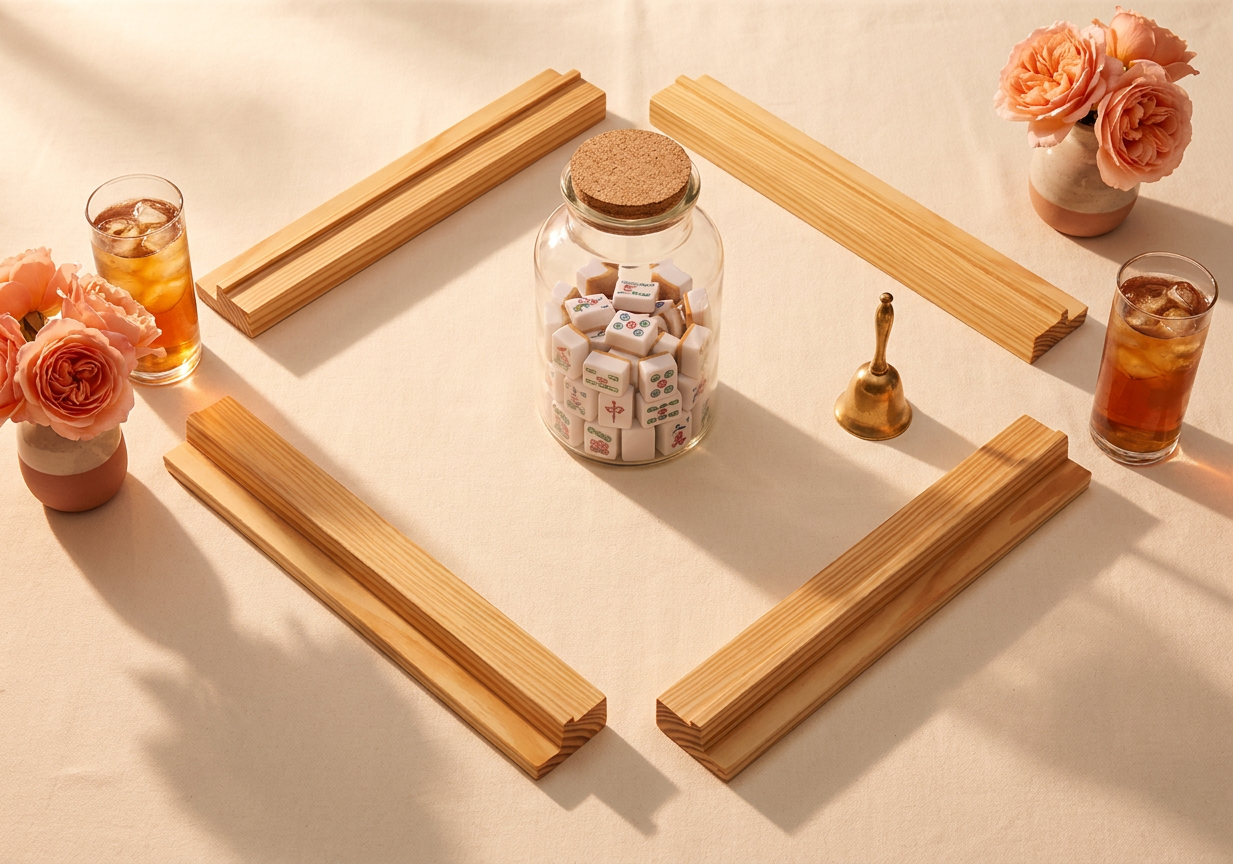
The hostess is the most watched and least seen woman at any table. She is watched constantly... every guest, whether she knows it or not, takes her cues from the woman whose house it is, whether to relax, whether the teasing is safe tonight, whether the newcomer will be folded in gently or left to fend. And she is seen almost never, because a hostess does her real work before the first tile is turned and between every hand thereafter, in a hundred small motions no one is meant to notice. The chair angled so the sun stays out of a guest's eyes. The beginner seated beside the kindest player, never the sharpest. The snacks that appear and vanish and reappear as if the house simply produces them. A great hostess makes an evening feel like it happened on its own. That is the entire illusion, and it is exhausting to maintain, and Prim is tired of watching it go unremarked.
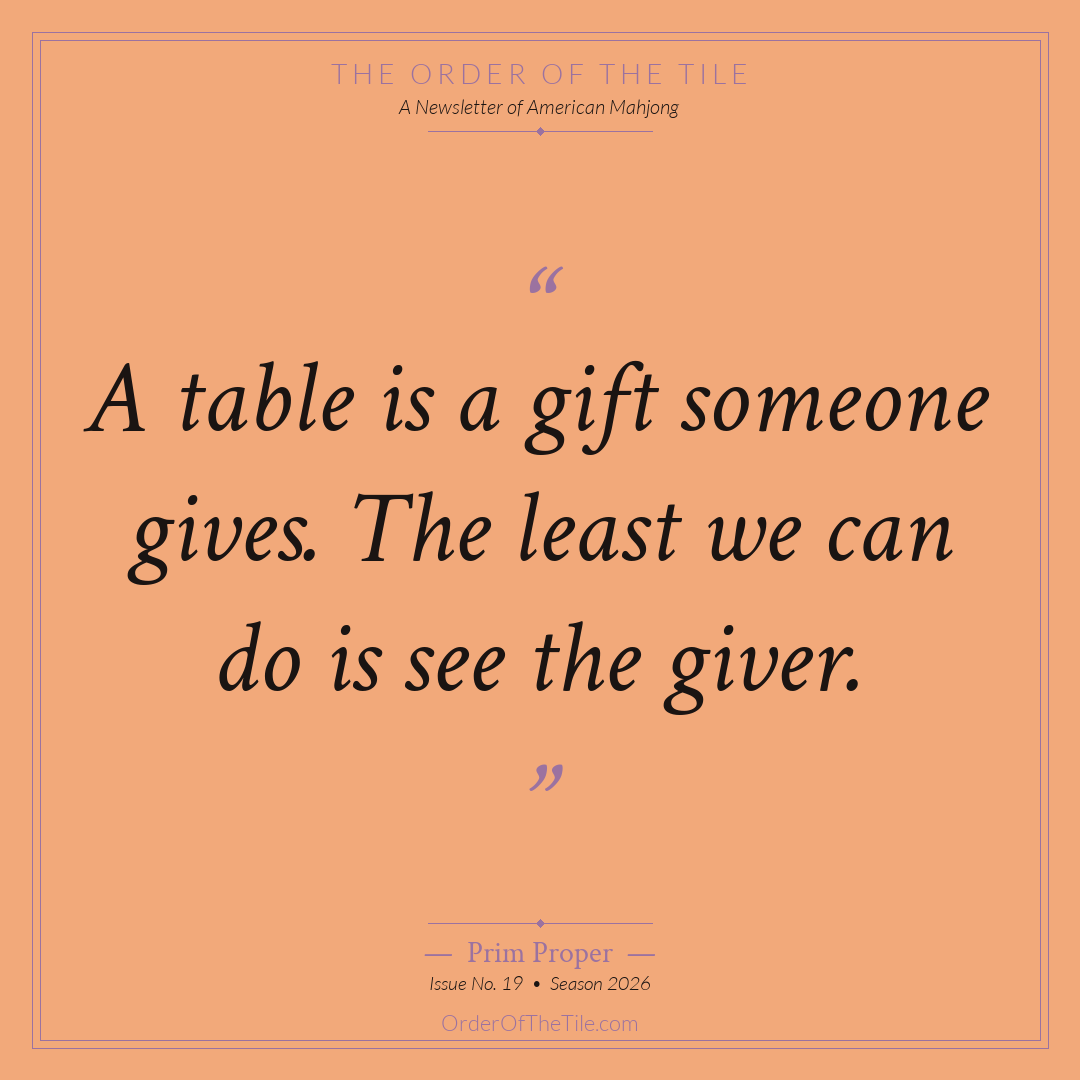
So Prim's ruling is in two parts, and she means both. To the hostesses: stop apologizing for the size of the thing you are doing. You are not "just having people over." You are building the room in which this whole friendship happens, week after week, and there is no version of this game that survives without you. Set the table the way you like it, ask for the help you actually need, and let someone else bring the wine without insisting they shouldn't have. And to everyone lucky enough to be hosted: watch her the way she watches you. Notice who refilled your glass. Notice whose ice it is. Bring something, offer something, and at least once this summer, say the sentence she has been waiting years to hear... let me host next time. A table is a gift someone gives. The least we can do is see the giver.
Bring that to your own game this week. And if you are the one who always hosts, forward this to the three who never do. Prim will take the blame.
WHO'S TALKING |
The house that has been watching over the craft since 1948 |
 |
In an issue about who has been watching, Prim would be remiss not to tip her hat to a house that has been watching over the actual tiles longer than most of us have been alive. While so much of the world found its way to mahjong in the years since the pandemic, a small workshop in Providence, Rhode Island has been quietly making the things since 1948, by hand, in America, without a single viral moment to its name. Prim finds that kind of persistence more impressive than any follower count, and this week she wants you to know their name. It is Crisloid.
The story has the shape Prim loves. It began not in a boardroom but in 1940s Brooklyn, at a little concern called A and L Manufacturing, run by two men named Alphonse and Lucky Lodato, which is very nearly too perfect a name for a game-maker to be real, and yet there it is. In 1970 a Rhode Islander named Chris Ruizzo bought the company and carried it north to Providence, where it has stayed and where it still is, on Porter Street, turning out backgammon and cribbage and dominoes and, of course, the tiles that concern us. It is the kind of American workshop everyone assumes no longer exists, and it does, and it has been minding its craft the whole time you were not looking.
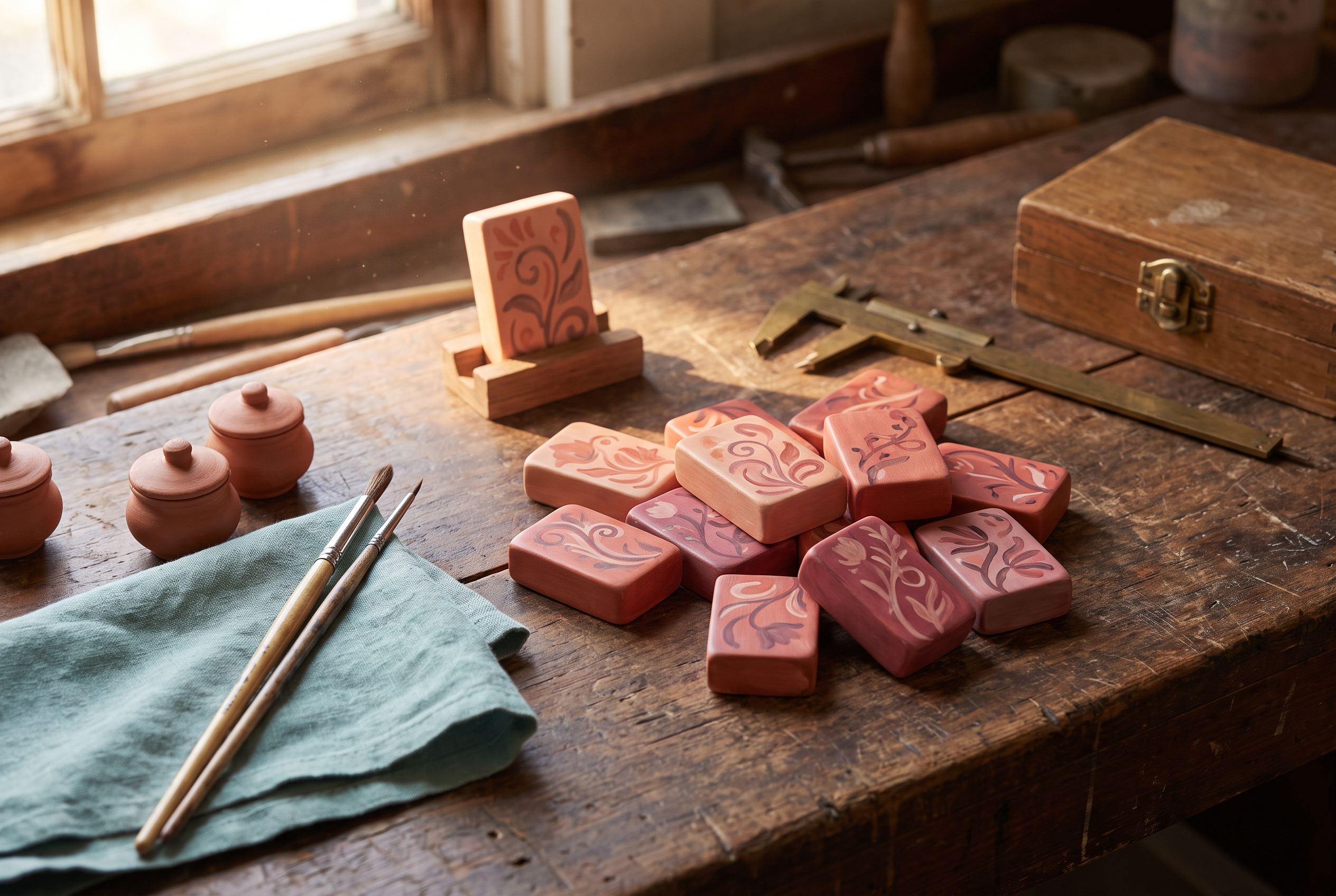
Here is the part that earns the feature in this particular issue. Crisloid still hand-paints every tile in its full sets, one at a time, by actual people in an actual room. And its lineage runs straight through the material this week's Crak Intelligence is about... the old Catalin, the Bakelite-family resin that ages into butterscotch, the very stuff the most coveted vintage sets are made of. Collectors hunt the old Crisloid Catalin sets for exactly that reason. So when Prim tells you this house has been watching over the craft, she means it with a collector's precision: the amber tiles in your grandmother's case and the sets coming off the Providence bench this month belong to the same unbroken story.
They are not cheap, and Prim will not pretend otherwise, nor should they be. The range runs from a genuinely portable travel set at around four hundred dollars to heirloom-grade sets that ask the better part of three thousand, with in-house designs and the occasional collaboration with an outside artist for those who want something singular. But you are not buying a commodity. You are buying a thing a person made with their hands, in a country that mostly stopped making such things, in a workshop that intends to still be there when your granddaughter opens the case. In a season of disposable everything, that is its own quiet radical act.
So if you have been coveting a set with a real provenance, one that will age the way the good old ones did and carry your evenings in its color, go look at what Providence is making. Find them at crisloid.com, and tell them Prim sent you, because a house that has kept faith with the craft for seventy-eight years deserves to know that we have been watching too.
TILE ENVY |
Beauty that was never afraid of the water |
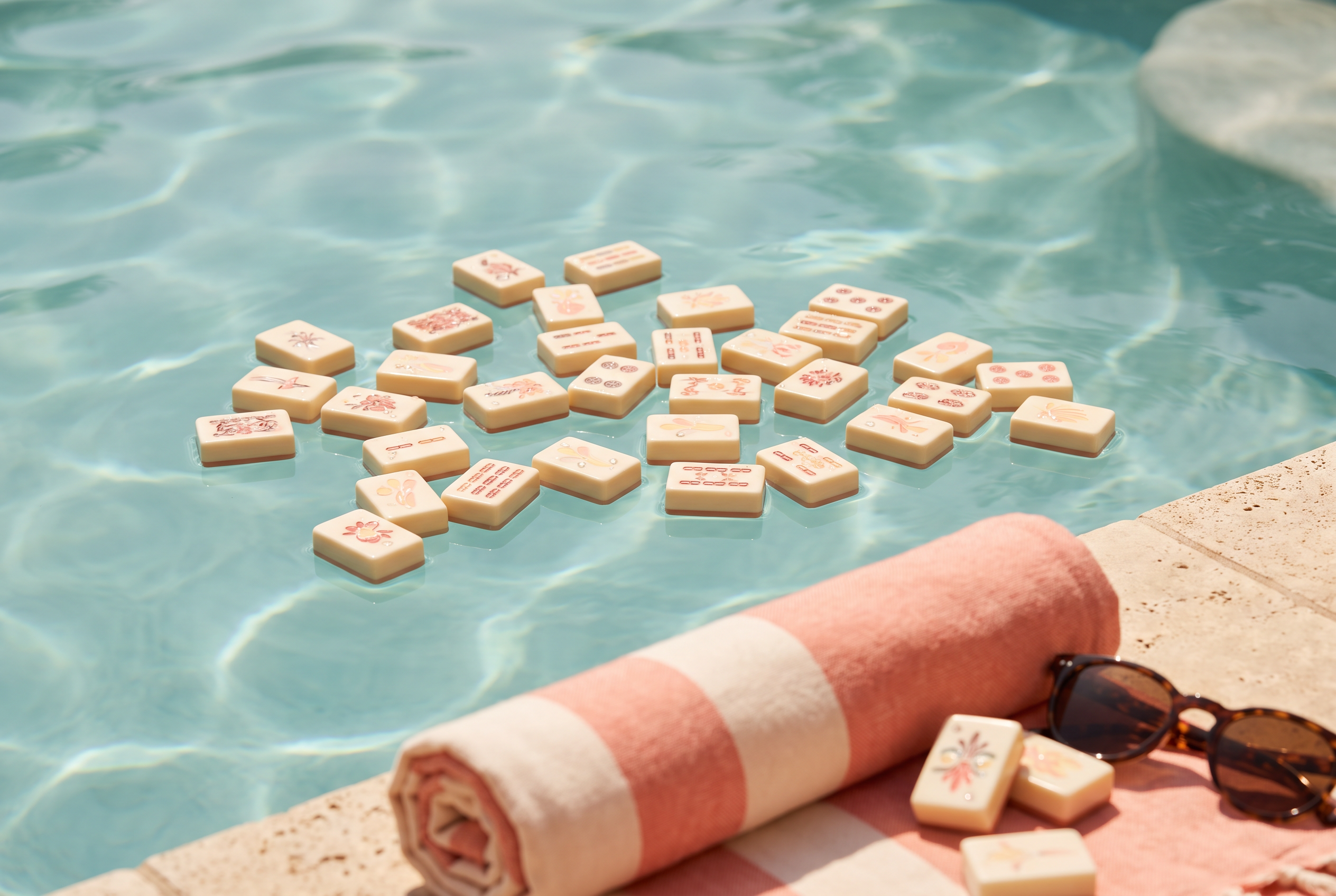 |
Prim has a confession suited to the season. She loves a set that is a little braver than she is. The four-figure lacquer stays home in July, watched over and adored and quietly terrified of a spilled drink, while summer belongs to the tiles that are not afraid of the world. And this year the loveliest of those do the unthinkable and the elegant thing at once. They float.
Her eye went first to the Tropical Edition from That's Mahj, out of that sun-soaked stretch of the Florida coast, because a floating tile has no business looking this good and these do. A full American set, jokers and all, in colorways named like cocktails, Magenta Pink and Vibrant Blue and Kelly Green and Mystic Purple, and here is the detail that won Prim over. They keep the sound. The real click, the one your hands know, the one that tells you a hand is being built. A set that can ride the surface of a pool and still shuffle like a proper set is a small marvel, and at a hundred and eighty dollars it is the kind of marvel a person actually buys.
And because Prim cannot help herself, one flourish. The Mahjong Line has gone and made a floating game table, a buoyant thing with grooves cut for your tiles and holsters cut for your drink, so the whole game can drift in the shallow end while you do nothing more strenuous than win. It is neither cheap nor necessary, which is precisely the point of a flourish. And if your budget prefers modesty, the plain foam sets can be had for the price of two nice lunches and they float just as faithfully. But whichever you choose, choose the one you will actually carry to the water. A set that follows you to the pool is a set that has been watching you have a good summer, and that, to Prim, is the only kind of beauty worth coveting in July.
SET YOUR RACK |
Where the game meets the shoreline |
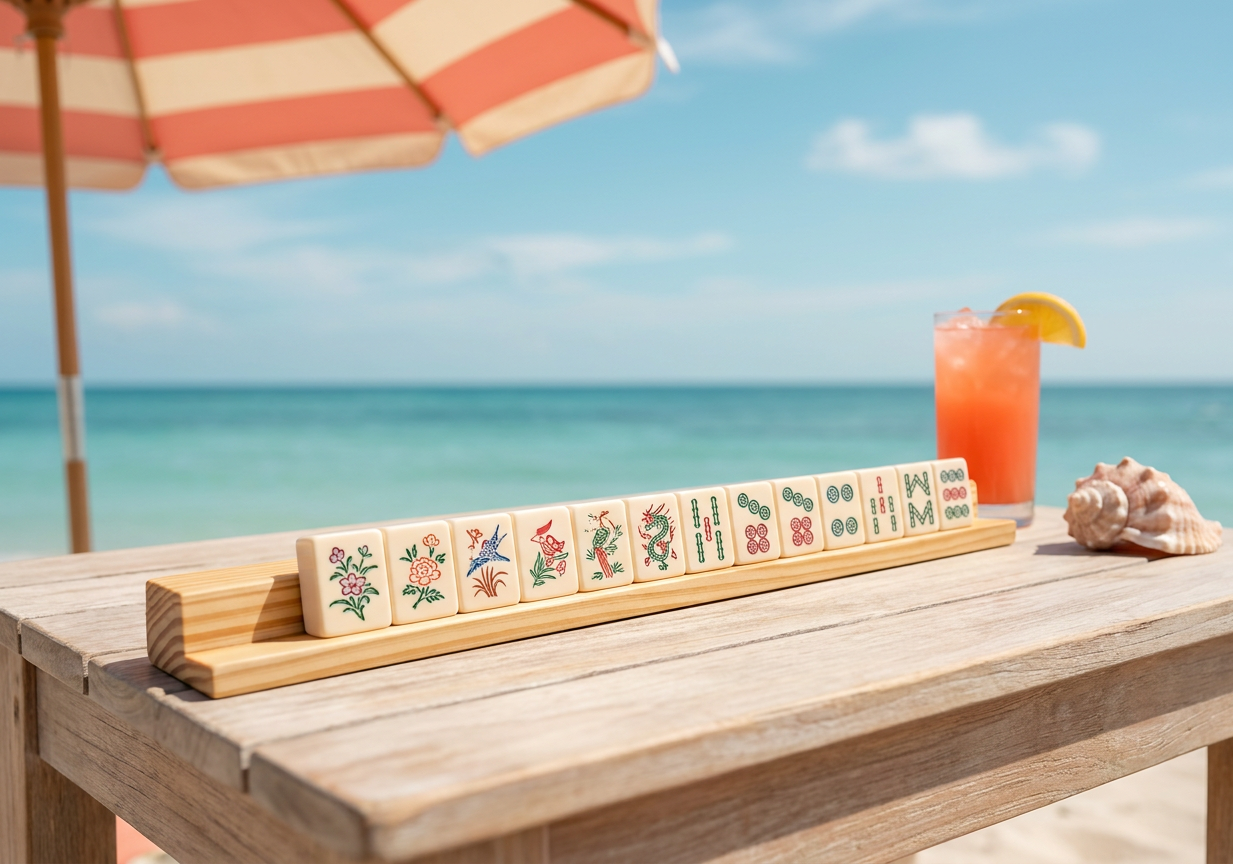 |
Some tables come to you. Some tables ask you to pack a bag, put on something you can play cards in and still walk a boardwalk in, and go find the game where the air is better. This week Prim wants to talk about the second kind, because summer is short and the shoreline is calling and there is no rule that says the best hand of your year has to be played indoors.
If Prim were to choose where to lose a whole glorious week to this game, she would choose the water, and this autumn the water has a very specific address. Crak Your Bags and Mah Jongg Fever have taken over the Celebrity Beyond for a seven-night Caribbean sailing, the fourth through the eleventh of October, and laid the tiles out where the Caribbean does its finest work. Picture it honestly. Two full days at sea given over to proper seven-round tournaments, every other idle hour dotted with ten-dollar minis, and in between the ship simply sets you down at Perfect Day on CocoCay, then Cozumel, then Grand Cayman, then Nassau, as though the entire itinerary were built to alternate a good hand with a good beach. Prim does not use the word paradise loosely. She is using it now.
And here is the honest part, because Prim always tells you how things stand. The tournament at sea is already sold out. Do not despair. A waiting list is open, and the more useful truth is that the tournament was never the whole point of a week like this. The sailing still welcomes you, the minis run from embarkation to the last night, and a table of four you adore plus a balcony plus a Grand Cayman sunset is a finer prize than most trophies gathering dust on a shelf. Book the cabin through Crak Your Bags, put your name on the tournament list in case a seat opens, and let the rest of it arrange itself around you.
|
|
CRAK INTELLIGENCE |
The tiles the color of a held breath |
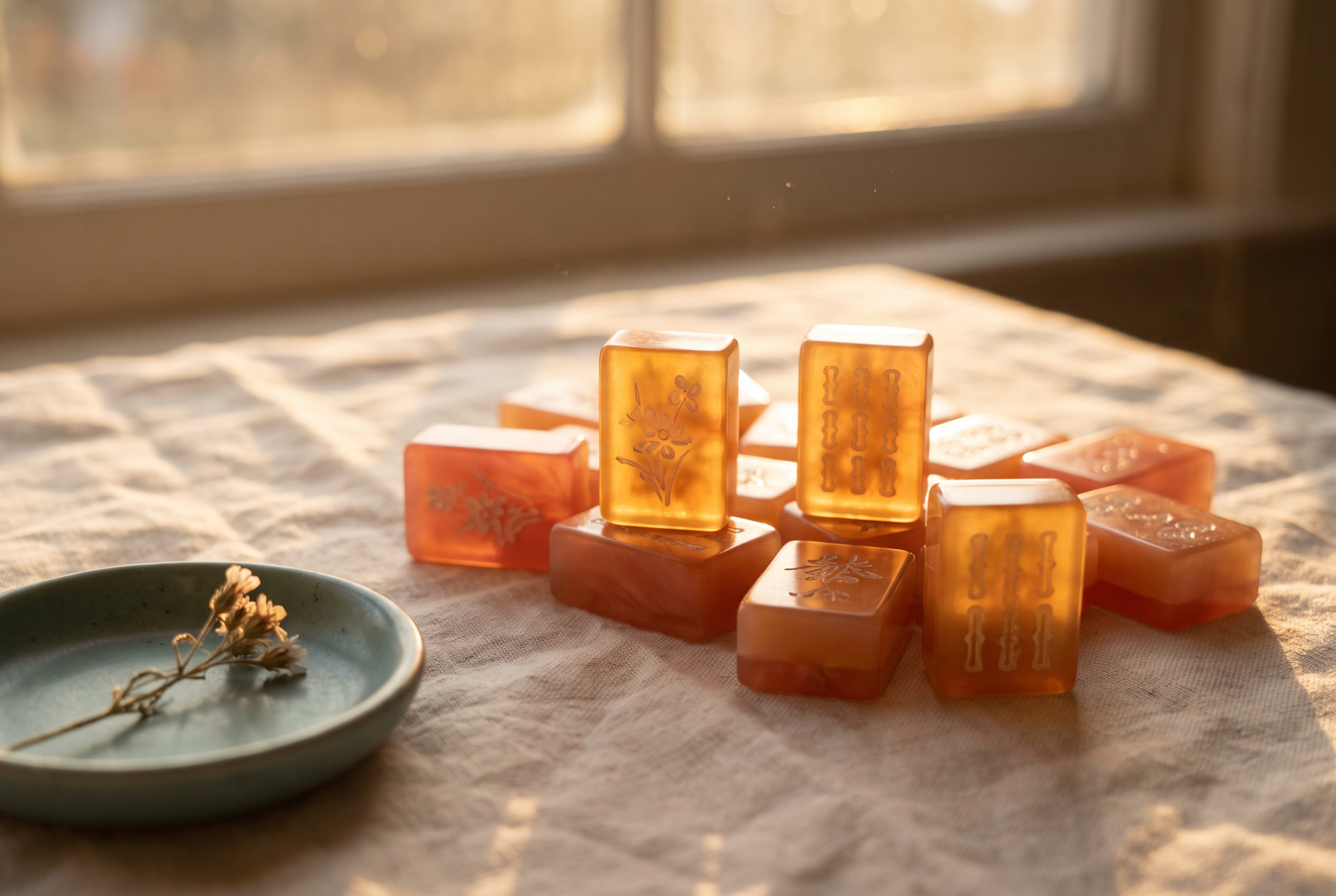 |
Here is something to carry to your next table, in the low voice Prim saves for the things worth knowing. Some of the most beloved tiles ever made were an accident of chemistry, and if your grandmother's set glows the warm amber of good whisky when you hold it to the light, you may be holding a small piece of the twentieth century's strangest, loveliest mistake.
Bakelite arrived in the early 1900s as the world's first true synthetic plastic, invented for insulators and telephone casings and all manner of unglamorous things. But somewhere in the 1930s and into the 1940s and 50s, it found its way into mahjong tiles, and something magical happened. The material aged. Exposed to years of light and air, the pale creams and butter-yellows deepened, slowly, into the rich translucent amber that collectors now call butterscotch... a color no factory set out to make, a color that is quite literally the tile remembering every afternoon it was ever played in. No two butterscotch sets are the same shade, because no two sets lived the same life. The color is a diary.
That is why Prim finds these tiles almost unbearably romantic, and why they command what they do among collectors who know. A butterscotch tile has been watching over this game since before most of us were born. It passed through hands we will never meet, at tables in living rooms and resorts and kitchen nooks, warming a half-shade richer with every hand. When you play a set like that, you are not just playing mahjong. You are the newest entry in a very long book, and the tile is keeping the record. We have been watching, the old sets seem to say. Go on. Make an afternoon worth remembering. We will hold onto it for you.
A CLOSING NOTE |
The table taught its lesson again this week, the way it always does, from every direction at once. It taught it through the hostess we forget to thank and through the amber tiles keeping their long quiet record. The lesson is the same one Prim keeps circling because it is the truest thing she knows. To pay attention to someone is the plainest form of love we have. The table is simply the place we practice it, one noticed glass and one refilled rack at a time. Prim has been watching you all season, and she likes very much what she sees.
Prim writes for the women at the table. The others who join us are also most certainly welcome. Everyone deserves a seat at this table.
| |||
|
Don't tap it, rack it, double stack it. | |||
|
Until next week, may your rack be blessed | |||
|
Prim, as always | |||
| |||
|
Forward this to your favorite fourth. |