
|
T H E O R D E R O F T H E T I L E | |||
| |||
|
Issue No. 11 | May 2026 | |||
|
"Nothing at the table escapes notice." |
My Dearest Table Guests,
Prim is writing this on the Thursday after Memorial Day, and she wants to thank you, plainly and without fuss, for the way the community carried last week. The responses to last week's issue have been unlike any response Prim has received in these pages. A reader in Tennessee wrote to say that she lit a candle at her Thursday game and cried with her tablemates for the first time in twenty years. A reader in Massachusetts told Prim about the specific Gold Star pin her mother wore to every game until she died. The inbox was heavy. Prim may not be able to reply to every one of those letters, but she would like you to know that she read every single one. Thank you for trusting her with what you wrote. The table held.
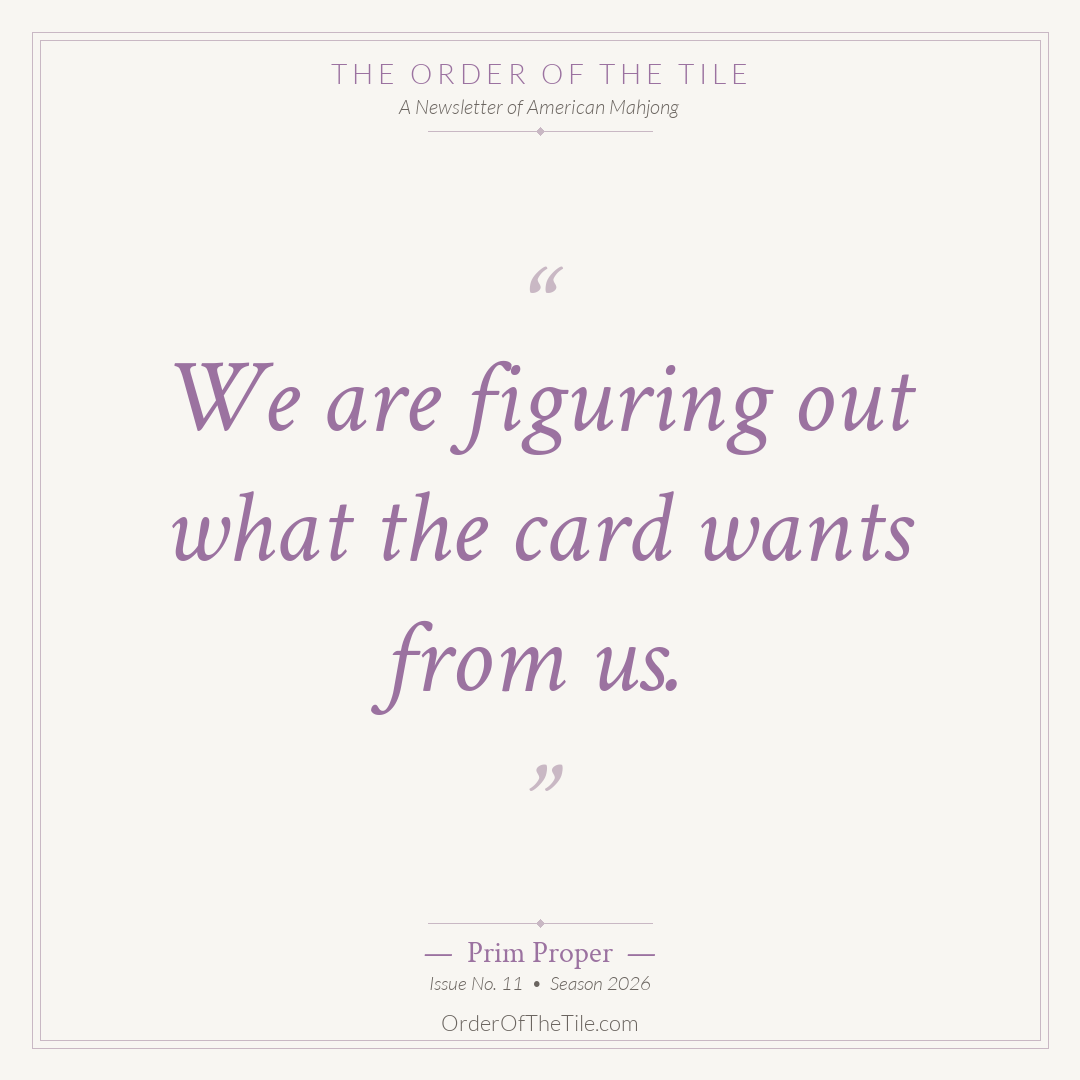
Now. The calendar moves. The Mediterranean Cruise photos have finished scrolling, the summer arc of the season begins in earnest, and the card that Prim has been writing about for ten weeks is finally, truly, settling into the community's hands. People are winning with it. People are losing with it. People are developing opinions about which sections reward which temperaments. The conversation has matured in a way that it had not yet by April. We are no longer figuring the card out. We are now figuring out what the card wants from us, which is a different and more interesting question, and this issue is about sitting with that question.
The tagline this week is the one Prim has been holding for months, because it is the one she most wants you to understand. Nothing at the table escapes notice. The game is an information game, and every player at the table is producing information constantly whether she intends to or not. The player who becomes excellent, over time, is the player who tunes her attention to the signals other players are unconsciously emitting. This issue is about noticing, and about being noticed, and about what to do when you realize one of your regulars has been reading you for longer than you realized.
|
We will talk about the Winds and Dragons section, which is the 2026 card's power-pattern category and which rewards exactly this kind of patient attention. We will talk about the tablemate who has figured out your patterns and what to do about it. We will meet a woman who quietly shaped this game from behind a desk for nearly three decades. We will look at the automatic mahjong tables that are slowly creeping into the American market. And we will tell the story of the first woman to host a mahjong television show, in 1951, because she was doing the work of broadcasting this community before most of us had been born. Pull up your chair. The wall is built. Let us begin.
~Prim |
|
Prefer to listen? Prim reads each letter aloud on Spotify. 
|
THE DRAW |
The summer arc opens, and the community exhales after a heavy week |
The community mood this week is what Prim would call restored quietness. Last week was heavy, and beautiful, and the right kind of heavy for that weekend, but a community cannot live at that register for long. The Facebook groups this week have rebalanced back toward their usual rhythms. Set photos are returning. Card debates are sparking again. A new argument about Charleston optionality flared briefly on Tuesday and then resolved itself by Wednesday morning, which Prim would note as a sign of a community that has regained its footing. The week did what weeks in this community do. It moved on, without forgetting what came before.
Two developments worth flagging in the wider community. First, registration for the midsummer and early fall events has visibly accelerated in the last seven days, which is the post-Memorial Day bump Prim has seen in every year she has been paying attention to the calendar. Players tend to think about summer and fall commitments after Memorial Day, not before. The registration managers know this. If you have been waiting to commit to a fall event, the next two weeks will be the decision window for many of the good ones. Set Your Rack below will have the particulars.
Second, the Mediterranean Cruise debrief has begun. Players are home, unpacked, and posting their thoughts, and the consensus on this year's cruise is that it was one of the strongest destination events in recent memory. The onboard tournament structure was praised almost universally. The ship's staff accommodated mahjong-specific needs gracefully. The ports of call offered genuinely beautiful playing backdrops, and a cluster of players have started circulating a rack-on-balcony-in-Santorini photo that Prim would call the single best piece of mahjong photography produced so far this year. The cruise circuit, as a format, has matured substantially in the last three or four years. It is no longer a novelty. It is a legitimate category, and the community is treating it as one.
One small community-pulse note. The Facebook groups have been quietly debating the etiquette of the mahjong table camera, meaning the question of when and whether to photograph a game in progress, and whether the rack photo crosses any lines in certain settings. Prim has opinions on this that she will save for a future issue. For now, the debate is worth reading. It reveals a community that is growing more aware of its own documentation, which is a healthy thing for any community to become.
|
Did this letter arrive by way of a friend? Prim would love to add you to the list. 
|
CRAK THE CARD |
The Winds and Dragons section, or the power patterns that reward disciplined players |
Prim has been circling the Winds and Dragons section for weeks, and she is going to give it the Crak the Card treatment this issue, because it is one of the most interesting and one of the most misunderstood sections on the 2026 card. A certain kind of player loves the Winds and Dragons hands. She sees the high point values, the dramatic exposures, the satisfying completion, and she chases them with enthusiasm. A different kind of player, usually a more experienced one, treats the section with cautious respect, plays it only when the deal invites it, and never forces it. Prim is firmly in the second camp. Let her walk you through why.
The section is about supply more than it is about strategy.
Here is the core truth about Winds and Dragons hands on any card, and on the 2026 card specifically. These hands depend on a tile supply that is structurally limited. There are only four of each wind tile in the set, and only four of each dragon tile. If you are building a Winds and Dragons hand that requires, for example, three North winds and three Green dragons, you are competing with the rest of the table for a supply that is already thin. The flowers are similarly limited, and while flowers are ubiquitous in supporting roles, the core winds and dragons are the hardest tiles to aggregate in the quantities these hands require. This is not a section where you succeed through cleverness. This is a section where you succeed when the deal, the Charleston, and the wall cooperate. If they do not cooperate, no amount of strategic play will rescue the hand.
The read on your deal happens immediately.
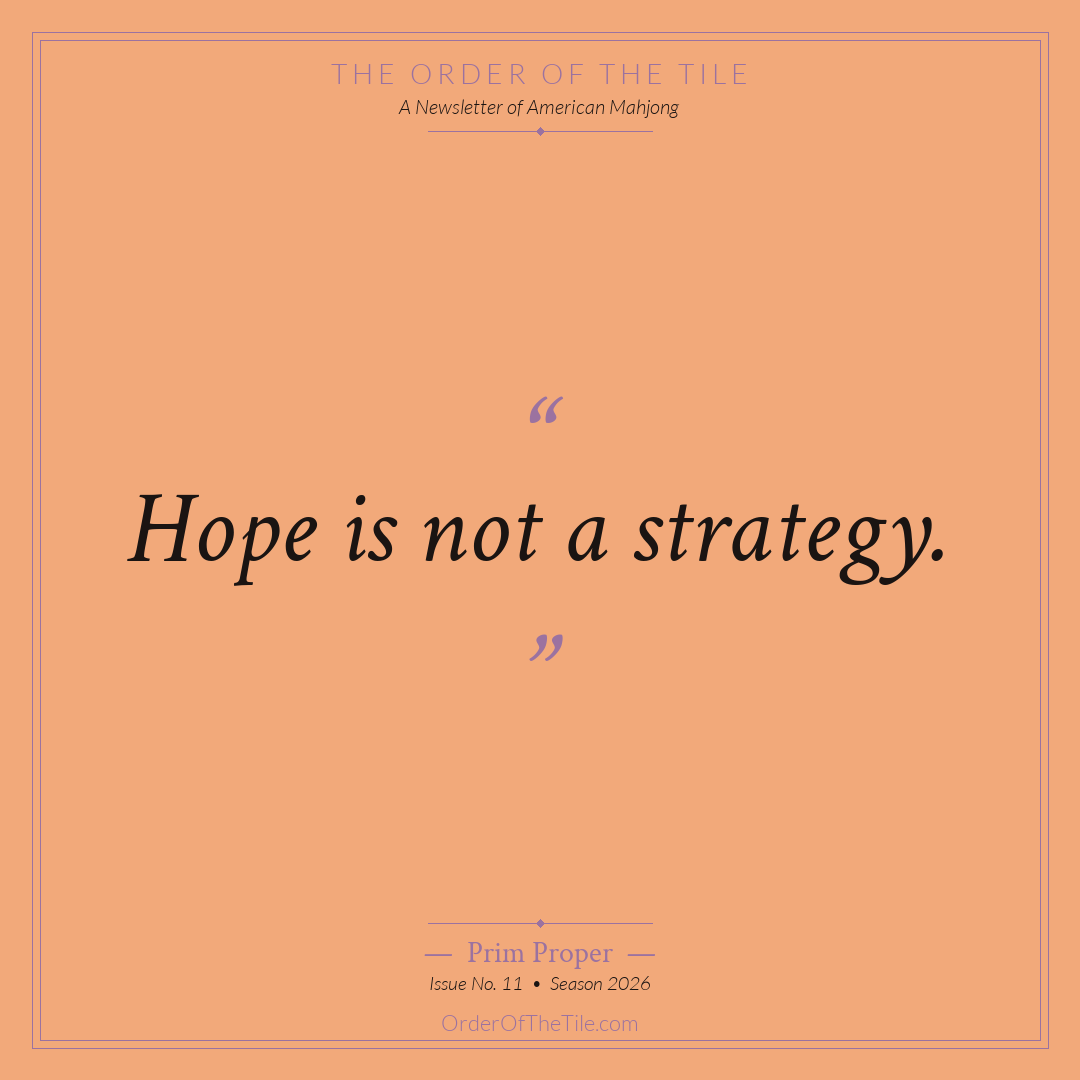
The decision to enter the Winds and Dragons section has to happen earlier than the decision to enter almost any other section on the card. The reason is tile scarcity. If you are going to commit, you need to be collecting, holding, and calling for winds and dragons from round one, because waiting until round three to decide means that half the tiles you need have already been thrown. The Charleston is your earliest and most honest indicator. If the Charleston is bringing you winds and dragons, you are being invited. If the Charleston is bringing you predominantly numbered tiles and flowers, the wall is telling you to build elsewhere. A player who forces a Winds and Dragons hand when the Charleston has not delivered is a player who is, to be blunt, hoping. Hope is not a strategy in this section. Accept what the wall gives you, and pivot without regret.
|
Dragon management is the subtle skill.
Once you are committed to a Winds and Dragons hand that involves dragons, the next challenge is managing the joker interaction carefully. Several of the Winds and Dragons hands on the 2026 card involve specific dragon counts, and jokers can substitute for dragon tiles under most conditions. The subtle strategic question is whether to use a joker to complete your dragon count early, locking in the value but exposing your intent, or to hold jokers in reserve while you try to aggregate natural dragons for a closed or partially closed version of the hand. Experienced players tend to hold the jokers longer than newer players do. The reason is that a joker exposed in a dragon pung is a joker that can be called by another player who has a natural dragon to swap for it, and in the Winds and Dragons section, those joker calls can be devastating late in the game. The move that looks strong in round three can become a liability in round seven. Hold jokers. Aggregate naturally where you can. Expose only when the timing forces it.
The defensive read is the other half of this section.
A final principle that most strategy discussions of this section skip. Even when you are not playing a Winds and Dragons hand yourself, you need to be watching for the player who is. The signals are distinct. A player who is aggregating winds and dragons tends to hold them in her rack without exposing for longer than a player in a numbered-tile section. A Charleston that sees winds and dragons disappear is one to pay attention to. Early discards are heavily skewed toward numbered tiles of multiple suits. Winds stay concealed and are not the early choice for release. She tends to pick and pause on any wind or dragon that surfaces in the center of the table. If you notice two or three of these signals in the same player, assume she is in the section, and adjust your own discard strategy accordingly. Do not throw loose winds or loose dragons late in the game. Do not pass a loose dragon in the Charleston if you can avoid it. The Winds and Dragons player is often quiet until the moment of her call, and her call is often on a tile the rest of the table threw carelessly. Do not be the player who carelessly feeds her. Read the table. Adjust. The section punishes inattention in both directions.
THE TABLE IS ASKING |
The regular tablemate who has read your patterns, and what to do about it |
The question this week came from a player who asked to be identified only as a longtime Thursday regular, and Prim thinks it is the best question she has received in a month.
|
"I have been playing with the same three women for eleven years. Over the last year, I have started to notice that one of them is beating me more often than she used to, and I think I have figured out why. She has read my patterns. She knows when I am building 2468 hands versus Consecutive Runs hands based on how I arrange my rack in the first Charleston. I am not imagining it. What do I do? I cannot confront her. I also cannot keep losing." |
Prim has thought about this question carefully, because it is the kind of question that touches on the deepest etiquette of long-term tablemates, and because it is also a real strategic problem with real solutions. Let her give you a three-part answer.
Part one: she has not done anything wrong.
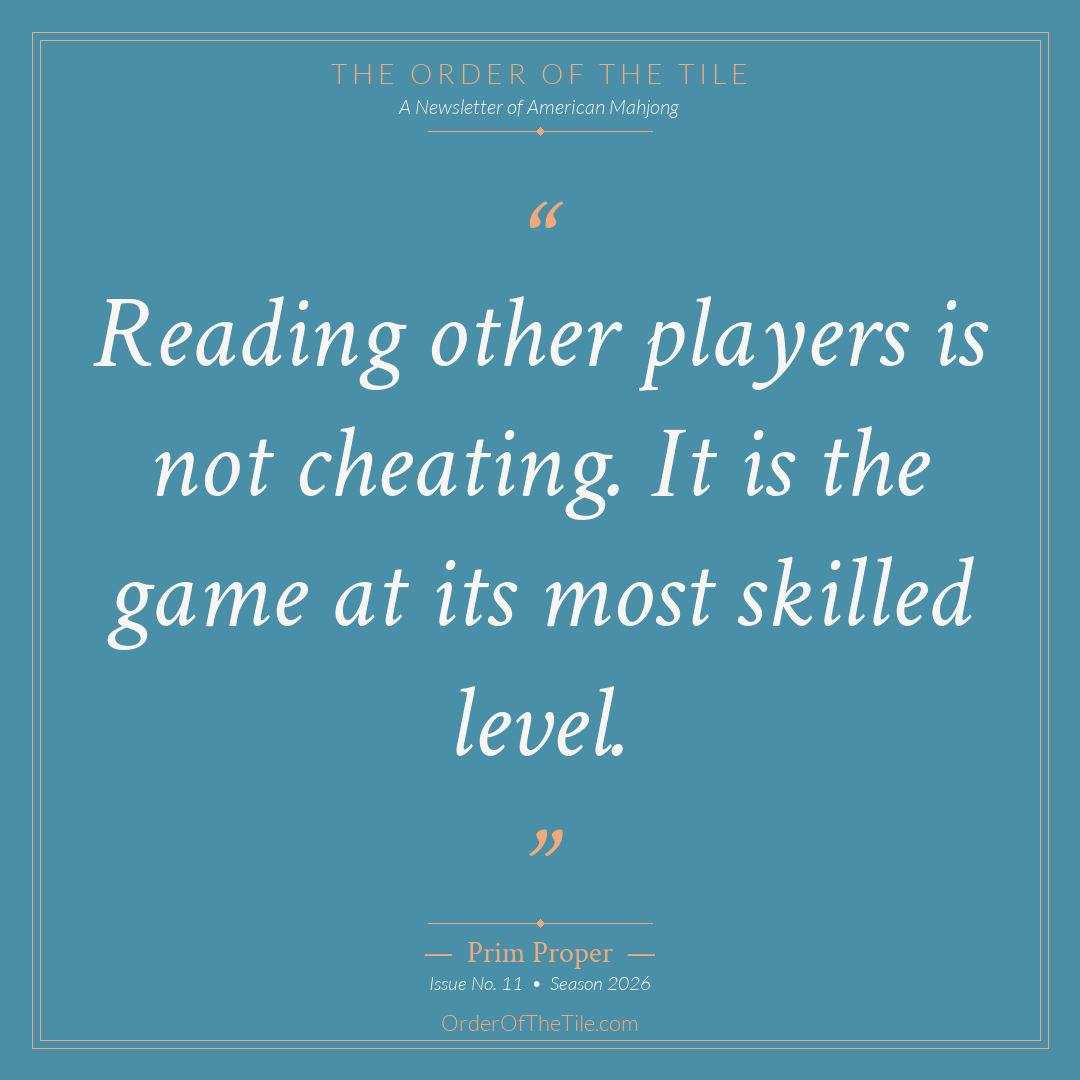
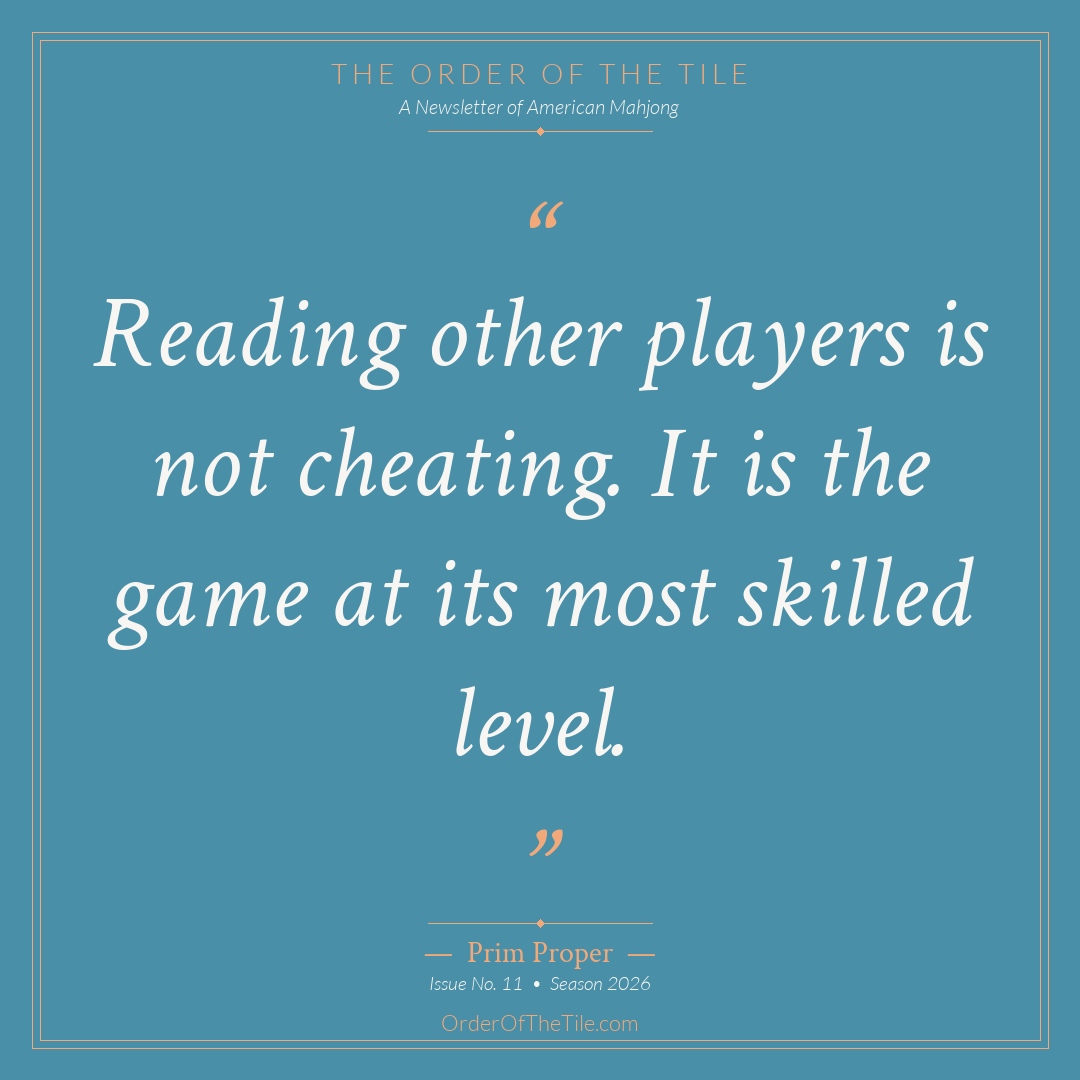
The first thing to name, for the asker's own peace of mind, is that the tablemate who has read her patterns is doing exactly what a good mahjong player is supposed to do. Reading other players is not cheating. It is not a violation of etiquette. It is, in fact, the game at its most skilled level. The players who win tournaments at the national level are, almost without exception, players who have trained themselves to read the subtle signals of other players. The tablemate in question has simply leveled up, and she has done it through eleven years of careful attention. You do not owe her a confrontation. You owe her, quietly, respect. She has earned her advantage honorably.
|
Part two: the advantage is reversible.
The good news, and this is the part Prim wants the asker to hear clearly, is that the advantage she is facing is entirely reversible. Your tablemate has read your patterns. You can change your patterns. The specific tell the asker identified, which is the way she arranges her rack during the first Charleston, is a habit, and habits can be modified. Try rearranging your rack in a different order for six games. When you accept tiles from a Charleston, mix them in before pulling them back out for the next pass. Try alternating numbered tiles and flowers across the rack rather than clustering them. Try leaving your rack more neutral for longer before you start sorting it visibly. Never leave your tiles separated into groupings. Everyone else can count the groupings. Above all else, never give value to good or bad passes in the Charleston. Others are listening. Any one of these changes will break the pattern that your tablemate has been reading, and for the next several games, you will have regained the information advantage you lost. She will, eventually, read your new patterns. That is fine. The game is an ongoing dialogue. You will rotate your signals. She will eventually rotate her reads. The dialogue is the game.
|
Part three: the relationship is more important than the ledger.
The third part of Prim's answer is the most important. You have been playing with these three women for eleven years. The relationship is worth more than any single season's win-loss ratio, and the behavior the asker describes is not a betrayal of the relationship. It is the relationship maturing. A table that has played together for a decade should be producing players who read each other. If you were not reading each other at this point, something would be wrong with the table. The right response to this situation is not to fix the tablemate. It is to match her. Level up your own attention. Notice, consciously, how she arranges her rack during the first Charleston. Watch how she holds her hand when she is early on a joker hand versus a numbered hand. Learn to read her as carefully as she has learned to read you. The ten years of friendship at the table will not be diminished by the fact that you are both getting better. It will be deepened, because the game will keep producing new things to notice about each other, which is part of what a long-running table is for.
The broader principle.
Prim would close this section with a principle that applies to every long-term mahjong relationship. The game is a window through which your tablemates see you, and through which you see them. What you reveal at the table, over years, is a reflection of who you are when you are not trying to manage the impression. Your patience, your impatience, your competitive fire, your generosity, your tendency to cut corners or your refusal to. All of it shows up at the table if you sit there long enough. This is why the game, done right, produces friendships that outlast most other social formats. The table does not lie. Neither do the women at it. The longer you play with the same tablemates, the more each of you becomes, to the others, a known quantity in the best possible sense. Prim would trade a lot of things for that kind of mutual legibility. She would not trade the table for a winning streak. Neither, she suspects, would you.
|
WHO'S TALKING |
Ruth Unger ran the quietest institution in American Mahjong for nearly three decades |
The League's longest-serving president, by most reasonable accounts.
Prim would like to introduce you to a woman whose name many of you will not have heard, but whose decisions shaped the game you play every Thursday. Her name was Ruth Unger, and she served as president of the National Mah Jongg League for nearly thirty years, from the early 1970s into the early 2000s. During her tenure, the League grew from a mid-century institution with a modest membership to a major cultural organization that shipped hundreds of thousands of cards annually and touched the lives of several million American women. Ruth did this work largely out of the public eye. She was not a media figure. She did not cultivate a public persona. She was a steward, in the oldest sense of the word, and she was extraordinarily good at it.
She understood that the card was the institution.
What set Ruth apart, for Prim, was a clear understanding that the League's primary product was the annual card, and that the annual card was the single most important piece of infrastructure holding the American Mahjong community together. Every major decision she oversaw, from printing runs to pricing to the composition of the card design committee, was guided by the principle that the card had to be worthy of the community's trust. The card is why an American Mahjong game in Ohio looks recognizably like an American Mahjong game in Florida and a game in California. The card is the common language. Ruth's stewardship ensured that the common language stayed coherent across three decades of community change, which included the decline of the mid-century mahjong generation, the quiet years of the 1990s, and the early signals of the revival that has become the boom we are living in now.
She kept the committee small, serious, and long-tenured.
Ruth's other signature decision, which is less discussed but equally important, was her commitment to a card design committee composed of players with decades of experience, who served long tenures, and who were selected for judgment rather than celebrity. The women who sit on that committee now, and the ones who sat on it in her time, accumulate five hundred years or more of combined playing experience across the table. This is why the card each year is not a surprise. It is a calibration. Ruth understood that an institution like the League could only maintain its authority if the people making the consequential decisions had the experience to justify the authority. The committee, under her leadership, became the most experienced game-design body in the American parlor-game industry, and it remains so today.
The game you play is the game she defended.
Ruth passed away in 2015, and the League's current leadership has carried her institutional philosophy forward in ways that honor her work. What Prim would like you to take from this feature is the simple recognition that the community you love, and the game you play, is held up by decades of quiet institutional labor performed by women whose names most of you will never learn. Ruth Unger was one of the most significant. She did her work from a desk, without fanfare, for nearly thirty years, and every time you play a hand on a new card, you are benefiting from the institutional discipline she built. At this table, we remember the soldiers. At this table, we also remember the stewards. Both kinds of memory belong at the same table. Ruth would have approved, Prim suspects, of that sentence.
TILE ENVY |
The automatic mahjong table, or the technology that is quietly arriving at the American market |
Prim wants to talk this week about a piece of equipment that most American players have seen in videos from Asia but that very few have encountered in person, which is the automatic mahjong table. If you are not familiar, the automatic mahjong table is a fully electric table that shuffles, stacks, and delivers the wall for the players at the start of every hand. The tiles drop into a chamber beneath the playing surface, are mechanically shuffled, stacked into four walls, and then raised up into position, all in under a minute. The players never touch the tiles between hands. The ritual of the wall-build, which is such a central part of the American game, is compressed into a brief hum and a mechanical rise.
Automatic tables are ubiquitous in Japan and in high-end mahjong parlors across East Asia, where the game is played for hours at a time in commercial settings and the table's ability to accelerate the between-hand interval is a meaningful productivity gain. The American market has, until very recently, shown almost no interest in these tables, for a combination of reasons Prim finds interesting. The American game is played in homes, not parlors. The wall-build is considered part of the social fabric of the game. The price point of a quality automatic table, which ranges from three thousand to fifteen thousand dollars depending on the tier, is a commitment most American players have not seen a reason to make. The machines are engineered for a Chinese or Japanese tile set, which is slightly different from an American set. All of these factors combined have meant that the American market has been essentially empty.
This is changing, slowly, and Prim wants you to know it is changing. A handful of importers have begun bringing automatic tables to the American market over the last two or three years, often with adapted tile chambers that can accommodate American sets. The price points are still high, and the tables are still relatively rare, but Prim has seen three in person at private residences in the last eight months, which is three more than she had seen in the previous decade. The buyers are generally players who play many hours per week, often in established home groups that play competitively, and the feedback Prim has received is mixed but leaning positive. The speed of the game increases meaningfully. The fatigue of repetitive shuffling at the end of a long evening decreases. The social fabric, which Prim worried about in advance, seems to remain intact, because the conversation during the wall-build is replaced by conversation during the slightly different pre-deal ritual when the machine is running.
Prim is not going to tell you to buy one. For most American players, an automatic table is not a good purchase. The home game with tiles on a mat is the heart of this community. Thinking about the loss of the beautiful mats saddens Prim. And the less beautiful tiles that are required, even more. Prim would not want the wall-build to disappear from the American experience of the game. But Prim also wants you to know that the technology exists, that it is slowly entering this market, and that there will eventually be a generation of American players who consider the automatic table standard equipment for serious home groups. How this interacts with the broader American aesthetic of the game is a conversation the community will have in the coming years. Prim has no strong prediction about the outcome. She will report developments as they emerge.
One small note for the collectors and aesthetes among you. The Japanese-made high-end automatic tables, particularly the Amos brand, are genuinely beautiful pieces of engineering. If you have occasion to see one in a mahjong parlor in Tokyo or Osaka, Prim recommends the detour. The tables are the kind of craft object that makes you think differently about what a game table can be, even if you never plan to own one. The Asian mahjong equipment market is more developed than the American one by a large margin, and observing it is useful context for where the American market might, or might not, eventually go.
|
Prim keeps a small shop of her own. Printables, score cards, and a few things she is quietly proud of. 
|
SET YOUR RACK |
The summer preview, with registrations accelerating and fall opening |
The post-Memorial Day acceleration is real.
Prim mentioned in The Draw that registration for summer and fall events has accelerated visibly in the last seven days. Here are the specifics. Destination Mah Jongg's Atlantic City event in mid-August has moved from sixty percent to eighty percent filled in one week. The Shriners Tournament in Austin on June 20 is now accepting names for the waitlist, not primary registration. Mah Jongg Fever's late-summer destination is approaching capacity. The Mah Jongg World Championship in October has added a second block of hotel rooms and a corresponding second wave of registrations, which is a meaningful sign of continued growth year over year.
The summer local circuit is in full swing.
The JCC and community center tournaments that Prim has been covering in these pages are now running at full summer cadence. The Atlanta area joint tournament weekend in mid-June has confirmed its inaugural dates and opened registration. The Chicago North Shore JCCs are running a three-weekend summer series beginning in mid-June. The South Florida federation's summer charity tournament calendar is now posted in full, with seven tournament dates between June and August, and three of them already near capacity. The Bay Area community centers are posting weekly through August. If you have been circling a summer local event, the calendar is now dense enough that you can probably find one within thirty minutes of your home on at least two or three dates this summer. Call around. Commit.
The fall is beginning to solidify.
Beyond the October World Championship, the fall destination calendar is now visible enough to commit to. Destination Mah Jongg is running events through November. Mah Jongg Fever is layering in two additional fall events beyond the one Prim has been covering. Mah Jongg Madness is running its traditional fall circuit with dates in September and October. If you are a player who wants to do more than one destination event this year, now is the time to build your fall calendar. The math on back-to-back destinations is favorable if you are organized about it. The math on deciding in September is much less favorable.
The retreat format, quietly gaining.
A final trend worth noting. The retreat format, meaning multi-day small-group intensive mahjong events with a teaching component, is visibly growing this year. Destination Mah Jongg's Cashiers retreat in April was well received. The Miraval Berkshires retreat, which was originally planned for Memorial Day weekend and has been moved to late August, is nearly full. Crak Your Bags continues to add retreat dates. The retreat format combines the destination aesthetic with serious teaching in a way that the tournament format does not. Prim has been watching this segment carefully. It may be the fastest-growing category of destination mahjong in the American market this year.
| 80% Filled | Destination Mah Jongg Atlantic City Atlantic City, NJ • August 16–18 |
| Waitlist | Shriners Mah Jongg Tournament Austin, TX • June 20 |
| Near Capacity | Mah Jongg Fever late-summer destination event Check the Fever site for dates |
| Open | Mah Jongg World Championship Paris Las Vegas • October 16–18 |
| Nearly Full | Miraval Berkshires Retreat Late August |
| Open | Summer local JCC and community center circuit Check your local listings |
| Opening | Fall Destination Mah Jongg calendar September–November |

|
CRAK INTELLIGENCE |
The 1951 television show, or the first time American Mahjong was broadcast |
Here is a piece of American Mahjong history that almost no one in the current community knows about, and Prim wants to change that. In 1951, at the height of the postwar American television boom, a producer named Dorothy Meyerson hosted what is widely regarded as the first televised American Mahjong program. The show aired locally in New York and, by some accounts, briefly on a small regional network. The format, by the standards of 1951 television, was unusual. Four women played a game of American Mahjong on camera, live, while Dorothy narrated the strategic moments and explained the rules to the home audience. The production was simple. The lighting was harsh, as 1951 television lighting was. The cameras were static. The game proceeded at roughly the pace a real game proceeds, which is to say, leisurely, with pauses and conversation and occasional confusion about whose turn it was.
What Dorothy Meyerson understood, and what almost no one else understood at the time, was that mahjong was a television-compatible game. The rhythm of the turn, the visible nature of the exposures, the drama of the call, the satisfaction of the closing hand, all of it translated to a visual medium in ways that most parlor games did not. Card games did not translate well, because the hands were private. Chess did not translate well, because the action was internal. Mahjong, with its public exposures and its public calls and its visible wall, was inherently telegenic. Dorothy saw this years before the rest of the broadcasting industry would have understood what she was doing. She was, in the sense that would matter decades later, early.
The show did not last long. Television in 1951 was an expensive medium, and a mahjong program did not attract the advertising revenue that the networks were looking for at the time. The program ran for a limited number of episodes and was not renewed. Dorothy continued her broader work in media production and in the mahjong community for decades afterward, but the televised experiment remained a footnote until recent researchers began to piece together the early history of the game's media presence. What the 1951 show demonstrates, in retrospect, is that the idea of mahjong as broadcast-worthy content is not a modern idea. It was tried seventy-five years ago. The medium was not ready. The audience was scattered. The game was.
Prim would like you to carry from this section a small corrective to the widespread assumption that mahjong has only recently become visible to the wider culture. The game has been trying to reach a broader audience for more than seven decades. The YouTube channels, the Instagram reels, the TikTok hands, the podcasts that are emerging now are not a new impulse. They are the continuation of a thread that Dorothy Meyerson pulled in 1951, when she set up four women at a table in front of a camera and explained, patiently, for a live audience, what was happening. Every modern mahjong content creator is, in a small and unacknowledged way, her descendant. The community has been broadcasting itself all along. We are finally in the era where the technology and the audience have caught up to the game. Dorothy would, Prim suspects, be delighted.
A CLOSING NOTE |
For the observers and the observed |
If you take one thing from this issue into your next game, let it be this. Nothing at the table escapes notice. Everything you do is being read by someone, and everything someone does is being read by you, and the long dance of mutual observation is the game itself. Play with awareness. Play with generosity. Play in the knowledge that your tablemates are reading you, and that they deserve your best signals and your worst tells in equal measure, because that is what the table is for.
|
Forward this issue to the friend at your table who notices everything and says nothing. She deserves to know you noticed.
Prim writes for the women at the table. The others who join us are also most certainly welcome. Everyone deserves a seat at this table.
| |||
|
Don't tap it, rack it, double stack it. | |||
|
Until next week, may your rack be blessed | |||
|
Prim, as always | |||
| |||
|
Forward this to your favorite fourth. |