
|
THE ORDER OF THE TILE | |||
| |||
|
ISSUE NO. 25 · SEPTEMBER 2026 | |||
|
"It's a quarter." |
My Fellow Table Guests,
Prim went for a walk last week on the family farm, the one that belonged to her grandparents and belongs to her uncle now, and she would like to tell you what happened on it, because it turns out to be a mahjong letter.
She heard the bees before she saw them. A loud buzz somewhere overhead, close enough to be unmistakable, hidden enough that she never actually found it. There is a row of bee boxes perhaps twenty feet off that path. Prim thought, well. Bees. And she carried on down the hill toward the tank, and thought nothing more about it on the way back up.
She mentioned it that evening the way one mentions weather.
Her uncle put down whatever he was holding. That sounds like a swarm.
Prim, who had until that moment held no opinions whatsoever about bees, discovered she had a great many questions.
A hive that is thriving will sometimes raise itself a second queen and simply split, and half of everything leaves. Catch them quickly and you can often keep them, by offering a box, securing the queen, and persuading the rest that the new address is acceptable. The difficulty was the calendar. It was the end of summer, which is the worst possible season for a hive to divide itself, the boxes standing ready had not been prepared for anything like this, and nobody had the first idea where the swarm had gone.
So they went back down the hill toward the tank to look for it. And there it was. The entire swarm, hanging off a branch in one heavy cluster, directly above the path Prim had walked underneath twice that afternoon without ever looking up.
Prim will not pretend to know the correct way to collect a swarm. She asked a truly punishing number of questions on the way down that hill, and a great many more once they got there, and she is confident her uncle has since reconsidered inviting her along. What she can report is that one chaotic way to do it is to hold a box underneath the branch and swing.
The bees fall. On the first swing about half of them went in. Her uncle swung it again, and another half, he said, went in after them.
And there were still bees on the branch.
So Prim asked a perfectly silly question, knowing full well it was a perfectly silly question, because she could not possibly resist it. Is that the third half?
No, he said. I suppose that was a quarter.
They laughed until they had to sit down, because not one part of that sentence survives contact with arithmetic, and neither of them cared.
Prim should mention the bee suit. There was one. It came down the hill with them and it never went on, which is a decision that looks entirely sensible right up until the moment it does not.
The beekeeper was stung five times. Not four, which would at least have been quarters. Five. The bees, you will note, were not interested in the arithmetic either, and they gave no quarter whatsoever.
She tells you all of this because it is the twenty fifth letter. Twenty five turns out to be significant in rather more ways than one, and Prim intends to spend this issue on a couple of them, starting with the one printed on the card in your hand. Twenty five cents. Thirty one of the fifty five lines the League published this year, priced at precisely the coin her uncle reached for while standing in the dark under a tree, being wrong in the most useful way anyone has been wrong at her all summer.
Here is the argument, and Prim suspects it will irritate a few of you. The quarter hands are not the consolation prize. They are the card. The whole season, the whole strategy, the entire quiet business of getting good at this game, rests on the smallest number the League prints, and most players have never once sat down to work out what that number is actually worth.
Prim has worked it out. There is more money on your card than you think, and it is nowhere near where you have been looking.
Read on.
|
~Prim |
|
Your seat at the table is open There is a chair with your name on it The practice table is always laid, and nobody there is waiting on you. Play a hand at your own pace, with no audience watching you think and no one drumming her fingers while you decide. Your newsletter email is already your key, so there is no password to invent and nothing whatsoever to remember. Ask for a sign-in link, take your seat, and begin with the free Daily Tile.
|
THE DRAW |
What the table argues about when the money comes out |
The argument that will not die this season is about naming, and it has finally escalated to correspondence.
Here is the shape of it. A woman calls a tile. The tile she puts down is not the tile she called. Somewhere between her mouth and the table, a Four Bam became a Four Crak, and now three other women have three different ideas about what happens next, all of them delivered with total confidence. This has been circling the groups since spring and Prim had rather assumed it would burn itself out.
It did not. It got worse, because somebody asked the follow up.
What if the tile that gets misnamed is a Joker?
The groups went off like a kettle. And what Prim noticed, watching a thread grow well past the point of usefulness and then keep going, is that almost nobody arguing was actually arguing about the tile. They were arguing about the bill. Because the misnamed tile rule is not a slap on the wrist. When a player misnames a tile and someone declares Mah Jongg on the tile she named, the discarder owes four times the value of the hand. Not double. Four times, from one woman, alone.
Sit with that for a moment against the arithmetic in the next section. An ordinary quarter hand won on a discard collects one dollar from the whole table. A misnamed quarter hand collects one dollar from a single person. The most expensive thing at your table is not a hand at all. It is a discard. It is not printed on the card anywhere, and it will still move more money across your table this year than the seventy five cent hand ever will. The tile you had already finished with. Somebody wins on it and it costs you double, and if you named it wrong on the way out it costs you four times, which is a remarkable price to pay for a tile you did not want.
Which is why the thread would not die, and why it stopped being a Facebook argument and became a letter. Modern Mahjong put the questions to the National Mah Jongg League in writing. Does the misnamed tile rule apply to a misnamed Joker. Does the discarder pay four times the value for that penalty win. They have said they will publish the answer when it arrives.
Prim declines to rule on it in the meantime, and she would ask you to notice that she is declining rather than guessing. The League answers those questions. That is the entire reason the League exists, and a woman with a newsletter is not a substitute for it. What Prim will say is this. Every one of these evenings, all of them, every single one, could have been prevented by three sentences said out loud before the first Charleston. Not the rule. The settlement. Who pays what, and when, and whether this table does the jokerless bonus at all.
Nobody writes a letter over a technicality that costs nothing. They write when it costs them, and this one costs four times.
|
Prefer to listen? Prim reads each letter aloud on Spotify.
|
CRAK THE CARD |
What the card actually pays, and what that tells you |
Prim went through the 2026 card line by line this week with a pencil and a column of numbers, which is an unglamorous way to spend an evening, and she has come back with three things she would like to put in front of you.
The first. This is a quarter card, and it is not close.
Fifty five lines. Thirty one of them pay twenty five cents. Nine more pay thirty exposed and four pay thirty concealed. After that the card thins out with startling speed. Two lines at thirty five. Three across the Quints, at forty and forty five. Five concealed at fifty. And then one line. Precisely one, on the entire card, at seventy five.
Read that as a shape rather than a list. The League did not build you a ladder of value to climb. It built a wide flat floor, put a few small steps at one end, and then set a single door in the far wall. More than half of everything you can legally do this year pays the same as everything else.
That is not a flaw in the card. That is the card making an argument, and the argument is that the money was never supposed to be the interesting part.
The second. A quarter hand is worth a dollar, and you have been thinking about it backwards.
Here is the arithmetic nobody does out loud.
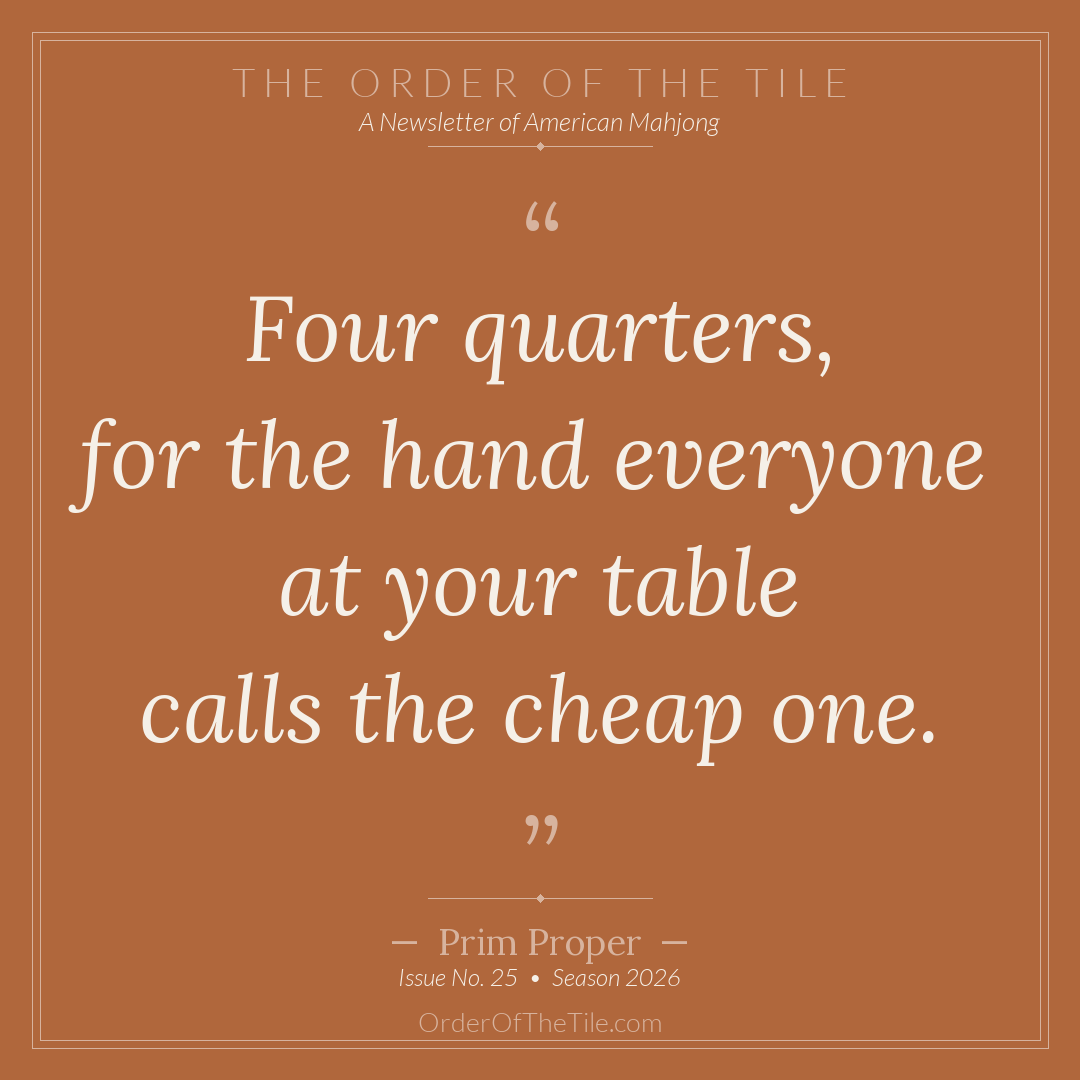
You win a twenty five cent hand on someone's discard. The discarder pays double, so she puts in fifty cents. The other two pay the face value, twenty five each. You have just collected one dollar. Four quarters, for the hand every player at your table calls the cheap one.
Self pick it instead, and all three pay double. That is a dollar fifty. Complete it without a single Joker and every one of those numbers doubles again, which puts you at two dollars on a discard and three dollars on a self pick, off the humblest line the League prints. One warning on that last one, and it catches good players every week. The jokerless bonus is not automatic. You have to announce it when you declare. Stay quiet and you have simply forfeited it, correctly and permanently, and nobody at the table is obliged to remind you.
Now price the famous one. The seventy five is concealed, it lives in Singles and Pairs, and Singles and Pairs does not take the jokerless bonus, because that bonus is already baked into the printed number. Win it on a discard and you collect three dollars. Self pick it and you collect four dollars and fifty cents.
So the whole card, floor to ceiling, humblest line to crown jewel, spans one dollar to four fifty. That is the entire empire. Every strategic decision you will make this season lives inside three dollars and fifty cents of daylight.
The third. This is why chasing the seventy five is usually a mistake, and Prim will hold this position under fire.
That single line is one legal hand. Not one section, not one family of hands, one hand, out of the more than one thousand legal hands the card permits across all fifty five of its lines. It is concealed, which means no exposures, which means you give the table nothing and you take nothing from it. You are playing blind and alone, for three times what an ordinary line pays.
Three times. For a hand you will complete a small fraction as often.
Prim is not telling you never to reach for it. She is telling you to know the exchange rate before you do, because at the moment most players are paying it without looking at the price. The woman who takes four quarter hands cleanly over an evening has moved four dollars across the table. The woman who spent the same evening concealed and hopeful has a lovely story and nothing at all in front of her.
Small is not nothing. Small, repeated, is the whole game.
And if that sounds like an argument for playing safe, read it again. It is the opposite. The quarter hands reward speed, decisiveness, and the willingness to commit early and be wrong occasionally. It is the seventy five that lets you hide.
|
Between the Letters Today's Latest News A letter a week is never quite enough for a game moving this fast. The Dispatch is Prim's daily page, where the latest updates and announcements land between letters... the releases, the tournaments, and the stories the table is talking about, gathered and told the moment they happen.
|
THE TABLE IS ASKING |
Who pays whom, and why nobody at your table agrees |
The question arrived the way these always do, which is to say after the hand was finished and the tiles were already going back into the wall.
Somebody had won. Everybody was reaching for coins. And one woman looked up and said, wait. Why am I paying more than she is?
Because you threw it. Prim is aware of how that sounds.
The League's standard settlement is not complicated. It is simply never taught, and it is almost never said out loud, and so it gets absorbed by imitation and passed along slightly wrong for years at a time.
Prim ran the arithmetic on all of this up in Crak the Card, and she is going to state the rules plainly again right here, in one place, on purpose. This is the paragraph a woman wants to be able to find in a hurry, usually at ten at night with a group chat going. Say it twice. Say it as often as it takes.
When a hand is won on a discard, the woman who discarded pays double the printed value and the other two pay it once. When a hand is self picked, all three pay double, because nobody handed her anything and she built it herself. A hand completed without a single Joker doubles all of that again, provided she announces it, and the one place the bonus does not apply is Singles and Pairs, where the extra is already inside the printed number.
That is the system. Three sentences.
And Prim would wager a considerable sum that at least one woman at your table on Tuesday has been settling wrong for years, has never been corrected, and never will be, because correcting her would require somebody else to admit she was not entirely certain either. This is the most common secret in American Mahjong. Everybody nods. Nobody checks.
Now, Prim's position, which is not the diplomatic one.
The discarder paying double is not a fine, and it should never be played as one. It is the game telling you that the tile you released had value. That is the entire discipline of defensive play, compressed into a single coin and handed to you at the end of the hand as a receipt. Nothing else in this game teaches it as cleanly.
Which means how your table treats that coin quietly decides what kind of players you all become. A table that experiences the double as a penalty will grow women who play frightened. They hold dangerous tiles too long. They stall rather than risk. They would genuinely rather nobody win than be the one who paid extra, and if you have played with a woman like that you know that the whole evening slows down around her. A table that experiences the double as information will grow women who watch exposures, count what is gone, and think for one extra beat before pushing a tile forward. Same coin. Same fifty cents. Completely different game, and completely different Tuesday.
So settle it before the Charleston rather than after the win. Say the three sentences once, at the start of the season, and then never have the argument again. And if your group runs house rules on top of the League's, and most groups do, say those out loud too. The woman who has been quietly paying you wrong for two years is not being difficult and she is not being slow. Nobody ever told her.
Bring it to your table this week. Ask all four of you to say the settlement out loud, separately, before anybody touches a tile. Prim suspects you will not get four matching answers, and she would be delighted to be wrong.
|
WHO'S TALKING |
The ones who put it in writing |
There is a particular kind of work in this community that photographs badly.
Strategy content is a pleasure to make. Hand analysis performs. A beautiful set on a beautiful mat will do numbers all day long, and it should, because it is beautiful. But underneath all of that sits a layer of genuinely tedious work that somebody has to do, and almost nobody wants to, and it is the work of establishing what the rule actually is when four reasonable women disagree.
That is where Prim's attention went this month, on account of the misnaming argument in The Draw.
Because there were two entirely available responses to that thread. The first was to post into it, at length, with confidence, and collect the agreement of everyone who already thought what you thought. It costs nothing. It is quite satisfying. It resolves absolutely nothing, and by Thursday the same question is being asked again three groups over by somebody who was not there.
The second was to stop arguing and write to the National Mah Jongg League.
Modern Mahjong, which is Dara Collins and Donna Kassman, took the second one. They put the questions in writing. Does the misnamed tile rule extend to a Joker that has been misnamed. Does the discarder owe four times the value of the hand for that penalty win. And then, rather than declaring an answer themselves, they said they would publish the League's reply when it comes.
Prim wants to be precise about why she is pointing at this, because she is not in the business of ranking anybody in this community and she is not about to start. This is not a verdict on anyone. It is a note about a choice, and the choice was to be publicly uncertain in front of an audience, which is a genuinely uncomfortable thing to do when your name is on a mahjong website and people arrive expecting you to know.
Saying "we have asked, and we will tell you what they say" is slower than saying "here is the answer." It is less shareable. It gets fewer comments. And it is the only version of that sentence that leaves the community better informed at the end of it, because the League is the body that actually decides, and everyone else, Prim very much included, is offering a reading.
Prim recognizes her educators. There is a whole category of women in this community doing work that will never trend, and writing the letter instead of the post is a fine example of it.
You will find them at modernmahjong.com.
|
Out in the World There is very likely a shop nearer to you than you think. Prim keeps a directory of them, along with the teachers and the tables, sorted by state and by the ones that ship anywhere. Every listing is backed by a source you can check yourself.
|
TILE ENVY |
Beauty that costs more than the hand ever will |
There is a delicious absurdity sitting at the very center of this game and Prim would like to hold it up to the light for a moment, because it has never once been mentioned in this letter and it is long past time.
You will spend an entire season playing for quarters. Actual quarters, sometimes, in a little dish, and by the end of a long and thrilling evening perhaps four dollars will have moved from one side of the table to the other. Someone will have felt triumphant about it.
And you will have played that evening on a set that costs more than every hand you will ever win with it for the rest of your natural life, combined, and not one woman at that table will find this strange for even a moment.
Prim does not find it strange either. She finds it the most honest thing about us.
Nobody has ever bought an heirloom grade set on the strength of the payout. The return on a beautiful set is not financial and was never pretending to be. It is the weight of the tile as it comes off the rack. It is the particular sound the wall makes going up, that dense wooden clatter that means the evening has started. It is what a good mat does to the noise of a room, softening it, making four women sound like a private conversation rather than a cafeteria. Those are the returns. The quarters are a scorekeeping device that we have all agreed to take seriously so that the evening has a shape and an ending.
This is why Prim has developed a mild allergy to the way sets are shopped for. The question is nearly always which one is impressive, and impressive is a photograph, and a photograph is the one thing about a mahjong set that you will never once experience while playing on it. You do not look at your tiles from above at a flattering angle. You look at the two inches in front of your hands, several thousand times, for a year.
So ask the other question this fall, as the new collections begin to surface. Pick the tile up. Set it down. Listen to it. There are makers who have organised their entire practice around exactly this, Mahjong Row and Company among them, building for weight and sound and the feel of the thing in a hand, on the theory that a set lives in a home rather than in a photograph. Whether that is your taste is entirely your business and Prim would not presume. But it is the right question, and almost nobody is asking it.
The money on this card is small on purpose. What sits under your hands while you play for it does not have to be, and that is not a contradiction. That is the whole point. The quarters are the excuse. The evening is the thing.
|
Prim's Own Shelf Written at the table, not at a desk Since we are discussing the things you keep, Prim keeps a shelf of her own. Every guide and printable in her shop is her own original work, written by somebody who actually plays, and it arrives the moment you buy it with nothing to wait on. The Game Pass sits there too, and it opens every game she has built, including the ones still to come.
|
SET YOUR RACK |
One room worth the drive this fall |
The spotlight: a fifth-year fundraiser in Shoreview, Minnesota.
Prim went looking in the Midwest this week, on the grounds that this circuit spends a great deal of its time on coasts and cruise ships, and she came back with something quieter and rather better.
Wednesday, September 23, at the Shoreview Community Center just north of Saint Paul: the fifth annual Mah Jongg tournament benefiting the Alzheimer's Association, run by a Twin Cities club.
The fifth annual. Prim would like that number to sit with you for a moment, because it means this is not a nice idea somebody had once. It is five years of the same women pointing an evening they were going to spend anyway at something that needed the money. Prim finds that considerably more interesting than a ballroom.
And if you have never played a tournament, understand what you are actually buying, because it is not the trophy. You are buying the strict standardized ruleset, enforced consistently, in a room where nobody is anybody's friend. Every question your home table has been quietly fudging for two years gets answered for you at the door. The settlement is not up for debate. The misnamed tile is not up for debate. Every soft edge your group has sanded down out of affection for one another is put back, sharp, and you get to find out what your game looks like without them.
There is a strategic reason this issue's argument travels well into that room. Tournament play does not settle in coins. The printed value of the hand feeds a running total across rounds, which means the modest hand you take quickly and cleanly is worth vastly more to you than it feels like at home, and the glorious concealed hand you did not finish is worth precisely nothing. The player who has trained herself all season to take the quarter hands, fast, without agonising, tends to arrive already fluent.
The rest of the season, everywhere in the country, lives on the calendar at orderofthetile.com/events. It is kept current, it is free, and it will always know more than a paragraph can.
|
|
CRAK INTELLIGENCE |
Two marks beside every line, and most players read only one |
Look at any line on your card. There are two pieces of information printed there that have nothing whatever to do with the tiles, and Prim is willing to wager you have only ever consciously used one of them.
The number on the right is the money. You know that one, in the loose way that everyone knows it, even if you have never once done the arithmetic on it. You have been reading it as a ranking rather than a price, which is a distinction this issue has spent two thousand words on already.
The colors are the other one. And here is the part that reliably astonishes women who have been playing for a decade.
The colors on the card are not the colors of the tiles. They never have been. Red does not mean Craks. Green does not mean Bams. Blue is not telling you to reach for Dots. The color on your card is not naming a suit at all. It is naming a relationship.
Tiles printed in the same color must come from the same suit as one another. Tiles printed in different colors must come from different suits. Which suits, entirely your business, and the card does not care in the slightest which way round you do it.
Prim finds this a genuinely elegant piece of design and she does not say that lightly about a piece of cardstock. One decision, made in ink, that lets a single printed line stand in for every suit combination at once. It is the reason fifty five lines can produce more than one thousand legal hands. It is a compression trick, executed in three colors, on a card small enough to prop against a rack.
It is also, and Prim says this with real sympathy, the single most common source of quiet confusion for a new player. She has decided that green means Bams, because green looks like bamboo and she is not being unreasonable. The card appears to be telling her something specific. It is not. And she will not know how to ask about it, because the question sounds foolish until somebody says the answer out loud, at which point it is obvious forever.
So the card hands you two marks beside every hand it prints. One tells you what the thing is worth. The other tells you how the suits relate to each other. Prim has met a great many players who read the first fluently, at speed, without ever having to think about it.
She has never once met a player who looked at the second and saw immediately how far it opens out.
And that is not a failing of theirs. It is that the card does not look expansive. It looks specific. It looks like it is telling you to build one particular hand, in one particular way, with those colors sitting there in what appears to be an instruction. So you read it as one way, because it is presented as one way, and you go off and try to build the thing it appears to have asked for.
But that one way is not written in stone. It never was. That single printed line has several meanings folded up inside it, and every one of them is a legal hand, and the card will not tell you so.
Look at it again this week. That is all she is asking.
A CLOSING NOTE |
It is the twenty fifth letter. A quarter of a hundred, which Prim finds she does not want to make more of than it is.
Nobody throws a party for a quarter. It is a small thing that is nonetheless worth something, and that is rather precisely the argument she has been making all the way down this page, so it would be poor form to now stand on a chair about it.
But she will say this much. The card agrees with her, and the card is not sentimental. Thirty one of its fifty five lines pay the smallest coin the League prints, and over a season those lines will put more money in front of you than the beautiful concealed hand you have been quietly dreaming about since the card came out in March. Not because they are better hands. They are not. Because they arrive, and it turns out that arriving is most of it.
Small, repeated, is the entire game. At the table, and, Prim suspects, very nearly everywhere else.
Her uncle was right, is the thing that has stayed with her. What was left on that branch was not a third half. There is no such object, and there never was. It was a quarter, and the whole reason the two of them were standing in the dark at the end of summer was that a quarter of a hive is still absolutely worth going back down the hill for.
Nobody swings a branch twice and calls it finished.
Prim may write for the women at the table, but she firmly believes everyone is welcome. Everyone deserves a seat at this table.
|
| |||
|
Don't tap it, rack it, double stack it. | |||
|
Until next week, may your rack be blessed | |||
|
Prim, as always | |||
| |||
|
Forward this to your favorite fourth. |