
|
THE ORDER OF THE TILE | |||
| |||
|
ISSUE NO. 23 · AUGUST 2026 | |||
|
"The tiles remember what you forgot." |
My Fellow Table Guests,
Prim's grandfather played golf for a living.
Not famously, professionally. He came to it through the military, where a young man with a real gift for the game found that the gift opened doors, and he walked through them. When the service was finished he turned the thing that had carried him, into the thing he did. Which is why he knew the rulebook the way a surgeon knows an artery. Every clause. Every relief procedure. Every penalty and exactly what it cost, because for him it had cost something.
He was not a stern man in her eyes. Prim wants that understood before anything else, because a man who keeps rules that carefully is very easy to picture wrongly. He did not lecture and he did not fuss. He was often playful with the grandchildren, but not in the way that you immediately think that gets a man called fun. What he did, was take you along. Up onto the horse. Up onto the tractor beside him. Out into a field that wanted tilling on a morning when a child was more hindrance than help, and he brought them, regardless.
And, as this story tells, out to the golf course, on ordinary mornings.
The rules there were his own, and he kept them without commentary. You turned up dressed properly, and if you had forgotten the collar he found you one and nothing further was said about it. The grip got fixed, and fixed again, quietly, as many times as it took. Count every stroke out loud, including the rough ones, especially the really rough ones. Stand still while somebody else swings. Do not walk through anybody's line. Rake the bunker behind you. Keep up with the group. He would encourage the same short shot until it stopped being luck, and he was never effusive about it, but you knew.
And then a ball would come to rest behind a tree on a root, as balls do. And he would stand over it with his hands on his hips and his chin down, and he would turn to whichever grandchild had luckily pulled the long straw that morning, and he would ask, with tremendous gravity, what would you do with this.
Prim, or one of the cousins, would say something earnest about the angle.
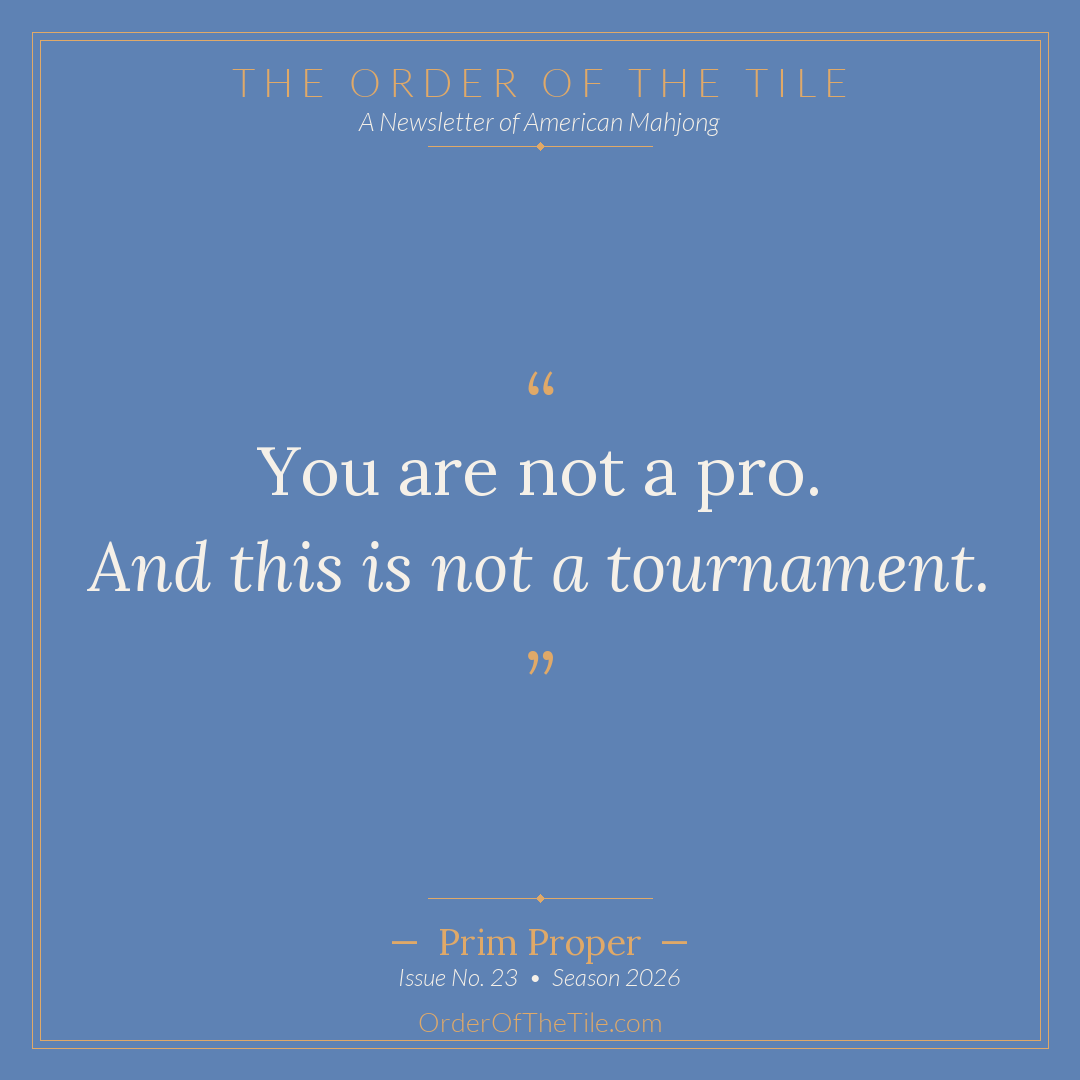
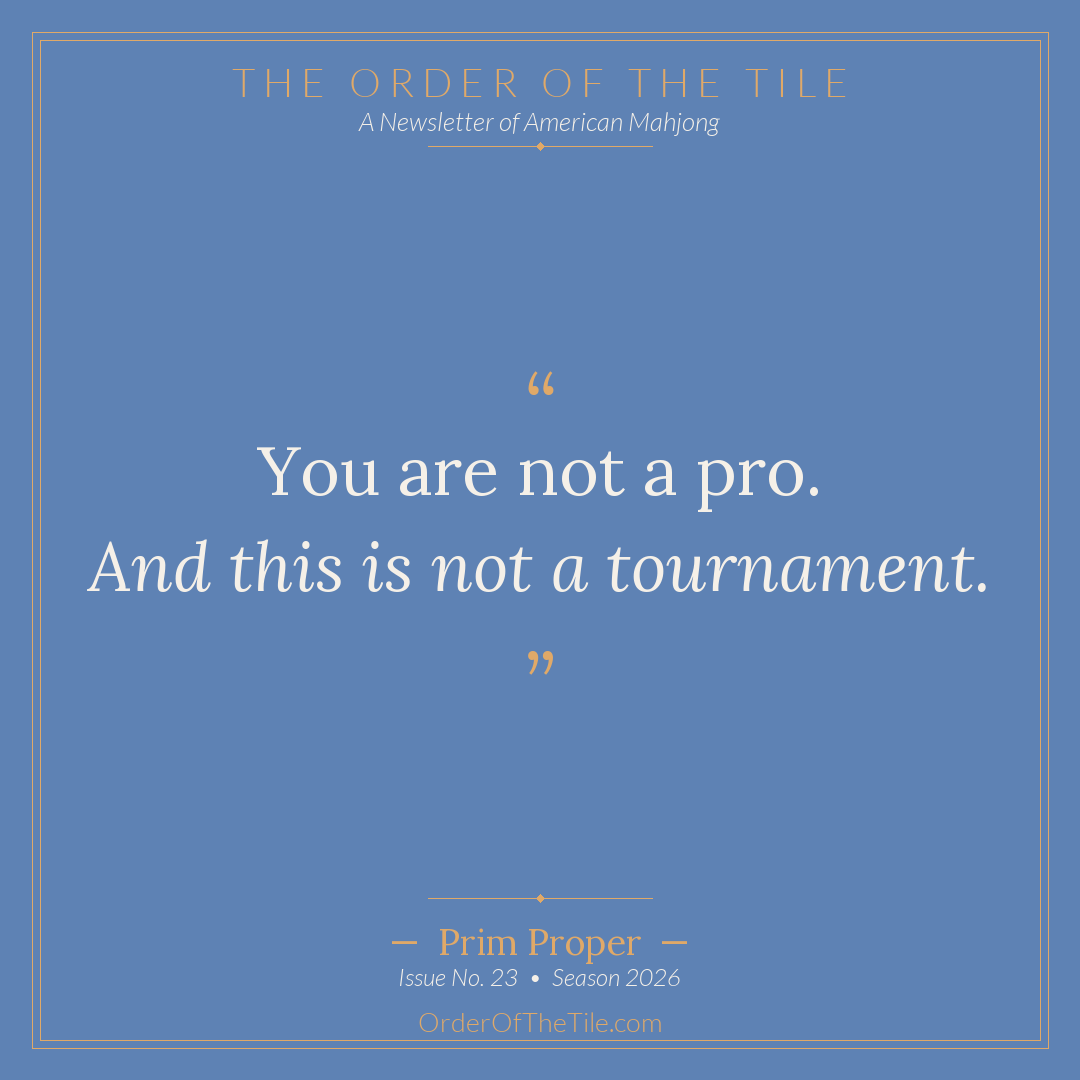
And her grandfather would look at the tree, and look at the child, and say: you are not a pro, and this is not a tournament. Then he would nudge the ball out from behind the tree with the toe of his shoe, tell her to go on and hit it, and get on with his lovely afternoon.
He was not making it easy for her. Prim needs that understood, because it is the entire point of the story. The man was a professional. If he had wanted to teach a nine-year-old the unplayable lie at that moment, he could have recited it from memory with the penalty attached and stood there while she took her medicine. He chose not to. He had decided, long before that morning, which parts of the game were load-bearing, the fundamentals and the manners and the honest count, and which parts had been written for a tournament that no child on that fairway had entered. He held the line on the first list and forgave the second, every single time, on purpose. The dress code was not negotiable, nor the manners. Neither was the count. The ball on the root behind the tree was another matter entirely.
He was not making the game easy. He was making it worth coming back to next Saturday.
He was making it fun.
My darlings, that is the entire issue, and it has very little to do with golf.
Somebody at your table this month is going to declare your hand dead, or make a call she is not entitled to make without your consent, or reach for a rule with the confidence of a woman holding a gavel. And you are going to need to know a few separate things: who you are sitting with, what the rule actually says, and whether this is a tournament.
Prim will be plain here, because she does not wish to be misunderstood. Some of you play to compete. You want the clock and the card and the whole unforgiving apparatus, enforced to the letter, and that is entirely legitimate. Prim would not dream of asking you to want a gentler game. Say so out loud, find each other, and go be magnificently ruthless together. She will cheer from the rail.
But when there is a beginner in the fourth chair, whether you invited her or she was simply there when you sat down, the question has changed. It is no longer only about the rule. It is about you. Who are you being in that chair? Is she going home to order a card of her own, or going home quietly certain that this game belongs to somebody else? Teaching and joy and room to be wrong, or an afternoon of being afraid to touch anything? She will have forgotten the hand by Friday. She will remember how you made her feel in a moment of confusion or mishap for years.
So learn the rules cold. All of them. And then look up from your rack, look around the table, and notice where you actually are. And when it comes down to it, play with joy.
|
~Prim |
|
Your seat at the table is open There is a chair with your name on it The practice table is always laid, and nobody there is waiting on you. Play a hand at your own pace, with no audience watching you think and no one drumming her fingers while you decide. Your newsletter email is already your key, so there is no password to invent and nothing whatsoever to remember. Ask for a sign-in link, take your seat, and begin with the free Daily Tile.
|
THE DRAW |
Everyone is suddenly writing down the penalties |
Prim reads the mahjong internet so that you do not have to, and she wishes to report a change in the weather.
For most of this year, the writing was about winning. Which hands to chase, what the 2026 card rewards, how to read an exposure. Pleasant, ambitious, slightly breathless. But something turned over the last stretch of the season, and the pieces getting published now have a very different flavor. They are about penalties. What makes a hand dead. What happens when you pick out of turn. What to do when a woman exposes a pung that does not exist on any line of the card. Careful, sober little articles, sourced to the League's own materials, footnoted like a term paper.
 |
Prim finds this fascinating, and she will tell you why. Nobody writes a penalty explainer for fun. That kind of piece gets written because the questions are arriving. Which means that somewhere out there, at a great many tables, a great many afternoons have recently gone sideways over a rule that nobody at the table could quote with confidence. Or, a rule that one is certain about and no one else has heard before. The community has grown fast this year. New tables everywhere, new players at them, and a card that half the room learned in March. Of course the rulings are getting messy. What you are watching is a game working out its manners in public.
So Prim's advice for the week is not the advice you expect. Go and read one of those articles. Read it properly, the whole way down. Not so that you can be the woman at the table with the gavel, heaven forbid, but so that you never again have to sit there while somebody guesses at your hand's fate out loud. Knowing the rule cold is what buys you the right to wave it off. You cannot generously decline to enforce something you do not actually understand.
|
Prefer to listen? Prim reads each letter aloud on Spotify.
|
CRAK THE CARD |
Knowing when it is over, and who gets to say so |
Here is the least romantic skill in American Mahjong, and Prim is going to argue that it is one of the most valuable. Knowing when a hand has died.
The card is unforgiving on this in a way that has nothing to do with anyone's feelings. A hand is dead when it can no longer be what it claims to be. You exposed a pung that matches no line printed on the card. You exposed at all while chasing a concealed hand. You are holding twelve tiles, or fourteen, when the count says thirteen. You picked out of turn, or from the wrong end of the wall, or you discarded before you drew. Or, quietly and most commonly, the tiles you need have all been seen by everyone and your hand is finished whether or not anybody has said the word. That is the painful truth, more or less, and every teacher publishing this month gives the same one.
 |
Now. Prim wants you to notice the thing that almost nobody notices, because it changes the entire emotional temperature of this subject. You are not permitted to declare your own hand dead. That is not how it works. A dead hand is something that must be called by another player, and until it is called you are still sitting there, still holding tiles, still in the game. Sit with the shape of that rule for a moment. It cannot work with one woman in the room. It needs a second.
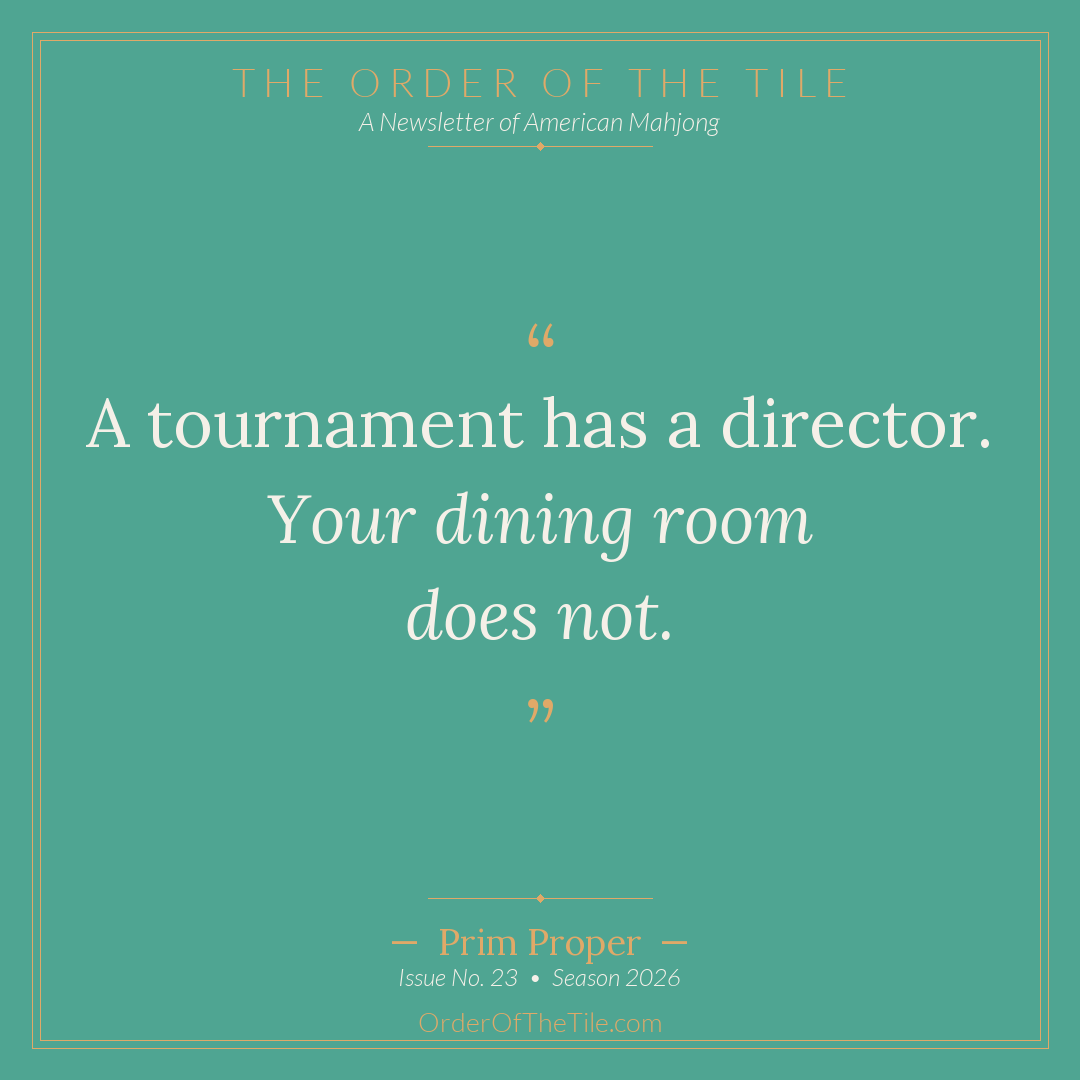
Which tells you precisely where it was written. A tournament has a director, a neutral party whose entire job is to say the hard sentence out loud so that none of the four women at the table has to carry it. Your dining room has no director. It has a plate of something on the sideboard and three friends, and so the saying falls to a friend. That is not a flaw in the rule. It is a rule that has arrived at your table without the person it was built around, and Prim would like you to know that before you pick it up.
So learn the ways a hand dies. Learn them cold, learn them this week, learn them well enough to recognize your own dead hand three turns before anybody else does, because that is genuine skill and it will save you from playing on in expensive hope. But learn them for yourself first. The knowledge is a mirror long before it is anything else. The best player at your table is the one who always knows exactly where the rules are, and almost never needs to reach for them.
|
Between the Letters Today's Latest News A letter a week is never quite enough for a game moving this fast. The Dispatch is Prim's daily page, where the latest updates and announcements land between letters... the releases, the tournaments, and the stories the table is talking about, gathered and told the moment they happen.
|
THE TABLE IS ASKING |
She made a call she was not entitled to make. Now what. |
The question came in from a reader who is plainly still annoyed, which Prim respects enormously. Prim refers to it as passion!
A woman at her table called a discard, exposed her tiles, and was wrong. Not cheating. Simply wrong, in the ordinary way, holding an exposure that matched nothing on the card. Nobody said anything. The game limped along in a fog of politeness until it ended in a manner nobody could quite reconstruct. And our reader has been chewing on it since. Was I supposed to say something?
Yes. And here is how, because the how is the entire thing.
You say it immediately, you say it kindly, and you say it to the tiles rather than to the woman. Wait, let us look at that together. Not you cannot do that. Not the long silence with the significant eyebrows, which everyone at the table can read anyway and which is somehow worse than being corrected out loud. Immediately, because a miscall that sits unmentioned for three turns poisons the whole hand and cannot be untangled later. Kindly, because she is not a defendant. And to the tiles, because the tiles are the thing that is wrong, and pointing at them lets a woman fix her mistake without anybody having to lose face over it.
 |
Prim will go further, and this is where she expects some disagreement. At a friendly table, the correct outcome of an honest miscall is almost never a penalty. It is a repair. Put the tiles back, let her reconsider, carry on with the afternoon. Yes, that is technically generous. Yes, at a sanctioned tournament with prize money on the line it would be handled very differently, by a director, according to a printed rule, and correctly so. But you are not at that tournament. You are in somebody's dining room with a plate of something on the sideboard, and the actual stakes at your table are not the fifty cents. The stakes are whether all four of you want to come back next week.
The exception, and Prim states it plainly so nobody can accuse her of softness: this holds for honest mistakes. A woman who makes the same convenient error every single week is not confused. She is doing something else, and it deserves a different conversation, held privately and away from the table. But that is rare, my darlings. It is so much rarer than being wrong.
|
WHO'S TALKING |
The two desks doing the homework so the rest of us do not have to |
Prim would like to hold the door for two people who have taken on the least glamorous assignment in American Mahjong, which is writing the hard parts down clearly enough that a stranger can follow them.
The first goes by Mahj Mind, and it comes to you from Arizona. Play Smart. Have Fun. Mahjong Together. is the whole of its stated ambition, and the woman behind it says her background is in education. Prim recognizes her educators. She has published not one but two separate pieces on dead hands, and here is the detail that earned her this paragraph: she shows her work. The NMJL card as the source of truth. Mah Jongg Made Easy, down to the page numbers. Anyone can tell you a rule. A teacher teaches you why it exists.
The second is Mahj Palazzo, which runs an editorial column called The Mahjong Edit alongside a shop full of very handsome things, and Prim would like to give proper credit for a choice nobody made them make. A shop that sells beautiful mats and porcelain tiles could stop at the beautiful part. This one went and wrote the dead-hand piece as well, cheerfully, sourced to the American Mah Jongg Association. A dead hand, they write, is simply a hand that has become disqualified because of a rules violation. Prim adores that simply. It is exactly the right tone to take with a nervous beginner. Nothing here is beyond you. It is only a rule. Let us have a look at it together.
And here is what Prim likes best about the pair of them. Neither one puts himself or herself out in front of the work. No portrait, no origin story, no long account of the Tuesday table where it was all learned. Just the rule, the source, and the page number. Prim, who has been writing to you for twenty three weeks under a name her own mother did not give her, is in no position whatsoever to remark on it. She raises her cup and says nothing further.
So if either of you is reading, and Prim rather hopes you are, consider this a standing invitation. Come and sit down. Name or no name, this table would be delighted to have you, and Prim would like to thank you properly for the homework.
|
Out in the World There is very likely a shop nearer to you than you think. Prim keeps a directory of them, along with the teachers and the tables, sorted by state and by the ones that ship anywhere. Every listing is backed by a source you can check yourself.
|
TILE ENVY |
Somebody in your zip code is betting her rent on this game |
Prim has spent this letter talking about who is sitting at your table. She would like to spend a moment now on the people who made room for the table in the first place.
There is a shop near you that has decided to carry mahjong.
Prim knows this because we keep a directory, and it currently holds better than a hundred places to buy this game, the great majority of them small, local, and run by somebody whose name is on the lease. And when Prim went through them properly this week, she noticed something she wants to put in front of you, because it is genuinely moving once you see it. These are few big mahjong companies. Mostly, they are ordinary neighborhood businesses that looked at this game and decided to make room.
Consider Rocky Ridge Drug Co. in Vestavia Hills, Alabama, which describes itself, accurately, as your neighborhood pharmacy. It is a pharmacy. You may collect a prescription there. And somewhere between the counter and the door, that pharmacy has assembled better than fifty mahjong items, agate racks and pushers at a hundred and ten dollars, mats, bags, an acrylic box, and cups with hearts on them, and it will book you into a class besides. Some woman at a neighborhood drugstore in Alabama looked at her floor space and gave a piece of it to this game. Prim finds that quietly magnificent.
Or The Happy Southerner, which holds down two doors in the Charleston area and claims, in print and without hedging, the largest mahjong selection in all of Charleston. Prim adores a shop with the spirit to make a claim like that. You can walk in and buy a set for something in the neighborhood of sixty to a hundred dollars, or a fifteen dollar shuffler, or wine glasses at twenty four fifty because obviously you need those too.
Or The Bam Bam Room KC in Kansas City, which has gone furthest of the three. It sells the tiles, yes, up into the hundreds for the good ones. But it also sells you the afternoon: eight dollars to walk in and play, a hundred and twenty for beginner lessons, a hundred and twenty five to join a league. Meet friends, learn, and laugh here, it says, which is not a slogan so much as a business plan, and a brave one.
So here is Prim's ruling for the week, and it is not a scolding, because she knows perfectly well what a screen can do at eleven at night. The next set, the next mat, the next pusher, the next bag you certainly do not need. Buy it from one of them. Not out of charity. Because the pharmacy that stocks racks and the boutique with two doors and the room that charges eight dollars for an afternoon are all making the same bet, which is that women in their town will keep wanting to sit down together. That bet is the reason there is anywhere to play at all. Prim would like it to keep paying off.
Walk in. Say what you play. Watch what happens.
And one more small thing, since neighborhood shops are the subject.
Ours is one too. The games at the Practice Table were not built by a company. They were built by one woman who loves this game to an unreasonable degree, first for her friends, then for her friends' friends, and now for a table that has grown considerably larger than she planned. Every board on there exists because somebody said she wanted a place to practice without an audience. So come and play, and tell Prim what you would like to see next. She is listening. There is even a button in the bottom right corner for telling her your dreams.
And Prim has a particular welcome to extend this week. Her uncle has joined the game. He turned up, sat down, and started playing, which is precisely the correct way to go about it. Prim may write for the women at the table, but she firmly believes everyone is welcome. Everyone deserves a seat at this table.
|
Prim's Own Shelf Written at the table, not at a desk Since we are discussing the things you keep, Prim keeps a shelf of her own. Every guide and printable in her shop is her own original work, written by somebody who actually plays, and it arrives the moment you buy it with nothing to wait on. The Game Pass sits there too, and it opens every game she has built, including the ones still to come.
|
SET YOUR RACK |
What is coming up |
No spotlight this week, my darlings, just the board. One of these is tomorrow.
|
CRAK INTELLIGENCE |
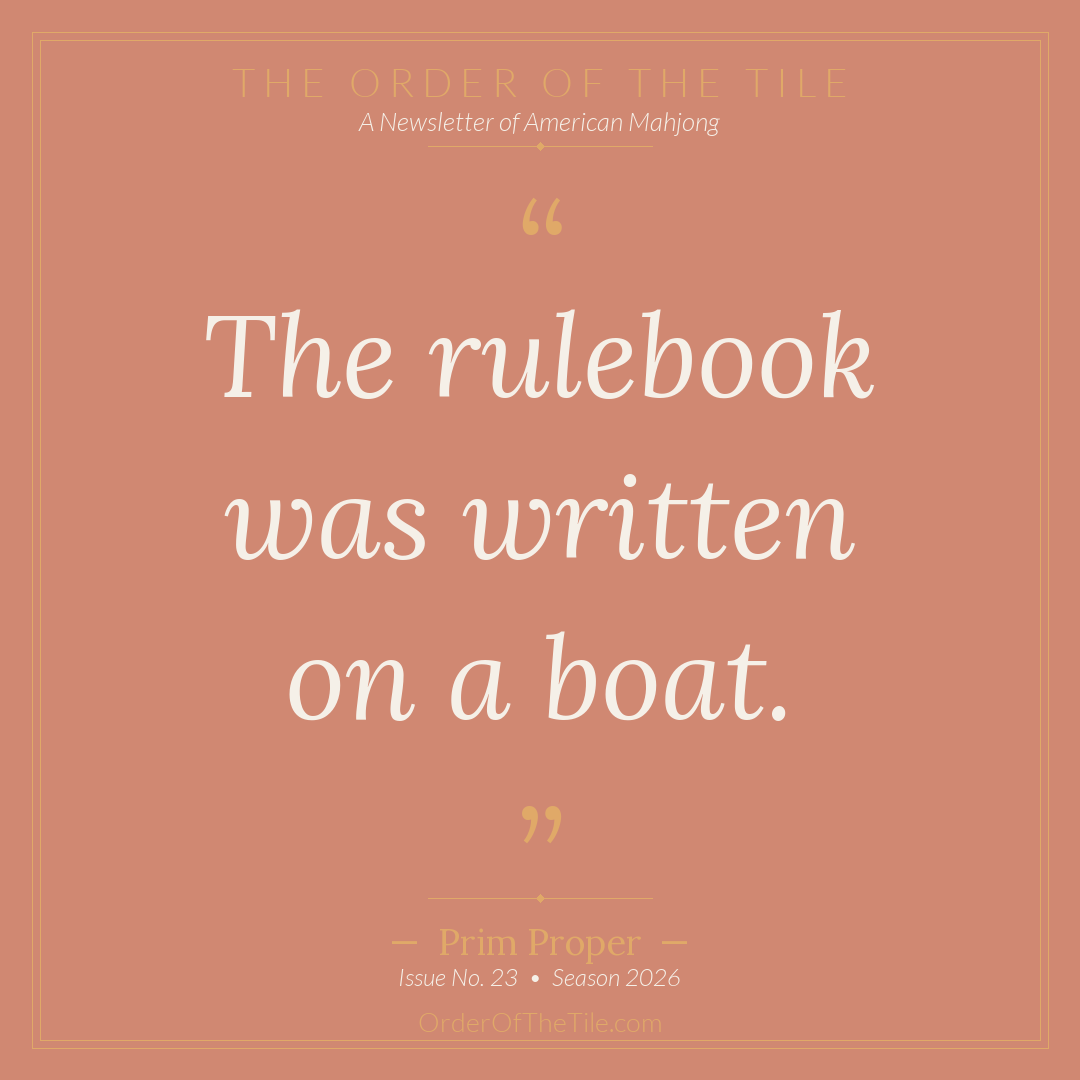
The rulebook was written on a boat |
Prim has saved the best thing she learned all week for last, and she would like you to hold on to it, because it settles the argument this entire letter has been having.
You know the Standardized National Mah Jongg Tournament Rules. Perhaps not by that name, but you know them, because they are the rules that get quoted to you. The ones about picking from the wrong end of the wall. The ones a woman reaches for when she wants to verify her memory.
They were written on a cruise ship.
 |
Not figuratively. In 1986 a couple named Dorothy and Larry Krams, who had been running themed weekend events and cruises, contacted Ruth Unger, then the presiding president of the National Mah Jongg League, and proposed something nobody had tried. The League said yes. What followed was nearly twenty five years of week-long tournament cruises aboard the largest ships on the ocean, and across those years, out of the practical business of running competitive mahjong in a room that will not stop moving, a body of rules accumulated. In 2005 Gladys Grad, who by then owned Mah Jongg Madness, simplified and codified the lot of it. Based on these cruise tournaments, she writes. Her words.
Do you see it, my darlings? Prim nearly put her cup down.
The rulebook that gets waved at your dining room table was not handed down. It was worked out, at sea, by people playing for prizes, so that a tournament with a hundred strangers and real stakes could be run fairly and finish on schedule. Every hard edge in it, every dead hand, every penalty, exists to solve a problem you have almost certainly never had. There is no cash purse in your dining room. There is no director. There is no round being called. There is a plate of something on the sideboard and three women you have known for years.
Which is not to say the rules do not matter. They matter enormously, and Prim has spent this whole letter telling you to learn them cold. It is to say that they were written for a place, and you should know which place, and you should notice when somebody imports them into a room they were never built for.
Learn the tournament rules. Play like a game fan who knows them.
And when the ball is behind the tree on a Tuesday afternoon, kick it out.
Grandpa called it a foot wedge!
A CLOSING NOTE |
The table taught its lesson again this week, and this week the lesson wore golf shoes.
Prim's grandfather was not being lax when he moved that ball. He was the best-informed man on the property. He knew the rule, he knew the relief, he knew the stroke it would have cost him in a tournament, and he set all of it aside for a child on an ordinary morning because he had already decided what the morning was for. Knowing the rule cold is precisely what gave him the standing to set it aside. Forgiveness is only forgiveness when it comes from a person who could have ruled the other way but chose to teach with joy.
That is the whole skill. Learn the rule properly. Learn it better than the woman who will quote it at you. And then choose, deliberately, who you are going to be while holding it: the one who teaches the game, or the one who guards it. Prim doesn't mind either, but the table should know the mood from the start.
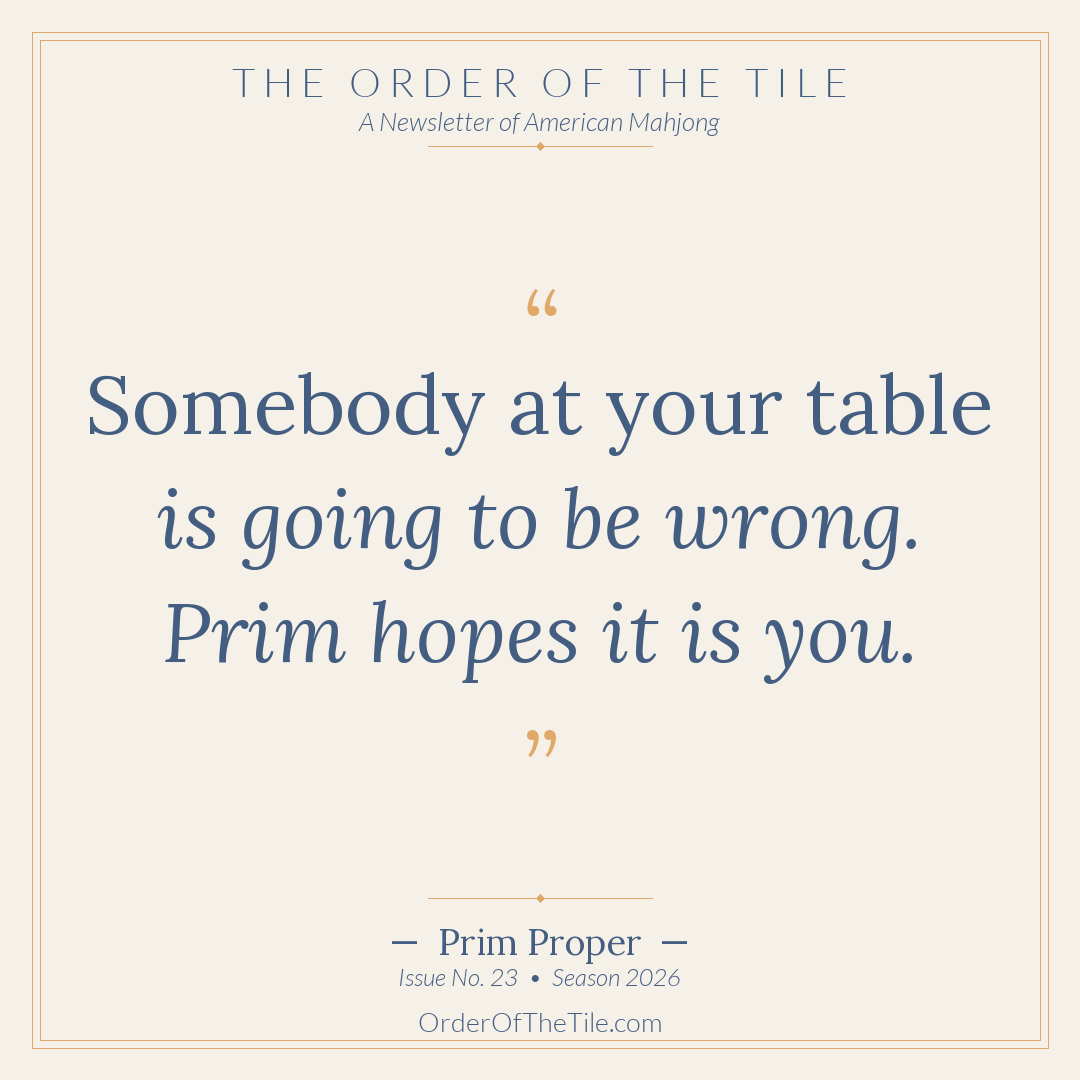
Somebody at your table this month is going to be wrong about something. Prim hopes it is you, honestly. It is such good practice. Being humbled is nothing short of a salty and often necessary pill. She knows. But if it is the newest woman at the table, remember that you are not ruling on a hand. You are helping her decide whether she wants to comes back.
The Order of the Tile is a weekly newsletter for the American Mahjong community. New issues drop every Thursday. Forward this to your favorite fourth. Everyone deserves a seat at this table.
| |||
|
Don't tap it, rack it, double stack it. | |||
|
Until next week, may your rack be blessed | |||
|
Prim, as always | |||
| |||
|
Forward this to your favorite fourth. |